Senate approves civics‑video requirement that instructs on founding fathers' religious beliefs after extended debate
March 09, 2026 | 2026 Legislature TN, Tennessee
This article was created by AI summarizing key points discussed. AI makes mistakes, so for full details and context, please refer to the video of the full meeting. Please report any errors so we can fix them. Report an error »
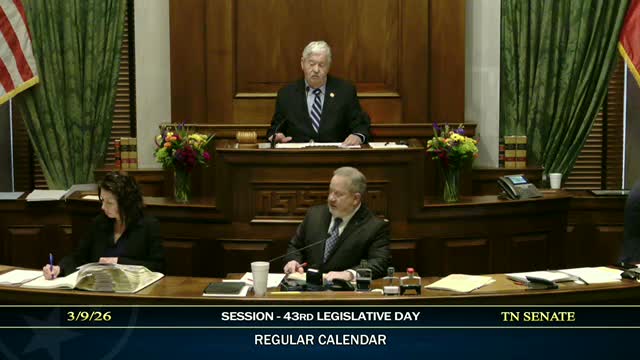
The Tennessee Senate passed House Bill 23 95 on March 11, 2026, after an extended and sometimes emotional floor debate over what middle‑ and high‑school students should be taught about the nation’s founding.
Sponsor Senator Lowe said the bill directs the textbook commission to select an instructional video that is historically accurate, void of political advocacy, and includes material on the Declaration of Independence — specifically the preamble sentence "we hold these truths to be self‑evident" — and "the religious affiliation and moral beliefs of the founding fathers involved in the Articles of Confederation and the Constitutional Convention." Lowe said the video "does not aim to resolve" scholarly disputes but to introduce students to the concepts and historical context.
Opponents cautioned the requirement risks oversimplifying contested historical and theological debates for students. Senator Yarbrough told the floor that the range of religious and moral views among the founders is complex and that a short video could mischaracterize those differences; he warned that mandating coverage of founders’ 'religious affiliation' may inadvertently domesticate religion to serve a governmental narrative. "A lot of that is complicated theology and history to get into that's really contested," Yarbrough said.
Senator Rose defended the bill, arguing the founders’ religious and moral backgrounds are relevant to understanding their political decisions and noting that many signers had theological training. "When you look at the historical founding of our nation, 26 of the 52 signers were seminary graduates," Rose said on the floor.
Senators asked whether the requirement would create a single canonical interpretation for students; supporters said the textbook commission’s selection should be historically accurate and non‑partisan, and they urged stakeholders to submit content for consideration. The clerk recorded the vote as 26 ayes and 5 nays.
What’s next: The Textbook Commission and the State Board of Education will be responsible for identifying or approving video content that meets the bill’s standards; the bill’s language about religious affiliation and moral beliefs is likely to prompt review by curriculum experts and potentially public comment when content is proposed.
Sponsor Senator Lowe said the bill directs the textbook commission to select an instructional video that is historically accurate, void of political advocacy, and includes material on the Declaration of Independence — specifically the preamble sentence "we hold these truths to be self‑evident" — and "the religious affiliation and moral beliefs of the founding fathers involved in the Articles of Confederation and the Constitutional Convention." Lowe said the video "does not aim to resolve" scholarly disputes but to introduce students to the concepts and historical context.
Opponents cautioned the requirement risks oversimplifying contested historical and theological debates for students. Senator Yarbrough told the floor that the range of religious and moral views among the founders is complex and that a short video could mischaracterize those differences; he warned that mandating coverage of founders’ 'religious affiliation' may inadvertently domesticate religion to serve a governmental narrative. "A lot of that is complicated theology and history to get into that's really contested," Yarbrough said.
Senator Rose defended the bill, arguing the founders’ religious and moral backgrounds are relevant to understanding their political decisions and noting that many signers had theological training. "When you look at the historical founding of our nation, 26 of the 52 signers were seminary graduates," Rose said on the floor.
Senators asked whether the requirement would create a single canonical interpretation for students; supporters said the textbook commission’s selection should be historically accurate and non‑partisan, and they urged stakeholders to submit content for consideration. The clerk recorded the vote as 26 ayes and 5 nays.
What’s next: The Textbook Commission and the State Board of Education will be responsible for identifying or approving video content that meets the bill’s standards; the bill’s language about religious affiliation and moral beliefs is likely to prompt review by curriculum experts and potentially public comment when content is proposed.
Don't Miss a Word: See the Full Meeting!
Go beyond summaries. Unlock every video, transcript, and key insight with a Founder Membership.
✓
Get instant access to full meeting videos
✓
Search and clip any phrase from complete transcripts
✓
Receive AI-powered summaries & custom alerts
✓
Enjoy lifetime, unrestricted access to government data
30-day money-back guarantee
