Evanston board debates criteria for ‘equity prioritized’ buildings under Healthy Buildings ordinance
March 09, 2026 | Evanston, Cook County, Illinois
This article was created by AI summarizing key points discussed. AI makes mistakes, so for full details and context, please refer to the video of the full meeting. Please report any errors so we can fix them. Report an error »
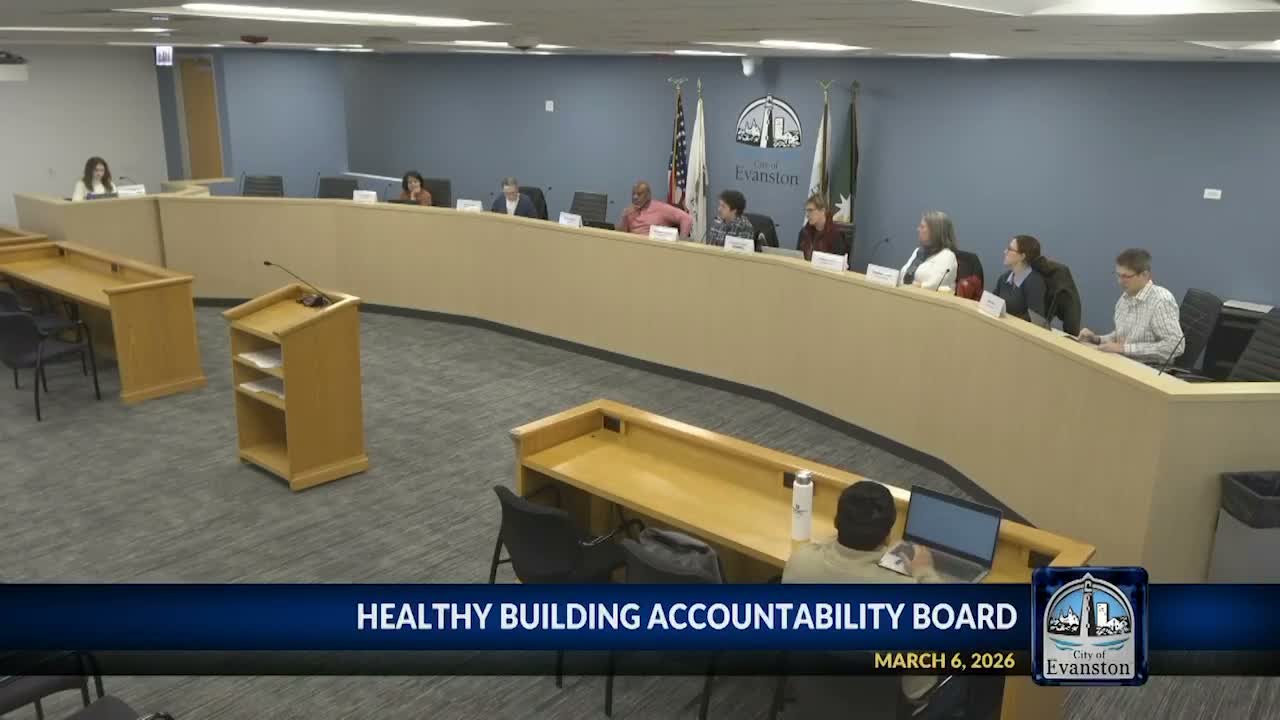
The Healthy Buildings Accountability Board met March 6 and spent the bulk of its session debating how to identify and prioritize "equity prioritized buildings" under Evanston's Healthy Buildings ordinance. A committee member leading the conversation said jurisdictions take different approaches and framed the core choice: "are you defining affordability based on the cost the unit, the rent or the price of the unit, or are you defining affordability based on the characteristics of the person who lives in that unit?"
Why it matters: board members said the decision will determine which buildings get prioritized for financial or technical assistance, alternative compliance pathways, or exemptions. Without clear local data, they warned, the designation could miss the buildings and people the policy intends to protect.
Discussion and key points
- Definitional choice: The presenting committee member explained trade-offs between a rent- or price-based definition (which uses observable rents but can misidentify higher-income tenants in lower-cost units) and an income-based definition (which more directly targets low-income residents but requires intrusive data collection). Members repeatedly urged staff to get building-stock and affordability data before finalizing the rule.
- Mixed-use buildings: Members asked whether dominant use, square footage splits, or revenue shares should determine a building's category. One member noted Boston's practice of categorizing by dominant use and suggested exploring split-calculations where residential and commercial portions are treated separately.
- Condos and ownership complexity: The committee noted condos create decision-making and data-collection challenges and flagged the need for special consideration in any EPB rules.
- Nonprofit and small-business pathways: Members discussed Denver-style alternative compliance pathways for nonprofits that provide direct services (houses of worship, food pantries) and whether revenue or mission should guide eligibility. Several members urged a tiered view of assistance—ranging from small planning grants or technical help to financial aid or timeline extensions—rather than assuming automatic direct subsidies for every EPB.
- Northwestern, hospitals and district-energy systems: The group flagged institutions with district thermal systems (Northwestern, some hospitals) as already having special considerations within the ordinance and said they may warrant separate treatment rather than blanket exclusion or inclusion.
- Process design and accountability: Members debated whether buildings should be designated by city staff or by owner application and emphasized that the ordinance already allows any owner to request an alternative compliance pathway for technical reasons.
- Data and mapping next steps: Staff said a GIS-based map with covered buildings, wards, TIFs, SSAs and census tracts is in development and is expected to be available in April. Members urged the board to meet with Community Development once that map and relevant data are available and to devote a future meeting specifically to residential rent affordability analysis.
Quotes
- Committee member: "So I think we have to be, pretty thoughtful about that." (on aligning EPB definitions with Evanston's housing stock)
- Committee member: "If a building owner meets that eligibility criteria, then they get to choose . . . which supports" (describing an application-based path to assistance).
What happens next: Board members agreed to develop a visual flow diagram and a list of the "big questions" the group needs to answer, to convene smaller working pairs to draft recommendations, and to ask staff to schedule Community Development for a future meeting. The board also asked staff to finish the GIS mapping tool to inform prioritization.
Ending: The board did not take a final vote on EPB criteria; instead it set homework for members, requested additional data from staff, and planned follow-up discussion once Community Development and mapping layers are available.
Why it matters: board members said the decision will determine which buildings get prioritized for financial or technical assistance, alternative compliance pathways, or exemptions. Without clear local data, they warned, the designation could miss the buildings and people the policy intends to protect.
Discussion and key points
- Definitional choice: The presenting committee member explained trade-offs between a rent- or price-based definition (which uses observable rents but can misidentify higher-income tenants in lower-cost units) and an income-based definition (which more directly targets low-income residents but requires intrusive data collection). Members repeatedly urged staff to get building-stock and affordability data before finalizing the rule.
- Mixed-use buildings: Members asked whether dominant use, square footage splits, or revenue shares should determine a building's category. One member noted Boston's practice of categorizing by dominant use and suggested exploring split-calculations where residential and commercial portions are treated separately.
- Condos and ownership complexity: The committee noted condos create decision-making and data-collection challenges and flagged the need for special consideration in any EPB rules.
- Nonprofit and small-business pathways: Members discussed Denver-style alternative compliance pathways for nonprofits that provide direct services (houses of worship, food pantries) and whether revenue or mission should guide eligibility. Several members urged a tiered view of assistance—ranging from small planning grants or technical help to financial aid or timeline extensions—rather than assuming automatic direct subsidies for every EPB.
- Northwestern, hospitals and district-energy systems: The group flagged institutions with district thermal systems (Northwestern, some hospitals) as already having special considerations within the ordinance and said they may warrant separate treatment rather than blanket exclusion or inclusion.
- Process design and accountability: Members debated whether buildings should be designated by city staff or by owner application and emphasized that the ordinance already allows any owner to request an alternative compliance pathway for technical reasons.
- Data and mapping next steps: Staff said a GIS-based map with covered buildings, wards, TIFs, SSAs and census tracts is in development and is expected to be available in April. Members urged the board to meet with Community Development once that map and relevant data are available and to devote a future meeting specifically to residential rent affordability analysis.
Quotes
- Committee member: "So I think we have to be, pretty thoughtful about that." (on aligning EPB definitions with Evanston's housing stock)
- Committee member: "If a building owner meets that eligibility criteria, then they get to choose . . . which supports" (describing an application-based path to assistance).
What happens next: Board members agreed to develop a visual flow diagram and a list of the "big questions" the group needs to answer, to convene smaller working pairs to draft recommendations, and to ask staff to schedule Community Development for a future meeting. The board also asked staff to finish the GIS mapping tool to inform prioritization.
Ending: The board did not take a final vote on EPB criteria; instead it set homework for members, requested additional data from staff, and planned follow-up discussion once Community Development and mapping layers are available.
View the Full Meeting & All Its Details
This article offers just a summary. Unlock complete video, transcripts, and insights as a Founder Member.
✓
Watch full, unedited meeting videos
✓
Search every word spoken in unlimited transcripts
✓
AI summaries & real-time alerts (all government levels)
✓
Permanent access to expanding government content
30-day money-back guarantee
