Residents press Richardson council for tighter short‑term rental rules; staff propose stronger registration, revocation and tracking
March 02, 2026 | Richardson, Dallas County, Texas
This article was created by AI summarizing key points discussed. AI makes mistakes, so for full details and context, please refer to the video of the full meeting. Please report any errors so we can fix them. Report an error »
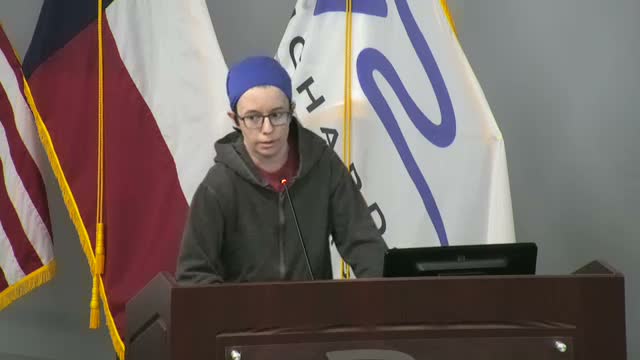
Several Richardson residents told the City Council on March 2 that short‑term rentals (STRs) operating in single‑family neighborhoods are degrading quality of life and threatening property values.
At the start of the meeting, speakers from multiple neighborhoods described persistent noise, large parties, blocked streets and trash. Ellen Beamer said four STRs opened in her Spring Park Meadows subdivision of 86 homes and urged the council to consider a moratorium on new STRs, annual inspections, and an approval process before a property may be listed. Rachel Upson said investor‑owned STRs near her Owens Park home have led to repeated police and code calls for noise, drug use and garbage; she recommended zoning changes, density limits, higher registration fees and platform accountability. Pete Weisel reported two large party incidents that left streets filled with hundreds of parked cars and said contact information for operators was often ineffective.
Staff described the city’s current program and proposed changes. Lindsay Termin, director of community services, reviewed Richardson’s current registration process: an STR is a property rented for 30 days or fewer; applicants must submit owner/operator contact information, a floor plan and a sworn statement. The city currently shows 92 single‑family properties registered and 43 pending registration. Registrations carry a $100 annual fee; interior inspections require owner or tenant consent or a warrant, staff said.
Police Chief Gary Tittle said disturbance and noise complaints are the most common STR‑related calls. He said the Richardson Police Department responded to 38 calls for service at 26 STR locations in 2025 (compared with 78 calls to 46 properties in 2024) and described a coordinated approach between patrol and community services to resolve repeat problems.
Assistant City Attorney Joe Gorfida framed the legal constraints: courts have generally rejected blanket prohibitions across all zoning districts, so restrictions must be supported by studies documenting a legitimate governmental purpose. He outlined proposed ordinance changes intended to strengthen enforcement without exceeding legal limits: expand owner definitions to identify responsible parties; require applicants to list all advertising links and update the city within 72 hours of changes; require display of a current registration certificate at the property; require collection and remittance of applicable hotel‑occupancy taxes; and clarify and expand grounds and procedures for revoking registrations with an appeal process to satisfy due process concerns.
Council members focused on several implementation questions. They asked whether the city could limit overnight occupancy (staff said occupancy can be limited by floor‑plan and minimum property standards), require posting of occupancy limits in the dwelling (staff said that can be accomplished through registration), and whether the city can adopt density or spacing restrictions (legal staff said density‑based rules are used by other cities but carry litigation risk and require supporting studies). Multiple members urged residents to keep reporting incidents so documented calls and data would support any future restrictions.
Council members and staff also discussed enforcement tools and resources. Staff said software to identify STR listings across platforms is in procurement and would improve the city’s ability to find unregistered properties. The council asked staff to return with examples of studies used by other cities, options for occupancy and density limits, a fee cost‑recovery analysis during the budget process, and details on revocation criteria.
No formal vote was taken on the ordinance amendments at the meeting. Staff said they would revise the redline ordinance based on council feedback and return with additional detail on occupancy, density studies and fee recommendations.
At the start of the meeting, speakers from multiple neighborhoods described persistent noise, large parties, blocked streets and trash. Ellen Beamer said four STRs opened in her Spring Park Meadows subdivision of 86 homes and urged the council to consider a moratorium on new STRs, annual inspections, and an approval process before a property may be listed. Rachel Upson said investor‑owned STRs near her Owens Park home have led to repeated police and code calls for noise, drug use and garbage; she recommended zoning changes, density limits, higher registration fees and platform accountability. Pete Weisel reported two large party incidents that left streets filled with hundreds of parked cars and said contact information for operators was often ineffective.
Staff described the city’s current program and proposed changes. Lindsay Termin, director of community services, reviewed Richardson’s current registration process: an STR is a property rented for 30 days or fewer; applicants must submit owner/operator contact information, a floor plan and a sworn statement. The city currently shows 92 single‑family properties registered and 43 pending registration. Registrations carry a $100 annual fee; interior inspections require owner or tenant consent or a warrant, staff said.
Police Chief Gary Tittle said disturbance and noise complaints are the most common STR‑related calls. He said the Richardson Police Department responded to 38 calls for service at 26 STR locations in 2025 (compared with 78 calls to 46 properties in 2024) and described a coordinated approach between patrol and community services to resolve repeat problems.
Assistant City Attorney Joe Gorfida framed the legal constraints: courts have generally rejected blanket prohibitions across all zoning districts, so restrictions must be supported by studies documenting a legitimate governmental purpose. He outlined proposed ordinance changes intended to strengthen enforcement without exceeding legal limits: expand owner definitions to identify responsible parties; require applicants to list all advertising links and update the city within 72 hours of changes; require display of a current registration certificate at the property; require collection and remittance of applicable hotel‑occupancy taxes; and clarify and expand grounds and procedures for revoking registrations with an appeal process to satisfy due process concerns.
Council members focused on several implementation questions. They asked whether the city could limit overnight occupancy (staff said occupancy can be limited by floor‑plan and minimum property standards), require posting of occupancy limits in the dwelling (staff said that can be accomplished through registration), and whether the city can adopt density or spacing restrictions (legal staff said density‑based rules are used by other cities but carry litigation risk and require supporting studies). Multiple members urged residents to keep reporting incidents so documented calls and data would support any future restrictions.
Council members and staff also discussed enforcement tools and resources. Staff said software to identify STR listings across platforms is in procurement and would improve the city’s ability to find unregistered properties. The council asked staff to return with examples of studies used by other cities, options for occupancy and density limits, a fee cost‑recovery analysis during the budget process, and details on revocation criteria.
No formal vote was taken on the ordinance amendments at the meeting. Staff said they would revise the redline ordinance based on council feedback and return with additional detail on occupancy, density studies and fee recommendations.
Don't Miss a Word: See the Full Meeting!
Go beyond summaries. Unlock every video, transcript, and key insight with a Founder Membership.
✓
Get instant access to full meeting videos
✓
Search and clip any phrase from complete transcripts
✓
Receive AI-powered summaries & custom alerts
✓
Enjoy lifetime, unrestricted access to government data
30-day money-back guarantee
