Washington implementation of multiple licensure pathways advances; justices press reciprocity and equity questions
March 06, 2026 | Supreme Court, Judicial , Washington
This article was created by AI summarizing key points discussed. AI makes mistakes, so for full details and context, please refer to the video of the full meeting. Please report any errors so we can fix them. Report an error »
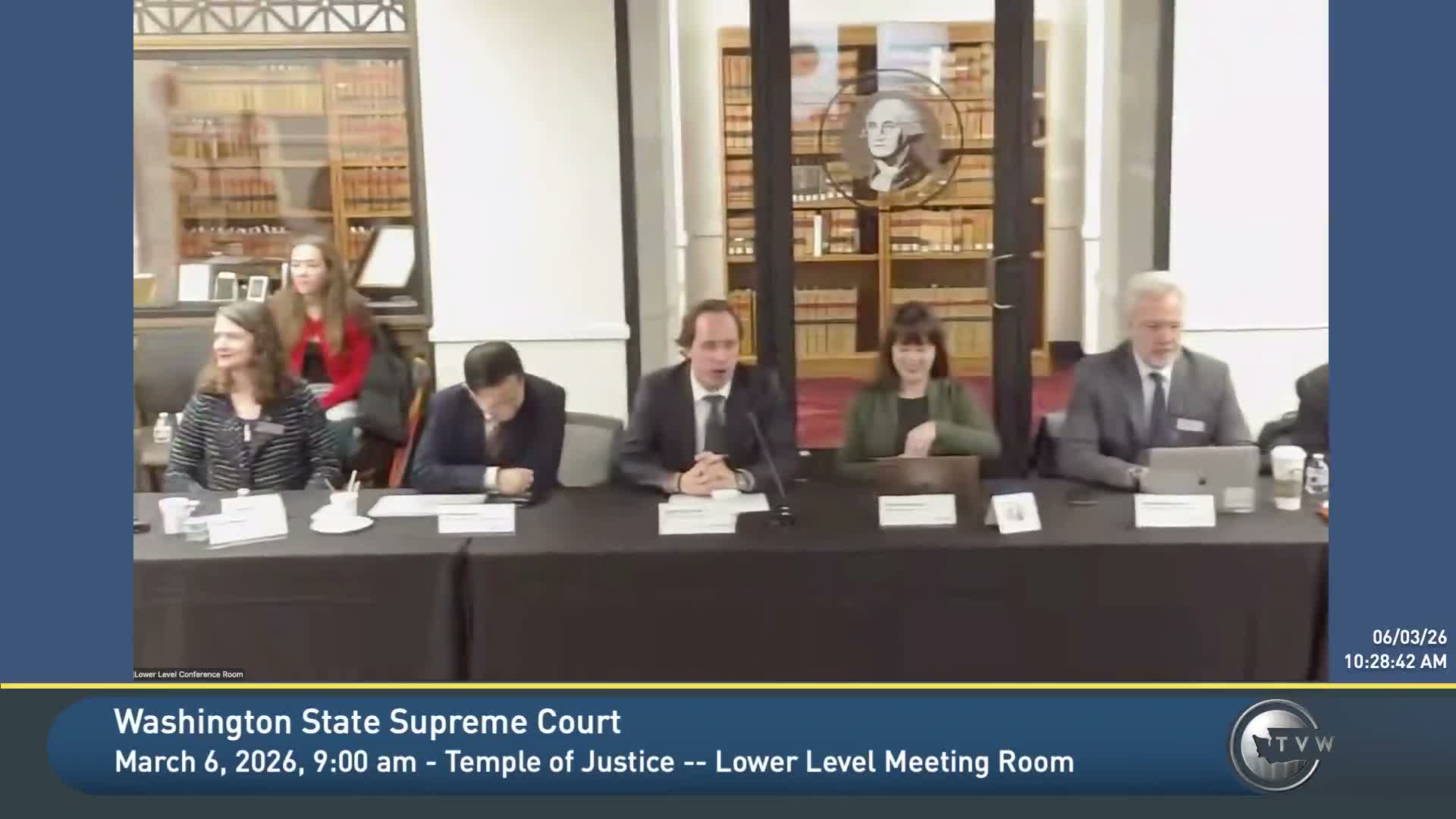
WSBA leaders told the court the state is progressing on implementation of multiple pathways to bar licensure, with an implementation target in 2027 and a push to validate nine core competencies across pathways.
“ We are on track to implement this by 2027,” Governor Jordan Couch told the court, describing a model that would require portfolio submissions showing client interviews, a negotiation exercise, research demonstrations, professional-responsibility evidence and either MPRE passage or written responses. Couch said the implementation group is also evaluating a consolidated supervised-practice requirement of 825 hours to create a uniform standard across pathways.
Why it matters: the reforms aim to broaden routes to licensure and address access-to-justice and equity concerns, including the disproportionate effect of a single high-stakes bar exam on applicants of color and applicants with disabilities. Justice Montoya Lewis emphasized those equity goals: “The reasons why we move forward with licensure reform… was in part in large part to address some of the access to justice issues… and the disproportionate negative impact of the bar exam as a single high stakes way to become licensed,” she said.
Court members also discussed reciprocity and portability. Staff warned that portfolio assessments and state-specific supervised-practice metrics may not transfer automatically to other states unless those states adopt comparable rules; UBE/score portability remains distinct and may be constrained by other states’ rule choices.
The court and WSBA staff also discussed coordination with national bodies and states adopting NextGen and other exam changes. WSBA reported it has begun collecting demographic data on applicants to monitor disparate impacts and will evaluate whether the NextGen exam or alternative pathways address equity concerns.
What comes next: the implementation group will present proposed rule changes for court review (materials noted to begin on packet page 17), and the court signaled it may request additional information about portability, character and fitness review timing and how supervised-practice standards will be measured across different candidate pathways. No final rule was adopted at this meeting.
“ We are on track to implement this by 2027,” Governor Jordan Couch told the court, describing a model that would require portfolio submissions showing client interviews, a negotiation exercise, research demonstrations, professional-responsibility evidence and either MPRE passage or written responses. Couch said the implementation group is also evaluating a consolidated supervised-practice requirement of 825 hours to create a uniform standard across pathways.
Why it matters: the reforms aim to broaden routes to licensure and address access-to-justice and equity concerns, including the disproportionate effect of a single high-stakes bar exam on applicants of color and applicants with disabilities. Justice Montoya Lewis emphasized those equity goals: “The reasons why we move forward with licensure reform… was in part in large part to address some of the access to justice issues… and the disproportionate negative impact of the bar exam as a single high stakes way to become licensed,” she said.
Court members also discussed reciprocity and portability. Staff warned that portfolio assessments and state-specific supervised-practice metrics may not transfer automatically to other states unless those states adopt comparable rules; UBE/score portability remains distinct and may be constrained by other states’ rule choices.
The court and WSBA staff also discussed coordination with national bodies and states adopting NextGen and other exam changes. WSBA reported it has begun collecting demographic data on applicants to monitor disparate impacts and will evaluate whether the NextGen exam or alternative pathways address equity concerns.
What comes next: the implementation group will present proposed rule changes for court review (materials noted to begin on packet page 17), and the court signaled it may request additional information about portability, character and fitness review timing and how supervised-practice standards will be measured across different candidate pathways. No final rule was adopted at this meeting.
Don't Miss a Word: See the Full Meeting!
Go beyond summaries. Unlock every video, transcript, and key insight with a Founder Membership.
✓
Get instant access to full meeting videos
✓
Search and clip any phrase from complete transcripts
✓
Receive AI-powered summaries & custom alerts
✓
Enjoy lifetime, unrestricted access to government data
30-day money-back guarantee
