Chairman Acres defends child protection commissioner pilot; committee adopts outcome-reporting amendment and reports bill
March 09, 2026 | 2026 Legislature WV, West Virginia
This article was created by AI summarizing key points discussed. AI makes mistakes, so for full details and context, please refer to the video of the full meeting. Please report any errors so we can fix them. Report an error »
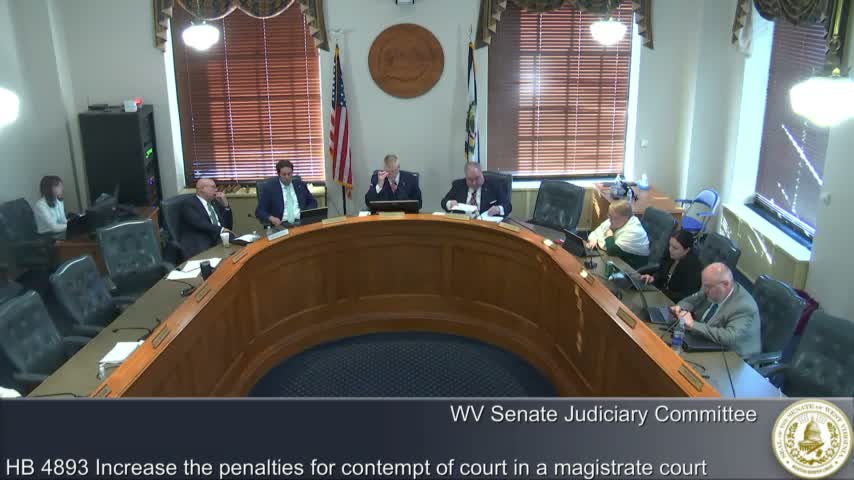
A legislative committee heard testimony and extensive questioning on House Bill 5684, a bill to authorize a pilot program for child protection commissioners intended to help West Virginia circuit courts handle growing abuse-and-neglect caseloads. The committee adopted an amendment that requires identifiable measurable outcomes, a pre-implementation baseline and annual reporting to the joint committee on government and finance, and then voted to report the bill to the full Senate with a recommendation that it pass.
Chairman Acres (speaker 6), identified in the transcript as the chairman of the House Judiciary and the bill sponsor, said the proposal is modeled on a Texas child-protection-commissioner approach and is intended to provide more regular, face-to-face contact between court personnel and children, to authorize emergency removals where permitted by law, and to centralize wraparound services. Acres said the commissioners would issue nonbinding reports and recommendations to presiding circuit judges, with final decision-making authority remaining with the circuit court.
Acres told the committee that the bill’s enabling language appears in chapter 49 (transcript reference "49 4 1 18") and that the program would include appointment qualifications, two-year appointments, removal processes and oversight. He said the program could authorize multi-circuit regions and permit senior judges or justices to serve as commissioners.
On funding, counsel and Acres said House Bill 5684 carries no separate fiscal note and that the funding mechanism discussed in the hearing is provided in a companion bill, House Bill 5074, which relates to the Medical Cannabis Program Fund. Acres and counsel stated that the fund has been accruing receipts since the program’s enactment and that the state treasurer could begin dispersing those accumulated funds. They identified an initial startup amount of $3,000,000 and an ongoing funding approach that would allot 10 percent of the medical cannabis fund annually for the program; using the figures quoted in the hearing, counsel said the fund’s annual revenues were projected at about $10,000,000, which would make a 10 percent disbursement roughly $1,000,000 per year. Acres also said he was told the account balance was about $38,000,000.
Committee members pressed whether the bill is truly a pilot (the bill text as presented contains no explicit sunset date) and whether the Supreme Court was consulted; Acres said the Supreme Court helped draft the enabling legislation, that the court could run pilot regions, and that he was willing to accept reporting requirements or legislative oversight. The senior senator from the fourth (speaker 7) proposed an amendment directing the administrative director of the Supreme Court of Appeals to identify measurable outcomes to be improved by the pilot, require a pre-implementation baseline, and require annual reporting to the joint committee on government and finance that includes costs and projected costs. Counsel restated the amendment on the record and the committee adopted it by voice vote.
After adopting the amendment, the vice chair (speaker 3) moved that House Bill 5684 as amended be reported to the full Senate with a recommendation that it pass; the committee voted by voice and the chair declared the motion adopted. The transcript records no roll-call tallies. The committee then adjourned.
The transcript contains a mix of supportive and skeptical comments: one senator called the bill a ‘‘horrible bill’’ and objected to creating a new bureaucracy, while others described the change as a novel approach to relieve overloaded dockets and improve outcomes for children. The committee’s amendment requires the Supreme Court’s administrative director to set measures and provide annual, baseline-comparative reporting so the legislature can evaluate whether the pilot achieves stated child-welfare improvements.
Chairman Acres (speaker 6), identified in the transcript as the chairman of the House Judiciary and the bill sponsor, said the proposal is modeled on a Texas child-protection-commissioner approach and is intended to provide more regular, face-to-face contact between court personnel and children, to authorize emergency removals where permitted by law, and to centralize wraparound services. Acres said the commissioners would issue nonbinding reports and recommendations to presiding circuit judges, with final decision-making authority remaining with the circuit court.
Acres told the committee that the bill’s enabling language appears in chapter 49 (transcript reference "49 4 1 18") and that the program would include appointment qualifications, two-year appointments, removal processes and oversight. He said the program could authorize multi-circuit regions and permit senior judges or justices to serve as commissioners.
On funding, counsel and Acres said House Bill 5684 carries no separate fiscal note and that the funding mechanism discussed in the hearing is provided in a companion bill, House Bill 5074, which relates to the Medical Cannabis Program Fund. Acres and counsel stated that the fund has been accruing receipts since the program’s enactment and that the state treasurer could begin dispersing those accumulated funds. They identified an initial startup amount of $3,000,000 and an ongoing funding approach that would allot 10 percent of the medical cannabis fund annually for the program; using the figures quoted in the hearing, counsel said the fund’s annual revenues were projected at about $10,000,000, which would make a 10 percent disbursement roughly $1,000,000 per year. Acres also said he was told the account balance was about $38,000,000.
Committee members pressed whether the bill is truly a pilot (the bill text as presented contains no explicit sunset date) and whether the Supreme Court was consulted; Acres said the Supreme Court helped draft the enabling legislation, that the court could run pilot regions, and that he was willing to accept reporting requirements or legislative oversight. The senior senator from the fourth (speaker 7) proposed an amendment directing the administrative director of the Supreme Court of Appeals to identify measurable outcomes to be improved by the pilot, require a pre-implementation baseline, and require annual reporting to the joint committee on government and finance that includes costs and projected costs. Counsel restated the amendment on the record and the committee adopted it by voice vote.
After adopting the amendment, the vice chair (speaker 3) moved that House Bill 5684 as amended be reported to the full Senate with a recommendation that it pass; the committee voted by voice and the chair declared the motion adopted. The transcript records no roll-call tallies. The committee then adjourned.
The transcript contains a mix of supportive and skeptical comments: one senator called the bill a ‘‘horrible bill’’ and objected to creating a new bureaucracy, while others described the change as a novel approach to relieve overloaded dockets and improve outcomes for children. The committee’s amendment requires the Supreme Court’s administrative director to set measures and provide annual, baseline-comparative reporting so the legislature can evaluate whether the pilot achieves stated child-welfare improvements.
Don't Miss a Word: See the Full Meeting!
Go beyond summaries. Unlock every video, transcript, and key insight with a Founder Membership.
✓
Get instant access to full meeting videos
✓
Search and clip any phrase from complete transcripts
✓
Receive AI-powered summaries & custom alerts
✓
Enjoy lifetime, unrestricted access to government data
30-day money-back guarantee
