Rep. Magnuson registers dissent as House approves funding for merged behavioral‑health agency
March 09, 2026 | 2026 Legislative Meetings, South Carolina
This article was created by AI summarizing key points discussed. AI makes mistakes, so for full details and context, please refer to the video of the full meeting. Please report any errors so we can fix them. Report an error »
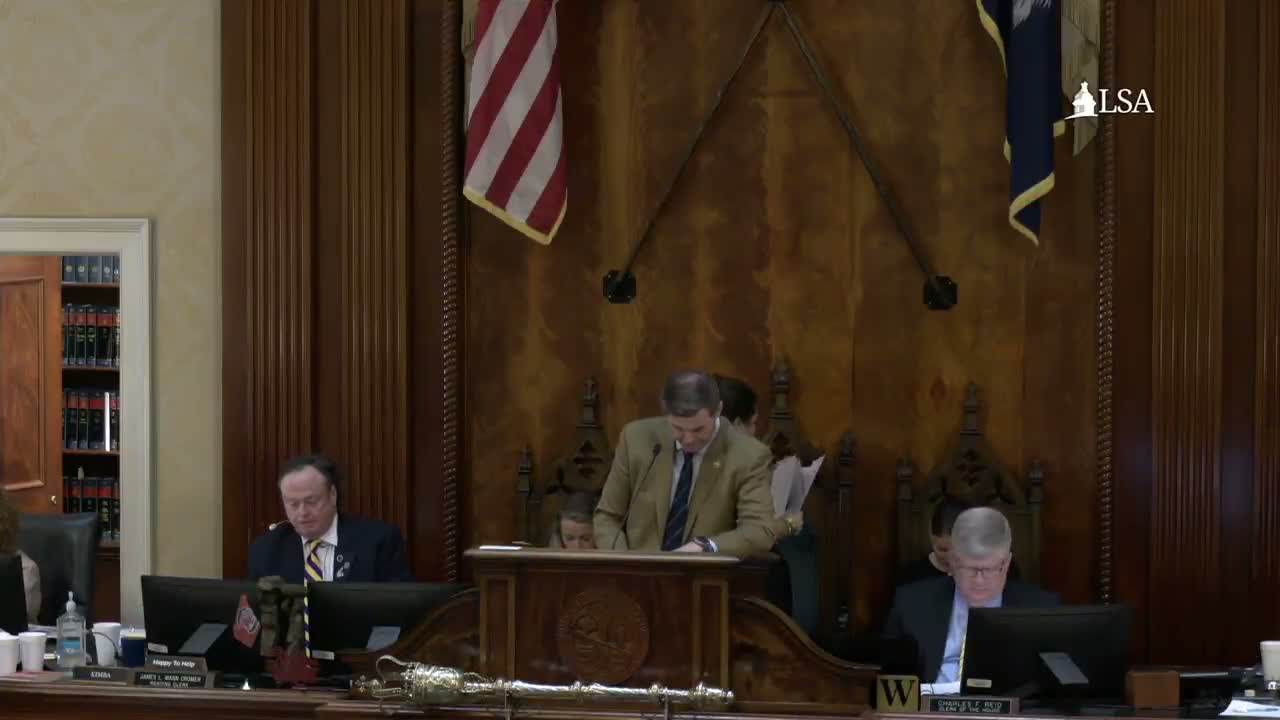
Representative Magnuson urged colleagues to oppose funding tied to the newly consolidated Department of Behavioral Health, saying the merger of three agencies should have yielded cost savings rather than a request for more money.
"Instead, the agency actually came back and requested an additional $100,000,000. They got 27,000,000 of it," Magnuson said on the floor, arguing the added dollars — including roughly $9 million described as information‑technology investments — should be backed by demonstrable efficiency gains.
Magnuson said he did not file last‑minute amendments but intends to press the agency for a follow‑up report on what was cut and what steps were taken to reduce taxpayer costs. "What I wanna see... is to have a report come back on what exactly they did to cut cost for the taxpayer," he said.
Speaker (S1) called for the roll call on adoption of the section after debate; the clerk recorded the vote as 81 in favor and 20 opposed, and the section was adopted.
Why it matters: The funding of a consolidated behavioral‑health agency affects service delivery and state spending. Magnuson’s objections highlight a common legislative tension between investing in service capacity and requiring measurable efficiency or accountability when agencies merge.
What to watch: Members requested reporting and oversight language on the floor; staff and the agency were asked to provide follow‑up detail on how consolidation will produce savings and how the IT investments will improve operations. The record shows a formal vote and dissent that may be used to press for further oversight in committee follow‑up.
Ending: The section passed and the budget advanced; members on both sides signaled interest in receiving written updates on efficiency measures and IT spending.
"Instead, the agency actually came back and requested an additional $100,000,000. They got 27,000,000 of it," Magnuson said on the floor, arguing the added dollars — including roughly $9 million described as information‑technology investments — should be backed by demonstrable efficiency gains.
Magnuson said he did not file last‑minute amendments but intends to press the agency for a follow‑up report on what was cut and what steps were taken to reduce taxpayer costs. "What I wanna see... is to have a report come back on what exactly they did to cut cost for the taxpayer," he said.
Speaker (S1) called for the roll call on adoption of the section after debate; the clerk recorded the vote as 81 in favor and 20 opposed, and the section was adopted.
Why it matters: The funding of a consolidated behavioral‑health agency affects service delivery and state spending. Magnuson’s objections highlight a common legislative tension between investing in service capacity and requiring measurable efficiency or accountability when agencies merge.
What to watch: Members requested reporting and oversight language on the floor; staff and the agency were asked to provide follow‑up detail on how consolidation will produce savings and how the IT investments will improve operations. The record shows a formal vote and dissent that may be used to press for further oversight in committee follow‑up.
Ending: The section passed and the budget advanced; members on both sides signaled interest in receiving written updates on efficiency measures and IT spending.
View the Full Meeting & All Its Details
This article offers just a summary. Unlock complete video, transcripts, and insights as a Founder Member.
✓
Watch full, unedited meeting videos
✓
Search every word spoken in unlimited transcripts
✓
AI summaries & real-time alerts (all government levels)
✓
Permanent access to expanding government content
30-day money-back guarantee
