Jackson and Teton County advance 90 Virginia Lane housing project, extend development-agreement timeline
March 09, 2026 | Jackson, Teton County, Wyoming
This article was created by AI summarizing key points discussed. AI makes mistakes, so for full details and context, please refer to the video of the full meeting. Please report any errors so we can fix them. Report an error »
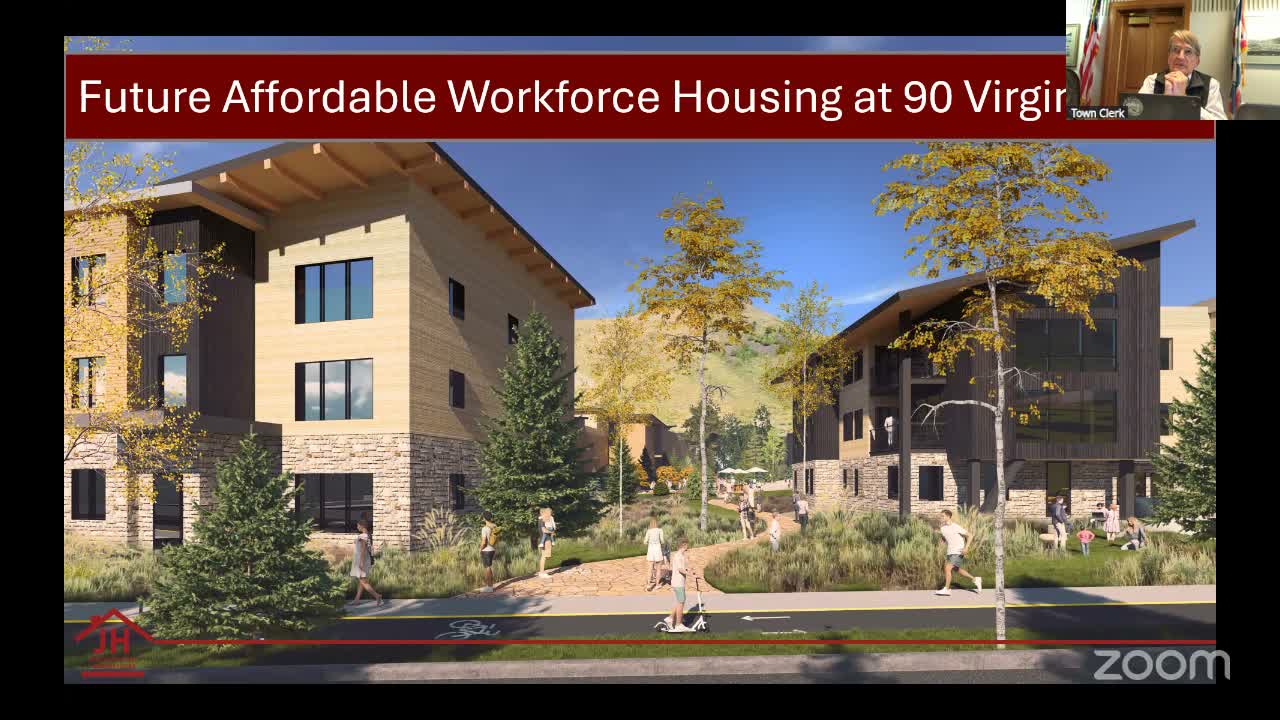
Jackson — Town and county elected officials voted March 9 to advance the 90 Virginia Lane affordable workforce housing project, directing staff to finalize development agreements and extending the negotiation timeline to May 4, 2026.
April Dorton, the housing director, told the joint meeting the site — a 5.15-acre parcel in Midtown purchased by the housing authority in 2023 — is designed to yield 221 permanently protected homes: 161 rental units and 60 for-sale units. "We are asking you all seven questions that are related to funding, phasing, and oversight of the project," Dorton said, framing the council and commission's decision as one about timing, protections and public investment.
Why it matters: Officials and residents said the project would add immediate housing supply near transit and services and help address local workforce shortages. Staff and the developer, Penrose, described a financing plan that relies on a mix of private debt and equity, developer guarantees, and public subsidy. Staff estimated public funding at roughly 28% of the project’s sources and said the housing authority and the town and county have previously committed $10,000,000; Penrose asked the jurisdictions to commit up to another $10,000,000 to bridge a remaining financing gap.
Developer commitments and protections
Shannon Cox Baker, regional vice president for Penrose, presented the developer’s track record and commitments. She said Penrose has invested in the project’s predevelopment work and expects to invest another $2 million upon agreement execution. Penrose also said it would pursue conventional debt and private equity and offer development guarantees and other financial assurances to help secure construction financing.
To reduce the risk that only the rental phase gets completed, staff and the developer said the town and county would secure entitlements, designs and special limited partner (SLP) rights that give the public a legal stake should the developer fail to finish later phases. Dorton described those protections: the housing authority would own entitlements and certain rights under the ground lease, and the SLP structure would create contract remedies and monitoring rights for the public.
Phasing and timeline
Staff recommended building the rental phase first to deliver the greatest immediate benefit. Dorton said staff favor constructing the rental phase once entitlements and designs for the full site are complete to protect public interests; Penrose said lenders require separate financings for each phase but agreed to entitle and design the entire campus before construction.
On schedule, Penrose said it could begin entitlement work immediately and is aiming for a fall groundbreaking; staff warned summer would be ambitious and said the May 4 timeline will give both bodies time to review final documents and allow Penrose to secure funders.
Public comment and local sentiment
Dozens of residents and nonprofit leaders spoke at the meeting, nearly all urging swift approval. Bob Wise, a Jackson resident, told the council the project ‘‘builds community’’ and urged officials not to delay. Shelter GH’s executive director Claire Stumpf and other speakers emphasized the project’s significance for renters, local workers and service providers.
Financing mechanics and policy tradeoffs
The meeting included extended discussion of how public funds would be structured. Staff proposed using the initial $10,000,000 on a reimbursement basis for horizontal infrastructure (estimated at $8.5 million) and loaning any remaining balance into the rental project at predetermined milestones. Penrose and the housing authority described potential tools to reduce public subsidy, including selling rights of first rental to employers or mission-aligned investors and targeting program-related investments or subordinate bonds to lower the public contribution.
Councilors and commissioners pressed staff and the developer for more detail on timing, unit mix and the consequences if only one phase is built. Tim Nash, a bond and affordable-housing consultant retained by the authority, outlined mitigants the authority has negotiated — including developer fee scheduling, withheld reimbursements tied to completion milestones and the housing authority’s ownership of entitlement work — as practical ways to reduce delivery risk.
Votes and next steps
Councilor Hunter Schachter moved to extend the ground-lease and development-agreement timeline to May 4, 2026, and to direct staff to draft the full set of 90 Virginia Lane legal documents for return consideration; Councilor Regan seconded the motion. Town and county bodies approved the motion; the transcript records the motion carried unanimously. Staff now will return a final development agreement and associated documents for joint consideration with additional details on funding mixes and market analysis.
The meeting closed with staff and Penrose agreeing to continue negotiating timelines and to pursue mission-aligned capital sources, while the housing authority and legal counsel work to translate the protections discussed into enforceable contract language.
April Dorton, the housing director, told the joint meeting the site — a 5.15-acre parcel in Midtown purchased by the housing authority in 2023 — is designed to yield 221 permanently protected homes: 161 rental units and 60 for-sale units. "We are asking you all seven questions that are related to funding, phasing, and oversight of the project," Dorton said, framing the council and commission's decision as one about timing, protections and public investment.
Why it matters: Officials and residents said the project would add immediate housing supply near transit and services and help address local workforce shortages. Staff and the developer, Penrose, described a financing plan that relies on a mix of private debt and equity, developer guarantees, and public subsidy. Staff estimated public funding at roughly 28% of the project’s sources and said the housing authority and the town and county have previously committed $10,000,000; Penrose asked the jurisdictions to commit up to another $10,000,000 to bridge a remaining financing gap.
Developer commitments and protections
Shannon Cox Baker, regional vice president for Penrose, presented the developer’s track record and commitments. She said Penrose has invested in the project’s predevelopment work and expects to invest another $2 million upon agreement execution. Penrose also said it would pursue conventional debt and private equity and offer development guarantees and other financial assurances to help secure construction financing.
To reduce the risk that only the rental phase gets completed, staff and the developer said the town and county would secure entitlements, designs and special limited partner (SLP) rights that give the public a legal stake should the developer fail to finish later phases. Dorton described those protections: the housing authority would own entitlements and certain rights under the ground lease, and the SLP structure would create contract remedies and monitoring rights for the public.
Phasing and timeline
Staff recommended building the rental phase first to deliver the greatest immediate benefit. Dorton said staff favor constructing the rental phase once entitlements and designs for the full site are complete to protect public interests; Penrose said lenders require separate financings for each phase but agreed to entitle and design the entire campus before construction.
On schedule, Penrose said it could begin entitlement work immediately and is aiming for a fall groundbreaking; staff warned summer would be ambitious and said the May 4 timeline will give both bodies time to review final documents and allow Penrose to secure funders.
Public comment and local sentiment
Dozens of residents and nonprofit leaders spoke at the meeting, nearly all urging swift approval. Bob Wise, a Jackson resident, told the council the project ‘‘builds community’’ and urged officials not to delay. Shelter GH’s executive director Claire Stumpf and other speakers emphasized the project’s significance for renters, local workers and service providers.
Financing mechanics and policy tradeoffs
The meeting included extended discussion of how public funds would be structured. Staff proposed using the initial $10,000,000 on a reimbursement basis for horizontal infrastructure (estimated at $8.5 million) and loaning any remaining balance into the rental project at predetermined milestones. Penrose and the housing authority described potential tools to reduce public subsidy, including selling rights of first rental to employers or mission-aligned investors and targeting program-related investments or subordinate bonds to lower the public contribution.
Councilors and commissioners pressed staff and the developer for more detail on timing, unit mix and the consequences if only one phase is built. Tim Nash, a bond and affordable-housing consultant retained by the authority, outlined mitigants the authority has negotiated — including developer fee scheduling, withheld reimbursements tied to completion milestones and the housing authority’s ownership of entitlement work — as practical ways to reduce delivery risk.
Votes and next steps
Councilor Hunter Schachter moved to extend the ground-lease and development-agreement timeline to May 4, 2026, and to direct staff to draft the full set of 90 Virginia Lane legal documents for return consideration; Councilor Regan seconded the motion. Town and county bodies approved the motion; the transcript records the motion carried unanimously. Staff now will return a final development agreement and associated documents for joint consideration with additional details on funding mixes and market analysis.
The meeting closed with staff and Penrose agreeing to continue negotiating timelines and to pursue mission-aligned capital sources, while the housing authority and legal counsel work to translate the protections discussed into enforceable contract language.
Don't Miss a Word: See the Full Meeting!
Go beyond summaries. Unlock every video, transcript, and key insight with a Founder Membership.
✓
Get instant access to full meeting videos
✓
Search and clip any phrase from complete transcripts
✓
Receive AI-powered summaries & custom alerts
✓
Enjoy lifetime, unrestricted access to government data
30-day money-back guarantee
