Residents urge end to ICE transfers at Orange County Truth Act forum; sheriff says department followed state law
March 26, 2024 | Orange County, California
This article was created by AI summarizing key points discussed. AI makes mistakes, so for full details and context, please refer to the video of the full meeting. Please report any errors so we can fix them. Report an error »
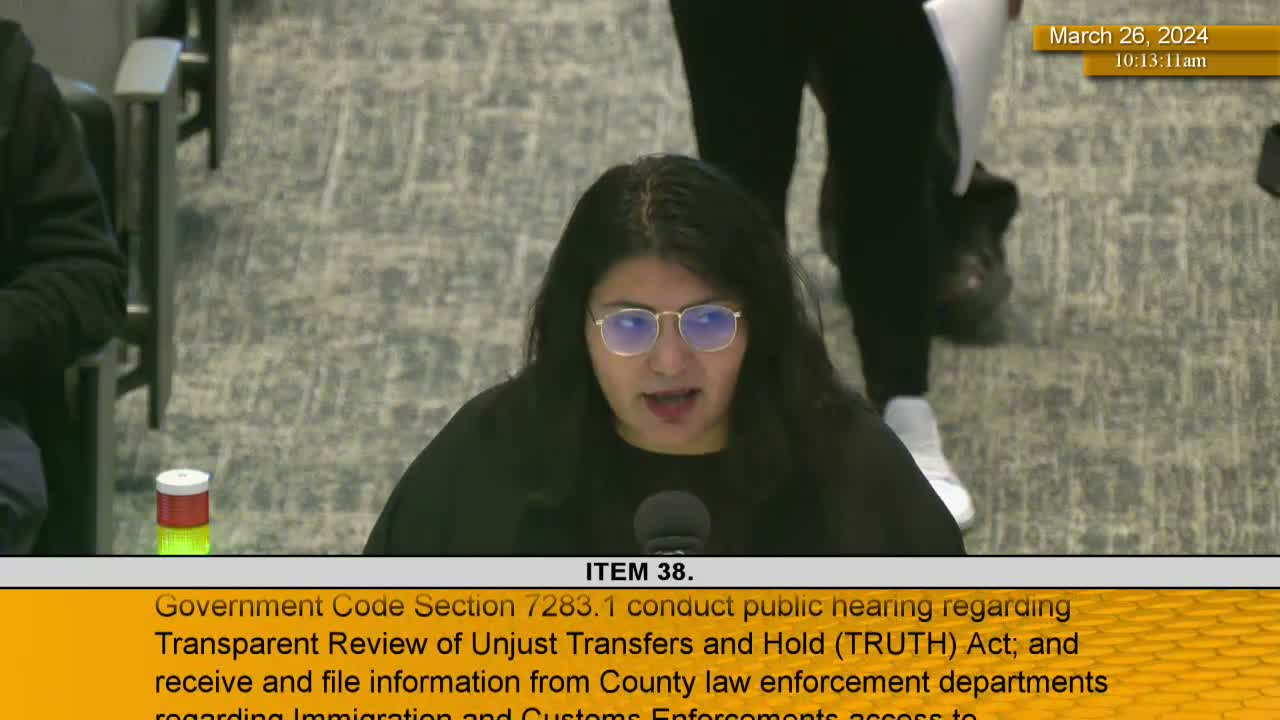
Dozens of residents, immigrant‑rights advocates and community groups urged the Orange County Board of Supervisors to end the sheriff’s department’s transfers of local jail inmates to U.S. Immigration and Customs Enforcement during a statutorily required Truth Act forum on March 26.
"I'm just tired of you of the sheriff, handing over all of our immigrant and refugee families to ICE legally and illegally," Sandra, a Rapid Response Network organizer, told the board, saying transfers separate families and erode trust in local law enforcement.
The forum — required by state law to provide public reporting on county interactions with federal immigration authorities — brought a steady stream of speakers who said transfer numbers spiked in 2023, disproportionately affecting Mexican and Vietnamese residents and leaving monolingual community members especially vulnerable.
Sheriff Don Barnes responded with figures from the department’s report. He said OCSD processed 547 incarcerated people in 2023 who had ICE detainers, of whom 302 met the state’s "serious offender" criteria under SB 54, and 221 were ultimately transferred into ICE custody. "OCSD does not engage in immigration enforcement," Barnes said. "We do not ask the immigration status of suspects, witnesses, or those who report crime. ICE determined who they placed an ICE detainer on. We do not."
Advocates at the hearing described what they called a twelve‑hundred percent increase in transfers and urged immediate policy changes, including ending transfers, publishing transparent transfer data and increasing legal representation and reentry supports for people released from custody. Several speakers cited analyses they said were produced from public records requests showing regional disparities and a heavy impact on Little Saigon communities.
Supervisors pressed the sheriff for fuller public data and an accounting of county costs tied to transfer activities. Supervisor Vicente Sarmiento emphasized oversight and the public‑trust implications, noting research that suggests immigrant‑focused enforcement can discourage reporting to police and hinder public safety. Supervisor Katrina Foley asked whether the data required by the statute could be posted on the county website; Barnes said he had provided the ASR to supervisors’ offices in advance, that some follow‑up questions had been answered, and that aggregated, non‑individually identifiable data might be posted if legally permissible.
Barnes and public commenters disagreed about responsibility for the 2023 increase. The sheriff said OCSD follows state law and only makes individuals available for transfer if they meet statutory criteria; he stressed that ICE independently decides whether to pick up an eligible individual. Community groups countered that the county’s referral practices and lack of transparency perpetuate family separation and civic harm.
The board took no policy vote at the hearing; after public testimony and discussion, supervisors voted to receive and file the Truth Act report. Several supervisors and staff said they would work between meetings on ways to provide timely, aggregated public data, assess county costs, and consider additional procedural or legislative steps.
What happens next: the board received and filed the report. Supervisors indicated they intend follow‑up work — including staff meetings on data publication and cost estimates — but no new county policy was adopted at the session.
(Reporting is based on public testimony and the sheriff’s presentation at the March 26 Orange County Board of Supervisors meeting. The sheriff’s numerical totals and descriptions of policy reflect his presentation to the board; community organizations’ percentage and increase claims reflect their statements at the hearing.)
"I'm just tired of you of the sheriff, handing over all of our immigrant and refugee families to ICE legally and illegally," Sandra, a Rapid Response Network organizer, told the board, saying transfers separate families and erode trust in local law enforcement.
The forum — required by state law to provide public reporting on county interactions with federal immigration authorities — brought a steady stream of speakers who said transfer numbers spiked in 2023, disproportionately affecting Mexican and Vietnamese residents and leaving monolingual community members especially vulnerable.
Sheriff Don Barnes responded with figures from the department’s report. He said OCSD processed 547 incarcerated people in 2023 who had ICE detainers, of whom 302 met the state’s "serious offender" criteria under SB 54, and 221 were ultimately transferred into ICE custody. "OCSD does not engage in immigration enforcement," Barnes said. "We do not ask the immigration status of suspects, witnesses, or those who report crime. ICE determined who they placed an ICE detainer on. We do not."
Advocates at the hearing described what they called a twelve‑hundred percent increase in transfers and urged immediate policy changes, including ending transfers, publishing transparent transfer data and increasing legal representation and reentry supports for people released from custody. Several speakers cited analyses they said were produced from public records requests showing regional disparities and a heavy impact on Little Saigon communities.
Supervisors pressed the sheriff for fuller public data and an accounting of county costs tied to transfer activities. Supervisor Vicente Sarmiento emphasized oversight and the public‑trust implications, noting research that suggests immigrant‑focused enforcement can discourage reporting to police and hinder public safety. Supervisor Katrina Foley asked whether the data required by the statute could be posted on the county website; Barnes said he had provided the ASR to supervisors’ offices in advance, that some follow‑up questions had been answered, and that aggregated, non‑individually identifiable data might be posted if legally permissible.
Barnes and public commenters disagreed about responsibility for the 2023 increase. The sheriff said OCSD follows state law and only makes individuals available for transfer if they meet statutory criteria; he stressed that ICE independently decides whether to pick up an eligible individual. Community groups countered that the county’s referral practices and lack of transparency perpetuate family separation and civic harm.
The board took no policy vote at the hearing; after public testimony and discussion, supervisors voted to receive and file the Truth Act report. Several supervisors and staff said they would work between meetings on ways to provide timely, aggregated public data, assess county costs, and consider additional procedural or legislative steps.
What happens next: the board received and filed the report. Supervisors indicated they intend follow‑up work — including staff meetings on data publication and cost estimates — but no new county policy was adopted at the session.
(Reporting is based on public testimony and the sheriff’s presentation at the March 26 Orange County Board of Supervisors meeting. The sheriff’s numerical totals and descriptions of policy reflect his presentation to the board; community organizations’ percentage and increase claims reflect their statements at the hearing.)
View the Full Meeting & All Its Details
This article offers just a summary. Unlock complete video, transcripts, and insights as a Founder Member.
✓
Watch full, unedited meeting videos
✓
Search every word spoken in unlimited transcripts
✓
AI summaries & real-time alerts (all government levels)
✓
Permanent access to expanding government content
30-day money-back guarantee
