Council grants variance for projecting sign at 3715 Silver Ave after divided hearing
March 02, 2026 | Albuquerque, Bernalillo County, New Mexico
This article was created by AI summarizing key points discussed. AI makes mistakes, so for full details and context, please refer to the video of the full meeting. Please report any errors so we can fix them. Report an error »
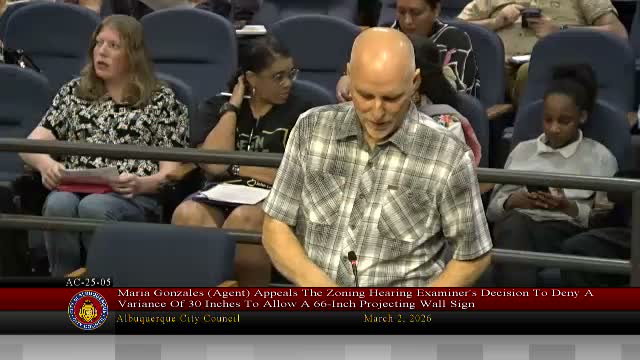
The Albuquerque City Council voted 5–4 to grant an appeal allowing an illuminated projecting wall sign to be mounted at 3715 Silver Avenue SE, reversing a prior decision by the Zoning Hearing Examiner (ZHE).
Pastor Dan Miller, representing City Unhail Church, told the council the sign had historic and community value and that mounting it on a pole — the alternative identified by planning staff — would increase costs and vandalism risk. "We would respectfully ask this council to approve the variance permit," Miller said, arguing the building‑mounted sign preserved sight lines and reduced the chance of theft or damage.
City planning staff told the council the ZHE and the Land Use Hearing Officer (LUHO) had concluded the applicant failed to meet the variance burden. Planning staff said the sign design and installation choice was made by the applicant and called the hardship "self‑imposed," adding that several nearby residents had expressed concerns about illumination and visibility from their homes.
Council members pressed both sides about the five variance criteria in the Integrated Development Ordinance. Supporters said the site’s proximity to Central Avenue and its historic neighborhood context provided unique circumstances; opponents pointed to a lack of evidence in the record about lumens, illumination hours and potential adverse impacts on neighbors.
Councilor Lewis moved to grant the appeal and adopt findings in favor of the applicant; Vice President Champine seconded the motion. The motion passed on a 5–4 vote. Council staff said they would prepare formal findings for adoption at the next council meeting.
What happened next: The council instructed staff to draft final findings for the next meeting to formalize the ruling. The ZHE decision had cited two failure points: insufficient demonstration of special circumstances not self‑imposed and inadequate mitigation of adverse neighborhood impacts.
Why it matters: The decision lets the applicant mount a larger projecting sign than the IDO's typical 30‑inch limit in MXM zoning, highlighting the tension councilors weighed between historic character, business expression and neighborhood impacts.
Pastor Dan Miller, representing City Unhail Church, told the council the sign had historic and community value and that mounting it on a pole — the alternative identified by planning staff — would increase costs and vandalism risk. "We would respectfully ask this council to approve the variance permit," Miller said, arguing the building‑mounted sign preserved sight lines and reduced the chance of theft or damage.
City planning staff told the council the ZHE and the Land Use Hearing Officer (LUHO) had concluded the applicant failed to meet the variance burden. Planning staff said the sign design and installation choice was made by the applicant and called the hardship "self‑imposed," adding that several nearby residents had expressed concerns about illumination and visibility from their homes.
Council members pressed both sides about the five variance criteria in the Integrated Development Ordinance. Supporters said the site’s proximity to Central Avenue and its historic neighborhood context provided unique circumstances; opponents pointed to a lack of evidence in the record about lumens, illumination hours and potential adverse impacts on neighbors.
Councilor Lewis moved to grant the appeal and adopt findings in favor of the applicant; Vice President Champine seconded the motion. The motion passed on a 5–4 vote. Council staff said they would prepare formal findings for adoption at the next council meeting.
What happened next: The council instructed staff to draft final findings for the next meeting to formalize the ruling. The ZHE decision had cited two failure points: insufficient demonstration of special circumstances not self‑imposed and inadequate mitigation of adverse neighborhood impacts.
Why it matters: The decision lets the applicant mount a larger projecting sign than the IDO's typical 30‑inch limit in MXM zoning, highlighting the tension councilors weighed between historic character, business expression and neighborhood impacts.
View the Full Meeting & All Its Details
This article offers just a summary. Unlock complete video, transcripts, and insights as a Founder Member.
✓
Watch full, unedited meeting videos
✓
Search every word spoken in unlimited transcripts
✓
AI summaries & real-time alerts (all government levels)
✓
Permanent access to expanding government content
30-day money-back guarantee
