WTD proposes 12.75% sewer rate increase for 2027, warns short‑term relief options raise long‑term risks
March 04, 2026 | King County, Washington
This article was created by AI summarizing key points discussed. AI makes mistakes, so for full details and context, please refer to the video of the full meeting. Please report any errors so we can fix them. Report an error »
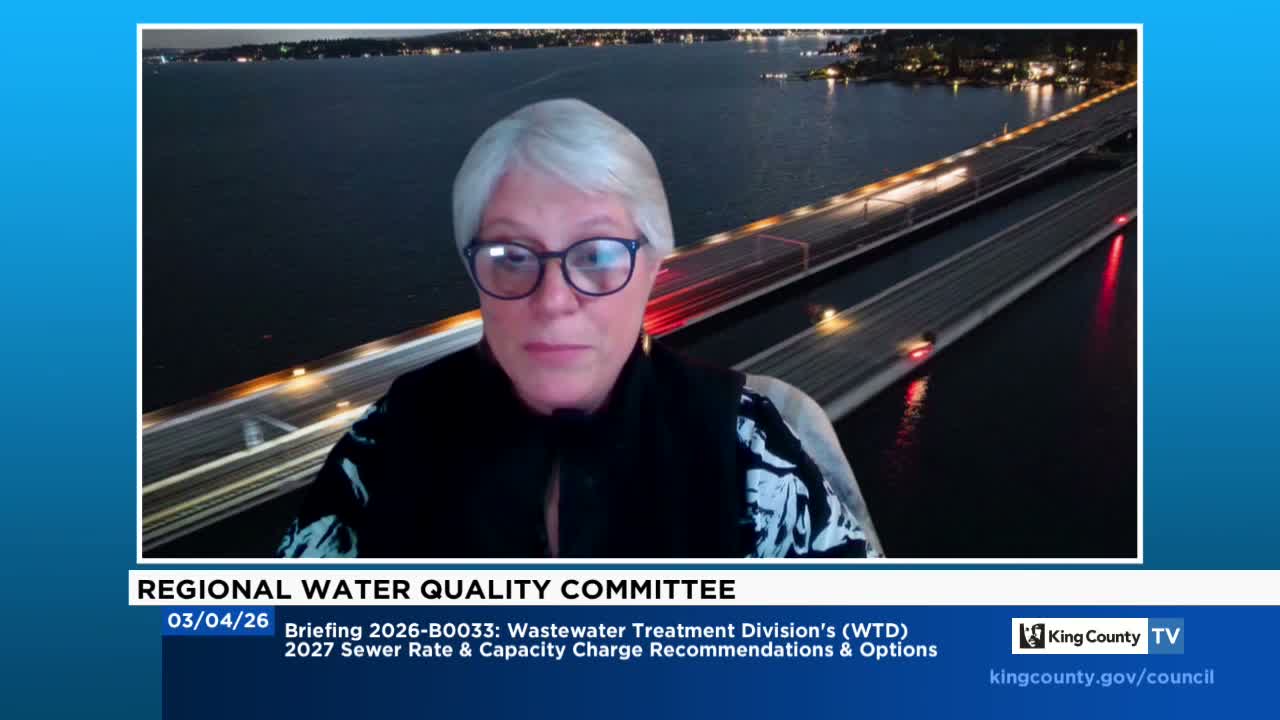
WTD Director Cameron Gural and Interim CFO Caitlin Hall presented the division‑recommended 2027 sewer rate and a 20‑year financial forecast to the Regional Wastewater Quality Committee on March 4.
"We are proposing a 12.75% increase in 2027," Hall said, describing that figure as the division‑recommended starting point; staff emphasized that the final executive recommendation and legislation will follow later. Hall added that the projection corresponds to a multi‑year forecast of elevated rates driven primarily by regulatory capital projects tied to consent‑decree obligations and permit requirements.
What was presented: staff showed a baseline (division‑recommended) scenario and two alternatives required for the executive package: a council‑requested illustrative scenario 2 percentage points lower (about 10.75% in 2027) and a theoretical regulatory‑deadline‑extension scenario that shifts large CSO projects later to reduce near‑term increases. WTD cautioned that while the deadline‑extension option produces short‑term rate relief, it generally increases long‑term costs because deferred projects become more expensive and raises regulatory compliance risk.
Staff noted key drivers: heavy near‑term spending on regulatory projects (for example, the mouth‑of‑Duwamish CSO project was forecast to spend roughly $200 million in 2027), rising local construction costs, and schedule‑risk dynamics that move near‑term expenditures into later years. Hall said the division's recommended 2027 rate and forecast prioritize regulatory compliance while seeking to limit increases through about 2034. She said the recommendation is intended to preserve WTD's financial policies and credit position.
Affordability and mitigation: staff reviewed affordability tools available to the wholesale utility, noting WTD is a wholesaler and cannot provide direct customer rate assistance. Hall pointed to capacity charge payment plans and targeted low‑income options for seniors and disabled customers and said WTD is supportive of national efforts for household assistance. Committee members repeatedly asked for more detailed trade‑off and cost information before making substantive recommendations.
Committee process: Chair Balducci proposed and the committee approved a process to prepare a leadership‑caucus draft letter to the county executive—building on prior letters—so RWQC concerns can be considered before the expected executive transmittal (target late April). Staff will recirculate last year’s letters and work with a small leadership group to produce a draft for committee consideration at the April 1 meeting.
Ending: staff will return with additional financial details and the committee plans to vote on a letter to the executive at its April meeting prior to the executive’s transmittal to the council.
"We are proposing a 12.75% increase in 2027," Hall said, describing that figure as the division‑recommended starting point; staff emphasized that the final executive recommendation and legislation will follow later. Hall added that the projection corresponds to a multi‑year forecast of elevated rates driven primarily by regulatory capital projects tied to consent‑decree obligations and permit requirements.
What was presented: staff showed a baseline (division‑recommended) scenario and two alternatives required for the executive package: a council‑requested illustrative scenario 2 percentage points lower (about 10.75% in 2027) and a theoretical regulatory‑deadline‑extension scenario that shifts large CSO projects later to reduce near‑term increases. WTD cautioned that while the deadline‑extension option produces short‑term rate relief, it generally increases long‑term costs because deferred projects become more expensive and raises regulatory compliance risk.
Staff noted key drivers: heavy near‑term spending on regulatory projects (for example, the mouth‑of‑Duwamish CSO project was forecast to spend roughly $200 million in 2027), rising local construction costs, and schedule‑risk dynamics that move near‑term expenditures into later years. Hall said the division's recommended 2027 rate and forecast prioritize regulatory compliance while seeking to limit increases through about 2034. She said the recommendation is intended to preserve WTD's financial policies and credit position.
Affordability and mitigation: staff reviewed affordability tools available to the wholesale utility, noting WTD is a wholesaler and cannot provide direct customer rate assistance. Hall pointed to capacity charge payment plans and targeted low‑income options for seniors and disabled customers and said WTD is supportive of national efforts for household assistance. Committee members repeatedly asked for more detailed trade‑off and cost information before making substantive recommendations.
Committee process: Chair Balducci proposed and the committee approved a process to prepare a leadership‑caucus draft letter to the county executive—building on prior letters—so RWQC concerns can be considered before the expected executive transmittal (target late April). Staff will recirculate last year’s letters and work with a small leadership group to produce a draft for committee consideration at the April 1 meeting.
Ending: staff will return with additional financial details and the committee plans to vote on a letter to the executive at its April meeting prior to the executive’s transmittal to the council.
Don't Miss a Word: See the Full Meeting!
Go beyond summaries. Unlock every video, transcript, and key insight with a Founder Membership.
✓
Get instant access to full meeting videos
✓
Search and clip any phrase from complete transcripts
✓
Receive AI-powered summaries & custom alerts
✓
Enjoy lifetime, unrestricted access to government data
30-day money-back guarantee
