Mountain View committee advances staff plan for FY2026–27 CDBG and HOME funding amid HUD addendum uncertainty
March 09, 2026 | Mountain View, Santa Clara County, California
This article was created by AI summarizing key points discussed. AI makes mistakes, so for full details and context, please refer to the video of the full meeting. Please report any errors so we can fix them. Report an error »
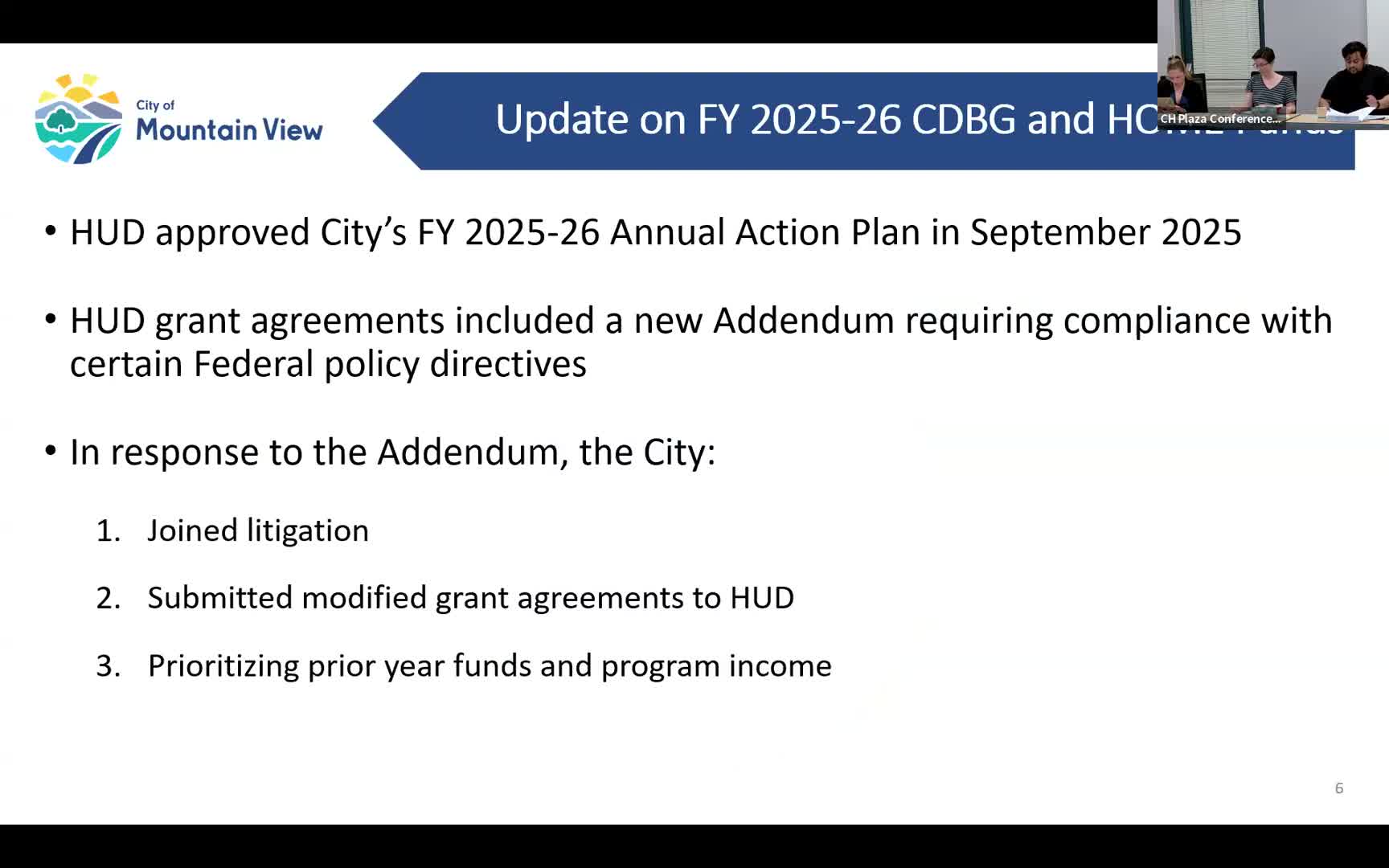
City staff presented the Human Relations Committee with proposed funding recommendations for the FY2026–27 CDBG and HOME annual action plan and outlined a strategy to limit exposure to a new HUD addendum that attaches policy conditions to federal grants.
“A maximum of 15% can be used for public services,” Housing Officer Alec Figaro told the committee, explaining statutory limits for CDBG use and that changes in anticipated program income — largely loan repayments to the city — reduce the amount available for public services. Staff recommended CDBG public-service grants for nonprofit partners totaling $373,831 for FY2026–27 and proposed a one-time contingency from the city’s housing funds to cover any shortfall if program income or prior-year unexpended funds become unavailable.
Alec said staff are using “scenario A” as the planning assumption: submit modified grant agreements to HUD, prioritize use of prior-year funds and program income that staff believe are not subject to the addendum, and pursue legal options. He told the committee the city has joined litigation challenging the legality of the HUD policy conditions and has submitted modified grant agreements that would temporarily prevent enforcement of the new conditions while staff use prior-year funds and program income where possible.
Committee members pressed staff on how the supplemental amounts were calculated and on the risk that future entitlement funding could arrive with the addendum attached. Alec said program income amounts fluctuate from year to year and staff will return with updated numbers; he also pointed the committee to the CAPER (Consolidated Annual Performance and Evaluation Report) as the annual HUD report that details subrecipient accomplishments and client counts.
Local nonprofit representatives urged continued funding. “These services are sorely needed,” Keith Ogden, managing attorney at Community Legal Services in East Palo Alto, told the committee during public comment, noting his program opened 77 cases for Mountain View households last year. Georgia Basile, directing attorney at Senior Adults Legal Assistance, said funding enables services for low-income seniors and thanked the city for the recommendation.
Staff said final CDBG and HOME entitlement allocations from HUD have not been released; if those allocations differ from the estimates staff will adjust recommendations accordingly. Alec said the final action plan will be submitted to HUD by May 15, pending HUD’s release of final allocations, and the staff recommendations will go to City Council on April 28 after a 30-day public comment period.
The committee did not take a final city-level funding vote on the annual action plan at the meeting but advanced related administrative steps and requested ongoing updates on program income estimates and litigation developments.
“A maximum of 15% can be used for public services,” Housing Officer Alec Figaro told the committee, explaining statutory limits for CDBG use and that changes in anticipated program income — largely loan repayments to the city — reduce the amount available for public services. Staff recommended CDBG public-service grants for nonprofit partners totaling $373,831 for FY2026–27 and proposed a one-time contingency from the city’s housing funds to cover any shortfall if program income or prior-year unexpended funds become unavailable.
Alec said staff are using “scenario A” as the planning assumption: submit modified grant agreements to HUD, prioritize use of prior-year funds and program income that staff believe are not subject to the addendum, and pursue legal options. He told the committee the city has joined litigation challenging the legality of the HUD policy conditions and has submitted modified grant agreements that would temporarily prevent enforcement of the new conditions while staff use prior-year funds and program income where possible.
Committee members pressed staff on how the supplemental amounts were calculated and on the risk that future entitlement funding could arrive with the addendum attached. Alec said program income amounts fluctuate from year to year and staff will return with updated numbers; he also pointed the committee to the CAPER (Consolidated Annual Performance and Evaluation Report) as the annual HUD report that details subrecipient accomplishments and client counts.
Local nonprofit representatives urged continued funding. “These services are sorely needed,” Keith Ogden, managing attorney at Community Legal Services in East Palo Alto, told the committee during public comment, noting his program opened 77 cases for Mountain View households last year. Georgia Basile, directing attorney at Senior Adults Legal Assistance, said funding enables services for low-income seniors and thanked the city for the recommendation.
Staff said final CDBG and HOME entitlement allocations from HUD have not been released; if those allocations differ from the estimates staff will adjust recommendations accordingly. Alec said the final action plan will be submitted to HUD by May 15, pending HUD’s release of final allocations, and the staff recommendations will go to City Council on April 28 after a 30-day public comment period.
The committee did not take a final city-level funding vote on the annual action plan at the meeting but advanced related administrative steps and requested ongoing updates on program income estimates and litigation developments.
View the Full Meeting & All Its Details
This article offers just a summary. Unlock complete video, transcripts, and insights as a Founder Member.
✓
Watch full, unedited meeting videos
✓
Search every word spoken in unlimited transcripts
✓
AI summaries & real-time alerts (all government levels)
✓
Permanent access to expanding government content
30-day money-back guarantee
