Committee hears first briefing on proposed public defense standards change
March 04, 2026 | King County, Washington
This article was created by AI summarizing key points discussed. AI makes mistakes, so for full details and context, please refer to the video of the full meeting. Please report any errors so we can fix them. Report an error »
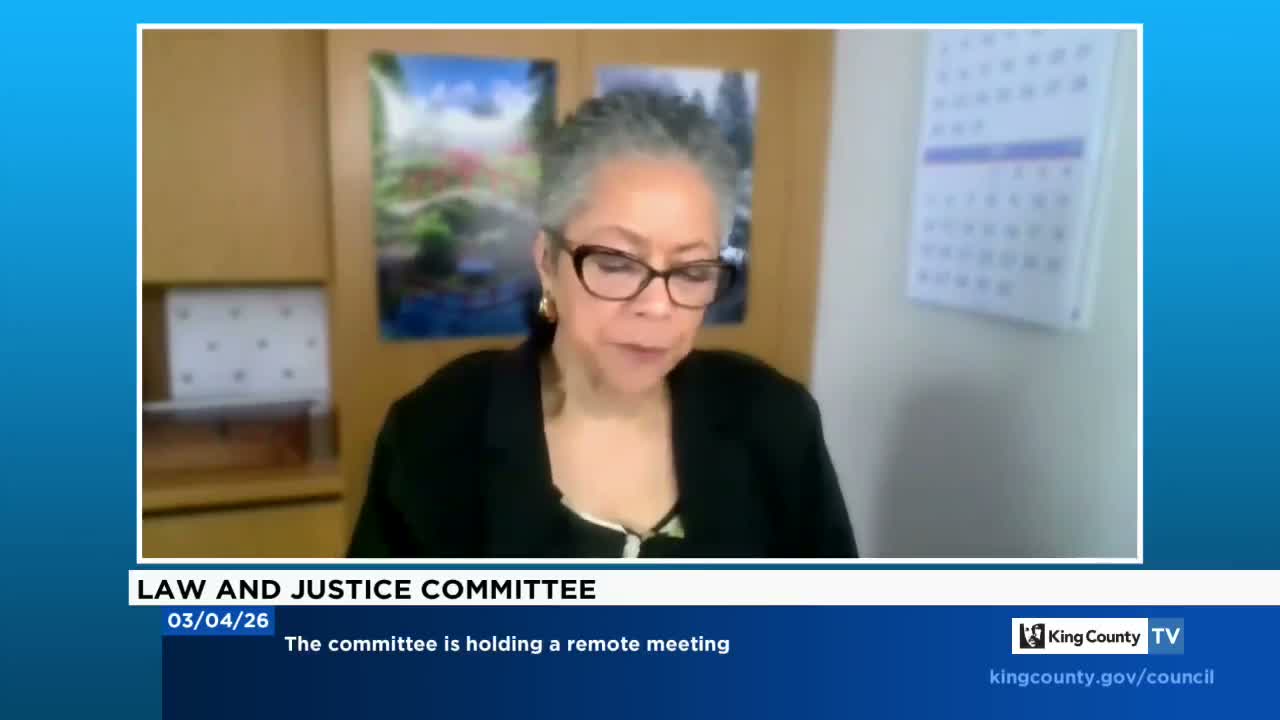
The Law and Justice Committee on March 4 held its first hearing on a proposed ordinance to update King County’s public defense standards in response to recent Washington State Supreme Court and Washington State Bar Association guidance.
Council staff summarized the bill and its rationale. "The proposed ordinance would make 2 changes to county code," said Leah Kreckelzappi, council staff, who told the committee the measure would adopt Supreme Court standards where the court rule exists and use the WSBA standards for required elements not yet reflected in court rules. Kreckelzappi said the proposal would also update the county’s reference to the American Bar Association’s 10 Principles to the August 2023 version.
Sponsor Council member Baron said the measure is intended to clarify ambiguous code language and avoid forcing staffing ratios into ordinance text. "My primary consideration is that the code is not really the appropriate place for us to be including that level of detail regarding staffing," Baron said, noting those decisions should be handled through collective bargaining and appropriations.
Department of Public Defense Director Matt Sanders told the committee DPD opposes the ordinance as drafted but outlined the department’s recent work to implement new standards. "I don't think it's gonna be a huge surprise to learn that DPD opposes the proposed ordinance," Sanders said, adding that DPD has been preparing for phase 2 of the WSBA standards since mid-2024. He projected that "we would need 5 revenue backed attorneys" to meet criminal demands under phase 2 beginning in July 2026 and warned that phase 3 (July 2027) would be significantly more costly.
Staff and several council members flagged fiscal impacts as a key open issue. Kreckelzappi and others said fiscal analysis is ongoing and would be presented at the next hearing. The staff report noted that while some proposed standards align with current DPD practice, other standards—especially caseload limits and ratios for mitigation specialists and nonlawyer professionals—could require more attorneys and support staff and increase administrative and capital costs.
Committee members asked about stakeholder engagement and process options. Kendall Moore, council legal counsel, pointed to the statute cited in staff materials that tasks local legislative authorities with adopting local standards and said that ordinance adoption is the legal mechanism for that function. Council members also discussed whether standards could be adopted administratively rather than by code, and how to balance compliance timelines with budget realities.
The committee did not take action on the ordinance; Chair Rhonda Lewis said staff would return with more analysis and the item would have at least one additional hearing for questions and fiscal detail.
Council staff summarized the bill and its rationale. "The proposed ordinance would make 2 changes to county code," said Leah Kreckelzappi, council staff, who told the committee the measure would adopt Supreme Court standards where the court rule exists and use the WSBA standards for required elements not yet reflected in court rules. Kreckelzappi said the proposal would also update the county’s reference to the American Bar Association’s 10 Principles to the August 2023 version.
Sponsor Council member Baron said the measure is intended to clarify ambiguous code language and avoid forcing staffing ratios into ordinance text. "My primary consideration is that the code is not really the appropriate place for us to be including that level of detail regarding staffing," Baron said, noting those decisions should be handled through collective bargaining and appropriations.
Department of Public Defense Director Matt Sanders told the committee DPD opposes the ordinance as drafted but outlined the department’s recent work to implement new standards. "I don't think it's gonna be a huge surprise to learn that DPD opposes the proposed ordinance," Sanders said, adding that DPD has been preparing for phase 2 of the WSBA standards since mid-2024. He projected that "we would need 5 revenue backed attorneys" to meet criminal demands under phase 2 beginning in July 2026 and warned that phase 3 (July 2027) would be significantly more costly.
Staff and several council members flagged fiscal impacts as a key open issue. Kreckelzappi and others said fiscal analysis is ongoing and would be presented at the next hearing. The staff report noted that while some proposed standards align with current DPD practice, other standards—especially caseload limits and ratios for mitigation specialists and nonlawyer professionals—could require more attorneys and support staff and increase administrative and capital costs.
Committee members asked about stakeholder engagement and process options. Kendall Moore, council legal counsel, pointed to the statute cited in staff materials that tasks local legislative authorities with adopting local standards and said that ordinance adoption is the legal mechanism for that function. Council members also discussed whether standards could be adopted administratively rather than by code, and how to balance compliance timelines with budget realities.
The committee did not take action on the ordinance; Chair Rhonda Lewis said staff would return with more analysis and the item would have at least one additional hearing for questions and fiscal detail.
View the Full Meeting & All Its Details
This article offers just a summary. Unlock complete video, transcripts, and insights as a Founder Member.
✓
Watch full, unedited meeting videos
✓
Search every word spoken in unlimited transcripts
✓
AI summaries & real-time alerts (all government levels)
✓
Permanent access to expanding government content
30-day money-back guarantee
