Speakers urge Austin commission to preserve Barton Springs Road Bridge after review is withdrawn
March 04, 2026 | Austin, Travis County, Texas
This article was created by AI summarizing key points discussed. AI makes mistakes, so for full details and context, please refer to the video of the full meeting. Please report any errors so we can fix them. Report an error »
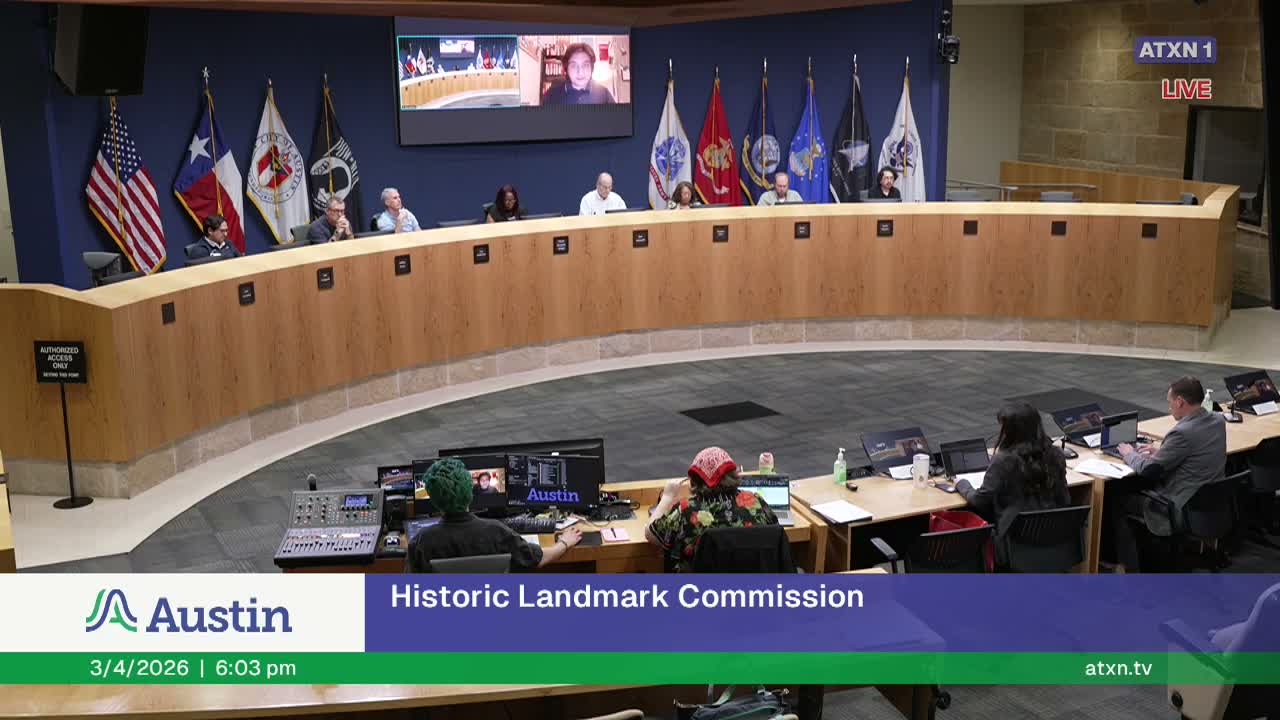
Dozens of preservation advocates and residents told the Austin Historic Landmark Commission on March 4 that the historic Barton Springs Road Bridge in Zilker Park should be preserved rather than demolished.
The public-comment period — held after the applicant withdrew item #3 from the posted agenda — featured architects, engineers, environmental advocates and neighbors who pressed the city to fully evaluate rehabilitation options, avoid encroaching on Umlauf Sculpture Garden property and follow federal review procedures including Section 106 and what speakers described as “Federal Highway section 4 f” requirements before endorsing demolition.
"This bridge is not simply infrastructure. It's a part of the historic fabric of Zilker Park," said Karen Coker, a documentary media producer, urging commissioners to consider alternatives to widening or replacing the structure.
Jason John Velhaskins, advocacy commissioner for the Austin chapter of the American Institute of Architects, said AIA members are preparing formal comments and expressed concern about what he called a lack of due process: "We would appreciate understanding better how this process became so perverse, how this came so late to you, and how they did not follow the correct procedures and skip so many required commissions and public reviews." He said AIA members support preservation and will submit recommendations.
Several speakers presented technical and environmental arguments for preservation. A presenter who identified himself as David Haman shared a preliminary carbon-emissions comparison, saying that repairing the existing bridge (with extensive local repairs) would generate roughly 193–236 metric tons of CO2e, while constructing an adjacent steel-and-wood pedestrian structure or a full new replacement would be substantially higher. "If you repair the existing bridge and build a steel bridge next to it, it is over its range about half the carbon cost of tearing the bridge out and replacing it," he said.
Charles Walker, P.E., retired from TxDOT, told commissioners that engineering reports should examine options that rebuild the floor system while preserving the arches — approaches he said have precedent in other Texas bridge rehabilitations. Patricia Bobek, a PhD hydrogeologist, flagged unstable slope conditions near the Umlauf property and raised a potential conflict of interest in using a contractor to determine the bridge's viability.
Advocacy groups framed the case in legal and procedural terms. Bill Bunch, executive director of Save Our Springs Alliance, said federal review steps would be required and urged commissioners not to endorse demolition: "They cannot tear down this bridge without a record scientific and engineering record that supports the conclusion that there's no feasible and prudent alternative to save the bridge," he said, citing a federal standard he referenced as Section 4(f).
Preservation Austin said it will participate as a consulting party in Section 106 and 4(f) processes. Speakers also urged attention to creek-bank stabilization and long-term transportation planning, noting that replacement carries both large financial and environmental costs.
Chair Heimseff thanked speakers and said staff will brief the commission at its April 1 meeting; the chair emphasized that a briefing is not a public hearing and that the applicant must return with a historic review application for the commission to issue formal comments. The chair asked staff to include options raised by speakers — including preserving the existing bridge for pedestrians and bicycles while constructing a new vehicle bridge — in the April briefing.
What happens next: the applicant has withdrawn the item from tonight's agenda but plans a staff briefing for the commission on April 1; a historic review application must return to the commission for formal comment and any eventual commission action.
The public-comment period — held after the applicant withdrew item #3 from the posted agenda — featured architects, engineers, environmental advocates and neighbors who pressed the city to fully evaluate rehabilitation options, avoid encroaching on Umlauf Sculpture Garden property and follow federal review procedures including Section 106 and what speakers described as “Federal Highway section 4 f” requirements before endorsing demolition.
"This bridge is not simply infrastructure. It's a part of the historic fabric of Zilker Park," said Karen Coker, a documentary media producer, urging commissioners to consider alternatives to widening or replacing the structure.
Jason John Velhaskins, advocacy commissioner for the Austin chapter of the American Institute of Architects, said AIA members are preparing formal comments and expressed concern about what he called a lack of due process: "We would appreciate understanding better how this process became so perverse, how this came so late to you, and how they did not follow the correct procedures and skip so many required commissions and public reviews." He said AIA members support preservation and will submit recommendations.
Several speakers presented technical and environmental arguments for preservation. A presenter who identified himself as David Haman shared a preliminary carbon-emissions comparison, saying that repairing the existing bridge (with extensive local repairs) would generate roughly 193–236 metric tons of CO2e, while constructing an adjacent steel-and-wood pedestrian structure or a full new replacement would be substantially higher. "If you repair the existing bridge and build a steel bridge next to it, it is over its range about half the carbon cost of tearing the bridge out and replacing it," he said.
Charles Walker, P.E., retired from TxDOT, told commissioners that engineering reports should examine options that rebuild the floor system while preserving the arches — approaches he said have precedent in other Texas bridge rehabilitations. Patricia Bobek, a PhD hydrogeologist, flagged unstable slope conditions near the Umlauf property and raised a potential conflict of interest in using a contractor to determine the bridge's viability.
Advocacy groups framed the case in legal and procedural terms. Bill Bunch, executive director of Save Our Springs Alliance, said federal review steps would be required and urged commissioners not to endorse demolition: "They cannot tear down this bridge without a record scientific and engineering record that supports the conclusion that there's no feasible and prudent alternative to save the bridge," he said, citing a federal standard he referenced as Section 4(f).
Preservation Austin said it will participate as a consulting party in Section 106 and 4(f) processes. Speakers also urged attention to creek-bank stabilization and long-term transportation planning, noting that replacement carries both large financial and environmental costs.
Chair Heimseff thanked speakers and said staff will brief the commission at its April 1 meeting; the chair emphasized that a briefing is not a public hearing and that the applicant must return with a historic review application for the commission to issue formal comments. The chair asked staff to include options raised by speakers — including preserving the existing bridge for pedestrians and bicycles while constructing a new vehicle bridge — in the April briefing.
What happens next: the applicant has withdrawn the item from tonight's agenda but plans a staff briefing for the commission on April 1; a historic review application must return to the commission for formal comment and any eventual commission action.
View the Full Meeting & All Its Details
This article offers just a summary. Unlock complete video, transcripts, and insights as a Founder Member.
✓
Watch full, unedited meeting videos
✓
Search every word spoken in unlimited transcripts
✓
AI summaries & real-time alerts (all government levels)
✓
Permanent access to expanding government content
30-day money-back guarantee
