Mountain View EPC backs package of BMR code updates, adds vetting and anti-concentration direction
March 09, 2026 | Mountain View, Santa Clara County, California
This article was created by AI summarizing key points discussed. AI makes mistakes, so for full details and context, please refer to the video of the full meeting. Please report any errors so we can fix them. Report an error »
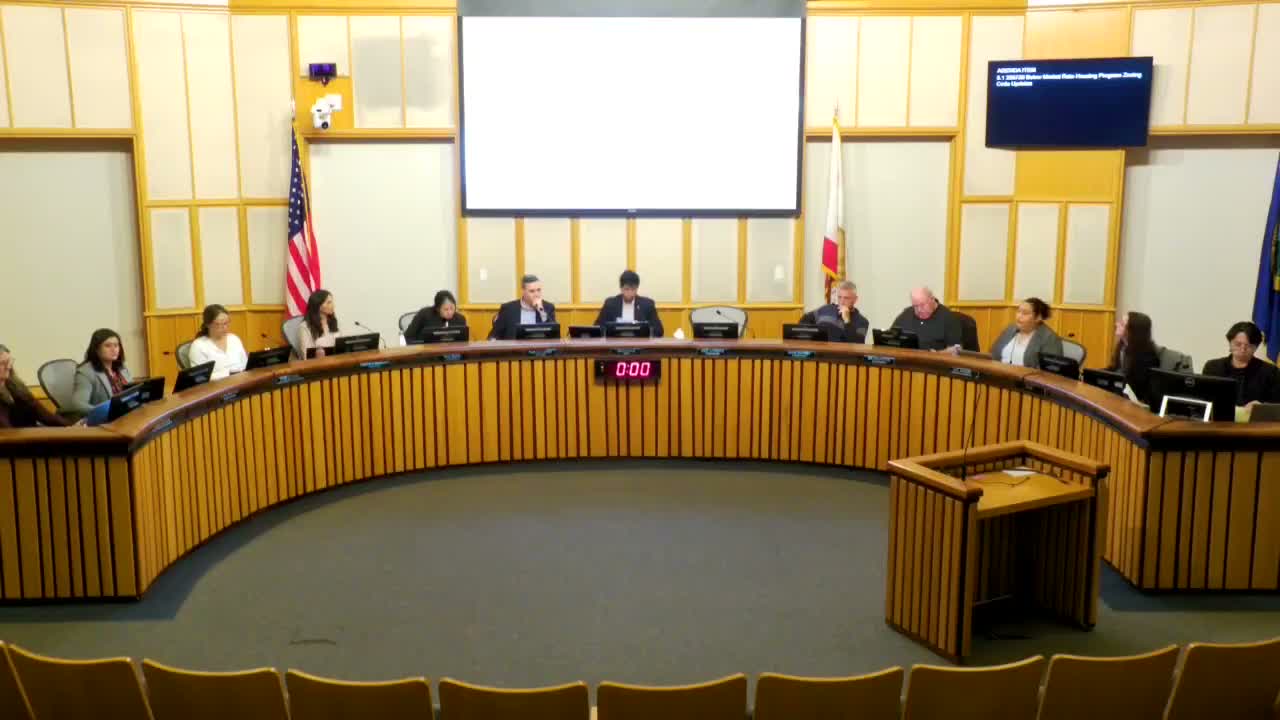
The Environmental Planning Commission on Tuesday recommended that the Mountain View City Council adopt a package of amendments to the city's Below Market Rate (BMR) program, updating how the city sets in-lieu fees, adds alternative compliance pathways and accessibility rules, and grants staff greater administrative authority to manage program guidelines. The commission's recommendation passed 6'to'0, with Commissioner Gutierrez absent.
Housing staff told the commission the seven-topic update is intended to make the BMR program clearer and more feasible for developers while preserving affordability. "My name is Anna Reynoso, and I'm a housing specialist here at the city," Reynoso said as she opened the presentation that laid out the changes, which staff said build on a 2019 update and a required December 2023 review.
Key changes include a minimum accessibility requirement (staff said about 13'18% of low-income households in California have a physical disability), new and clarified alternative compliance options (land dedication, off-site development and acquisition/preservation of existing units), a proposal to change the in-lieu fee escalator from CPI to the California Construction Cost Index (CCCI), removal of a developer HOA reserve fund for deed-restricted ownership units because of Assembly Bill 572 limits, and a graduated fee reduction to incentivize small projects. Staff also proposed moving routine BMR guideline updates to an administrative process rather than requiring a council resolution.
Why it matters: the ordinance determines whether developers must provide affordable units on-site or can comply by other means; it also frames how the city collects and uses fees that staff said have been a primary funding source for local affordable housing.
How alternative compliance will work: staff said alternative compliance proposals must show economic equivalency to providing on-site units by submitting a complete BMR compliance plan that includes feasibility and financing analyses, a cost-recovery fee to cover staff time, and, where relevant, locational and amenity requirements for off-site units. For example, if off-site units sit within 750 feet of the primary project and do not include equivalent amenities, off-site residents would need access to shared facilities at the market-rate site.
Acquisition and preservation: the new acquisition/preservation option would allow developers to buy and rehabilitate existing housing that is not subject to deed restrictions. Staff said developers must submit a physical needs assessment and confirm rehabilitation scope and costs; the resulting affordability for preserved units must be no less than the on-site requirement.
Fees and funds: staff recommended switching the in-lieu fee escalator from CPI to the CCCI to better reflect construction cost pressures. Wayne Chen, the housing director, told commissioners the city has used in-lieu fees and housing impact fees to help finance about 1,700 fully affordable units and said staff estimates roughly $118 million in BMR in-lieu fees have been collected since the program began in 1999. Staff also noted a small $4 million allocation for a community acquisition-preservation fund.
HOA reserve fund: staff recommended removing the HOA reserve fund requirement for deed-restricted ownership units after state law (Assembly Bill 572) limited HOA increases and developers reported the reserve fund impeded feasibility for low-income homeownership projects.
Public comment and small-builder concerns: three in-person speakers urged greater fee relief and flexibility for small projects. "The fee burden in Mountain View tends to be around $350,000 per unit," said Ben Tinklenberg, a small-scale builder, arguing that high fees make middle-income projects impossible and suppress housing production. Developers and small builders in public comment asked the commission to extend the graduated fee reduction to projects up to 10 units and to allow staging flexibility for BMR units in phased construction.
Legal and oversight questions: commissioners pressed staff and the city attorney about legal constraints and oversight. Commissioner Cranston sought assurance the city could prevent unsuitable partners from carrying out alternative compliance projects; City Attorney Jennifer Logue said state law requires that the ordinance list alternative means of compliance and cautioned against making the options so subjective that they are effectively unavailable. Logue and staff proposed adding objective documentation requirements (for instance, proof that a partner is a "qualified developer") so the city retains the ability to evaluate proposals without violating state requirements.
Deliberation and action: during deliberations commissioners generally supported staff's recommendations but asked staff to return with objective vetting criteria and further analysis to ensure off-site alternatives do not concentrate lower-income housing in particular neighborhoods. Chair Nunez moved that the EPC recommend council adopt the ordinance amendments to Chapter 36 with added language directing staff to assure qualified partners for alternative compliance proposals and to analyze and prevent concentration risk; Commissioner Cranston seconded the motion. The motion carried, 6 yes, 1 absent.
Next steps: staff said the ordinance will be presented to City Council for first and second readings in May and June, with an effective date 30 days after the second reading (staff indicated July 9 as the anticipated effective date). The commission asked staff to draft objective criteria for partnership vetting and to explore additional mapping or data-based safeguards so off-site alternatives do not exacerbate concentrations of low-income tracts.
Housing staff told the commission the seven-topic update is intended to make the BMR program clearer and more feasible for developers while preserving affordability. "My name is Anna Reynoso, and I'm a housing specialist here at the city," Reynoso said as she opened the presentation that laid out the changes, which staff said build on a 2019 update and a required December 2023 review.
Key changes include a minimum accessibility requirement (staff said about 13'18% of low-income households in California have a physical disability), new and clarified alternative compliance options (land dedication, off-site development and acquisition/preservation of existing units), a proposal to change the in-lieu fee escalator from CPI to the California Construction Cost Index (CCCI), removal of a developer HOA reserve fund for deed-restricted ownership units because of Assembly Bill 572 limits, and a graduated fee reduction to incentivize small projects. Staff also proposed moving routine BMR guideline updates to an administrative process rather than requiring a council resolution.
Why it matters: the ordinance determines whether developers must provide affordable units on-site or can comply by other means; it also frames how the city collects and uses fees that staff said have been a primary funding source for local affordable housing.
How alternative compliance will work: staff said alternative compliance proposals must show economic equivalency to providing on-site units by submitting a complete BMR compliance plan that includes feasibility and financing analyses, a cost-recovery fee to cover staff time, and, where relevant, locational and amenity requirements for off-site units. For example, if off-site units sit within 750 feet of the primary project and do not include equivalent amenities, off-site residents would need access to shared facilities at the market-rate site.
Acquisition and preservation: the new acquisition/preservation option would allow developers to buy and rehabilitate existing housing that is not subject to deed restrictions. Staff said developers must submit a physical needs assessment and confirm rehabilitation scope and costs; the resulting affordability for preserved units must be no less than the on-site requirement.
Fees and funds: staff recommended switching the in-lieu fee escalator from CPI to the CCCI to better reflect construction cost pressures. Wayne Chen, the housing director, told commissioners the city has used in-lieu fees and housing impact fees to help finance about 1,700 fully affordable units and said staff estimates roughly $118 million in BMR in-lieu fees have been collected since the program began in 1999. Staff also noted a small $4 million allocation for a community acquisition-preservation fund.
HOA reserve fund: staff recommended removing the HOA reserve fund requirement for deed-restricted ownership units after state law (Assembly Bill 572) limited HOA increases and developers reported the reserve fund impeded feasibility for low-income homeownership projects.
Public comment and small-builder concerns: three in-person speakers urged greater fee relief and flexibility for small projects. "The fee burden in Mountain View tends to be around $350,000 per unit," said Ben Tinklenberg, a small-scale builder, arguing that high fees make middle-income projects impossible and suppress housing production. Developers and small builders in public comment asked the commission to extend the graduated fee reduction to projects up to 10 units and to allow staging flexibility for BMR units in phased construction.
Legal and oversight questions: commissioners pressed staff and the city attorney about legal constraints and oversight. Commissioner Cranston sought assurance the city could prevent unsuitable partners from carrying out alternative compliance projects; City Attorney Jennifer Logue said state law requires that the ordinance list alternative means of compliance and cautioned against making the options so subjective that they are effectively unavailable. Logue and staff proposed adding objective documentation requirements (for instance, proof that a partner is a "qualified developer") so the city retains the ability to evaluate proposals without violating state requirements.
Deliberation and action: during deliberations commissioners generally supported staff's recommendations but asked staff to return with objective vetting criteria and further analysis to ensure off-site alternatives do not concentrate lower-income housing in particular neighborhoods. Chair Nunez moved that the EPC recommend council adopt the ordinance amendments to Chapter 36 with added language directing staff to assure qualified partners for alternative compliance proposals and to analyze and prevent concentration risk; Commissioner Cranston seconded the motion. The motion carried, 6 yes, 1 absent.
Next steps: staff said the ordinance will be presented to City Council for first and second readings in May and June, with an effective date 30 days after the second reading (staff indicated July 9 as the anticipated effective date). The commission asked staff to draft objective criteria for partnership vetting and to explore additional mapping or data-based safeguards so off-site alternatives do not exacerbate concentrations of low-income tracts.
Don't Miss a Word: See the Full Meeting!
Go beyond summaries. Unlock every video, transcript, and key insight with a Founder Membership.
✓
Get instant access to full meeting videos
✓
Search and clip any phrase from complete transcripts
✓
Receive AI-powered summaries & custom alerts
✓
Enjoy lifetime, unrestricted access to government data
30-day money-back guarantee
