Secretary of State details FY27 budget, says phased rollout of new voting system expected in 2027
March 04, 2026 | 2026 Legislature LA, Louisiana
This article was created by AI summarizing key points discussed. AI makes mistakes, so for full details and context, please refer to the video of the full meeting. Please report any errors so we can fix them. Report an error »
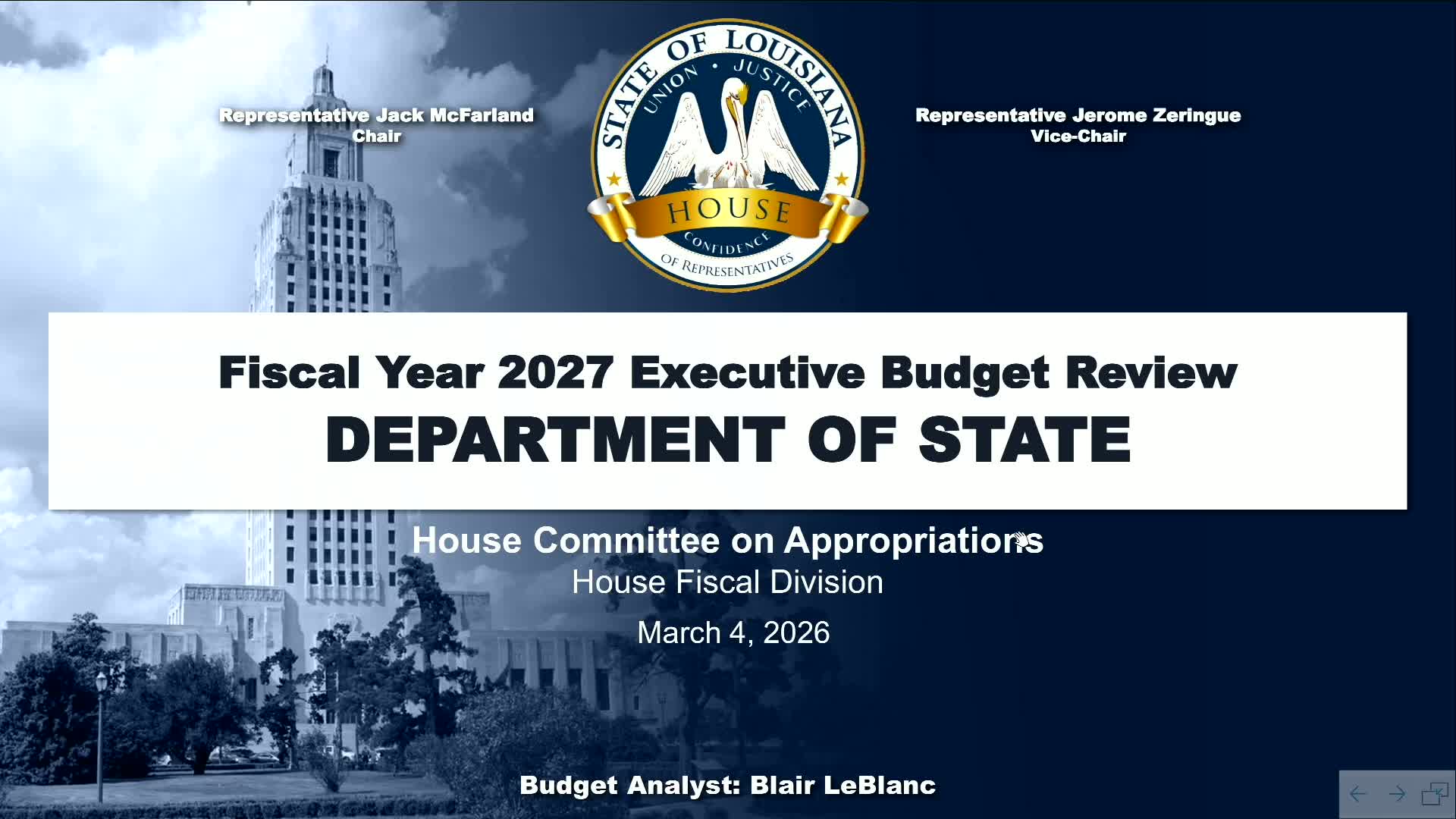
Secretary of State Nancy Landry outlined the Department of State’s fiscal year 2027 budget request and the office’s plan to implement Louisiana’s new closed party primaries and replace the state’s 35‑year‑old voting equipment.
Landry told the legislative committee that the department’s FY27 recommended budget is $128.6 million with 367 authorized positions and that elections account for the largest share of departmental spending. She said the office’s top priorities are replacing outdated voting equipment with systems that produce voter‑verifiable paper ballots and allow risk‑limiting audits and expanding voter education about the recently enacted closed primary system.
Landry said the new voting system procurement has been a multiyear process and that the department is nearing the end of pre‑procurement requirements. She described a phased rollout beginning with pilots in a handful of parishes, with a contract hoped for by the end of the year and implementation starting in 2027 with a target to complete transition within three years.
On costs, department staff said they estimate the total program need around $100 million and that the funding plan will be a mix of federal Help America Vote Act (HAVA) grants (which typically require a state match) and state appropriations. The department reported a voter technology fund balance and indicated additional state funds will likely be needed to reach the full replacement cost.
Lawmakers pressed officials on practical voter‑notification and polling logistics after similar confusion elsewhere. Landry said polling places remain the same unless changed by local authorities; voters receive mail notification if a precinct moves, and the department’s “Go Vote” mobile app and on‑site staff post emergency location changes when necessary.
Committee members also questioned the recurring cost of voter education tied to closed primaries. Department staff provided a five‑year estimate for conversion and outreach of about $31.5 million, including an initial $10.5 million for 2026 (conversion and outreach) and recurring annual costs in subsequent years.
Landry requested $4,670,000 in FY27 to secure climate‑controlled storage for voting equipment and paper ballots and emphasized the need for continued cybersecurity and IT modernization funding. She also said the department is conducting statewide outreach — direct mail, multimedia campaigns and training for local election administrators — and has materials and videos available for legislators to share with constituents.
The committee asked about pay for election commissioners; staff said a bill under consideration would raise election commissioners’ pay by $100 (from $200 to $300 for the day), reflecting the long hours of the position.
The committee did not take formal action on the budget during this hearing; Landry and staff committed to provide additional cost breakdowns and to continue voter education efforts ahead of May elections.
Landry told the legislative committee that the department’s FY27 recommended budget is $128.6 million with 367 authorized positions and that elections account for the largest share of departmental spending. She said the office’s top priorities are replacing outdated voting equipment with systems that produce voter‑verifiable paper ballots and allow risk‑limiting audits and expanding voter education about the recently enacted closed primary system.
Landry said the new voting system procurement has been a multiyear process and that the department is nearing the end of pre‑procurement requirements. She described a phased rollout beginning with pilots in a handful of parishes, with a contract hoped for by the end of the year and implementation starting in 2027 with a target to complete transition within three years.
On costs, department staff said they estimate the total program need around $100 million and that the funding plan will be a mix of federal Help America Vote Act (HAVA) grants (which typically require a state match) and state appropriations. The department reported a voter technology fund balance and indicated additional state funds will likely be needed to reach the full replacement cost.
Lawmakers pressed officials on practical voter‑notification and polling logistics after similar confusion elsewhere. Landry said polling places remain the same unless changed by local authorities; voters receive mail notification if a precinct moves, and the department’s “Go Vote” mobile app and on‑site staff post emergency location changes when necessary.
Committee members also questioned the recurring cost of voter education tied to closed primaries. Department staff provided a five‑year estimate for conversion and outreach of about $31.5 million, including an initial $10.5 million for 2026 (conversion and outreach) and recurring annual costs in subsequent years.
Landry requested $4,670,000 in FY27 to secure climate‑controlled storage for voting equipment and paper ballots and emphasized the need for continued cybersecurity and IT modernization funding. She also said the department is conducting statewide outreach — direct mail, multimedia campaigns and training for local election administrators — and has materials and videos available for legislators to share with constituents.
The committee asked about pay for election commissioners; staff said a bill under consideration would raise election commissioners’ pay by $100 (from $200 to $300 for the day), reflecting the long hours of the position.
The committee did not take formal action on the budget during this hearing; Landry and staff committed to provide additional cost breakdowns and to continue voter education efforts ahead of May elections.
Don't Miss a Word: See the Full Meeting!
Go beyond summaries. Unlock every video, transcript, and key insight with a Founder Membership.
✓
Get instant access to full meeting videos
✓
Search and clip any phrase from complete transcripts
✓
Receive AI-powered summaries & custom alerts
✓
Enjoy lifetime, unrestricted access to government data
30-day money-back guarantee
