House debate expands free school meals; lawmakers split over scope and cost
March 09, 2026 | House Committee on Education, House of Representatives, Legislative , Hawaii
This article was created by AI summarizing key points discussed. AI makes mistakes, so for full details and context, please refer to the video of the full meeting. Please report any errors so we can fix them. Report an error »
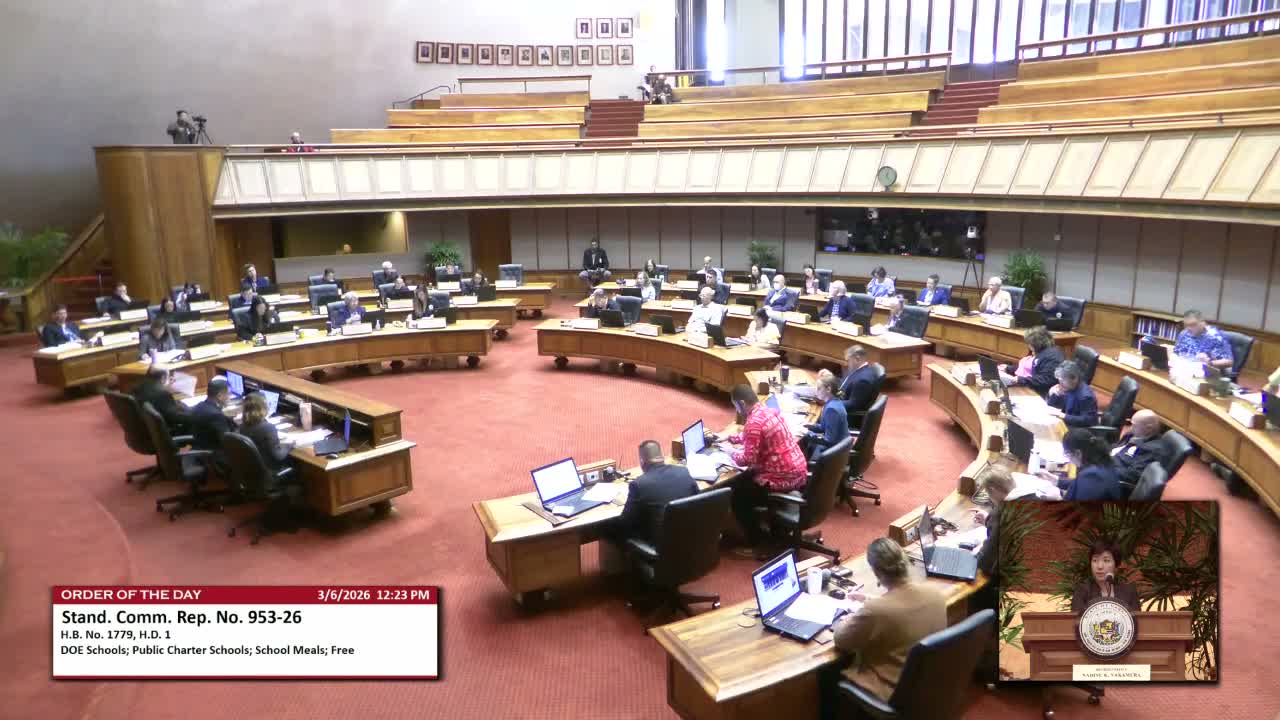
The House heard an extended debate on a measure to expand universal free school meals, with lawmakers sharply divided over cost and scope.
Supporters said the policy would reduce stigma, increase attendance and boost learning. Representative Matayoshi, speaking as a former teacher, said universal meals "get rid of that stigma" and help students "focus on their studies," and argued the administrative burden of means-testing can leave children without meals. Representative Souza said feeding keiki is the best use of taxpayer dollars for vulnerable students on the West Side of Oahu.
Opponents framed the proposal as an improper subsidy. Representative Garcia said the program goes "far beyond helping families in need" and warned it would "subsidize the rich," urging that eligibility should be targeted rather than universal. Garcia also referenced a near-$30,000,000 cost for the measure in floor comments.
Backers emphasized evidence from other jurisdictions. A member who entered remarks for the record said jurisdictions that implemented universal meals saw improvements in attendance and several percentage-point gains in test scores. Supporters also pressed for charter-school inclusion, noting that some charter schools have been left out of prior meal expansions.
While members expressed reservations about funding and implementation details, the floor discussion focused on policy trade-offs rather than parliamentary maneuvers: supporters highlighted child nutrition and simplified administration; opponents pressed for tighter eligibility and fiscal restraint. The transcript does not record a final floor vote on this specific measure during the excerpt provided. The House proceeded to other standing committee reports after the exchange.
Supporters said the policy would reduce stigma, increase attendance and boost learning. Representative Matayoshi, speaking as a former teacher, said universal meals "get rid of that stigma" and help students "focus on their studies," and argued the administrative burden of means-testing can leave children without meals. Representative Souza said feeding keiki is the best use of taxpayer dollars for vulnerable students on the West Side of Oahu.
Opponents framed the proposal as an improper subsidy. Representative Garcia said the program goes "far beyond helping families in need" and warned it would "subsidize the rich," urging that eligibility should be targeted rather than universal. Garcia also referenced a near-$30,000,000 cost for the measure in floor comments.
Backers emphasized evidence from other jurisdictions. A member who entered remarks for the record said jurisdictions that implemented universal meals saw improvements in attendance and several percentage-point gains in test scores. Supporters also pressed for charter-school inclusion, noting that some charter schools have been left out of prior meal expansions.
While members expressed reservations about funding and implementation details, the floor discussion focused on policy trade-offs rather than parliamentary maneuvers: supporters highlighted child nutrition and simplified administration; opponents pressed for tighter eligibility and fiscal restraint. The transcript does not record a final floor vote on this specific measure during the excerpt provided. The House proceeded to other standing committee reports after the exchange.
View the Full Meeting & All Its Details
This article offers just a summary. Unlock complete video, transcripts, and insights as a Founder Member.
✓
Watch full, unedited meeting videos
✓
Search every word spoken in unlimited transcripts
✓
AI summaries & real-time alerts (all government levels)
✓
Permanent access to expanding government content
30-day money-back guarantee
