House floor hears arguments for and against climate literacy certificate in schools
March 09, 2026 | House Committee on Education, House of Representatives, Legislative , Hawaii
This article was created by AI summarizing key points discussed. AI makes mistakes, so for full details and context, please refer to the video of the full meeting. Please report any errors so we can fix them. Report an error »
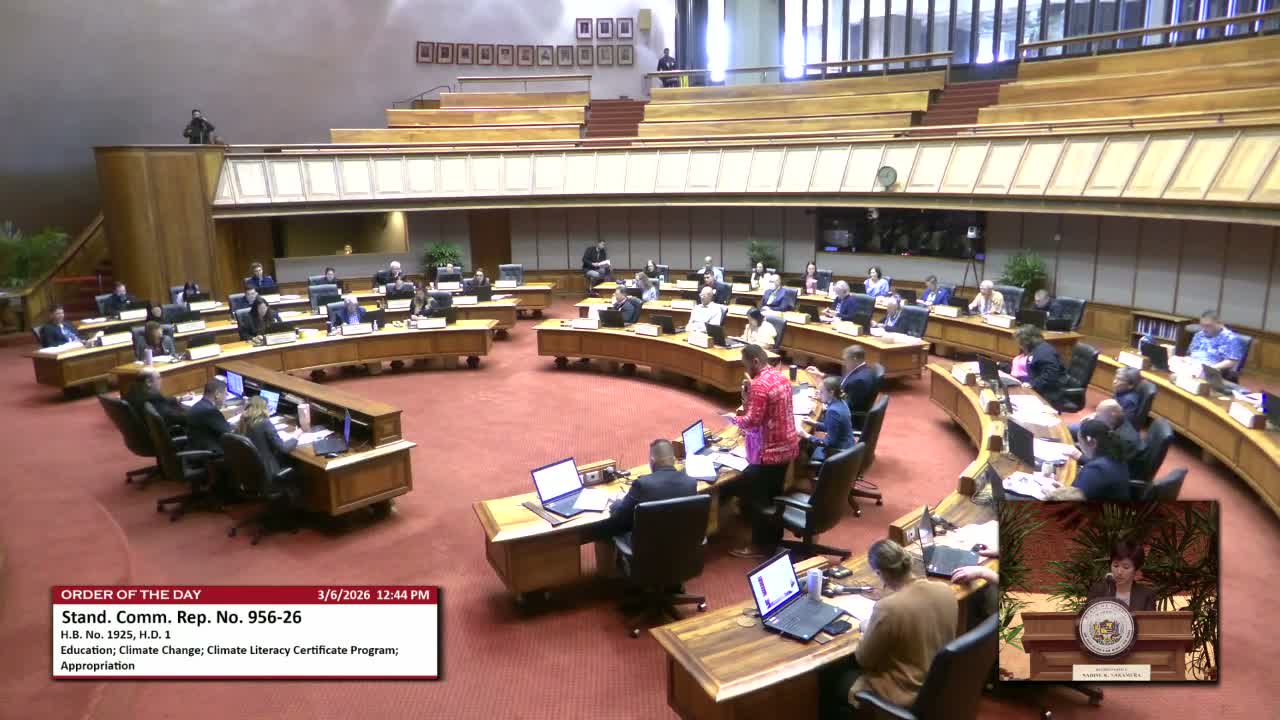
The House took up a measure authorizing the Department of Education to create a climate literacy certificate program and appropriating funds for related coursework. Members divided along lines of educational priority and curriculum focus.
Representative Garcia spoke in opposition, saying that with Hawaii near the bottom in reading and math proficiency, the state should prioritize fundamentals like reading, writing and math rather than adding new climate coursework: "Until we address the serious gaps in core learning across our public schools, adding new ideological course work is simply not the direction we should be going."
Supporters, including Representative Martin and Representative Quinlan, said climate literacy is not ideological but a factual area that will affect the state budget and residents for generations. Representative Martin said the subject will "impact our state budget more than anything else... for generations and generations to come," and Representative Quinlan described climate change as "an observable fact supported by millions and millions of data points." Representative Olds clarified the program would be optional for students.
The debate focused on priorities for limited classroom time and funding; proponents framed climate literacy as relevant to future fiscal and community resilience, while opponents favored redirecting resources to core academic deficiencies and disaster preparedness. The transcript does not record a final floor vote on this bill during the provided excerpt.
Representative Garcia spoke in opposition, saying that with Hawaii near the bottom in reading and math proficiency, the state should prioritize fundamentals like reading, writing and math rather than adding new climate coursework: "Until we address the serious gaps in core learning across our public schools, adding new ideological course work is simply not the direction we should be going."
Supporters, including Representative Martin and Representative Quinlan, said climate literacy is not ideological but a factual area that will affect the state budget and residents for generations. Representative Martin said the subject will "impact our state budget more than anything else... for generations and generations to come," and Representative Quinlan described climate change as "an observable fact supported by millions and millions of data points." Representative Olds clarified the program would be optional for students.
The debate focused on priorities for limited classroom time and funding; proponents framed climate literacy as relevant to future fiscal and community resilience, while opponents favored redirecting resources to core academic deficiencies and disaster preparedness. The transcript does not record a final floor vote on this bill during the provided excerpt.
Don't Miss a Word: See the Full Meeting!
Go beyond summaries. Unlock every video, transcript, and key insight with a Founder Membership.
✓
Get instant access to full meeting videos
✓
Search and clip any phrase from complete transcripts
✓
Receive AI-powered summaries & custom alerts
✓
Enjoy lifetime, unrestricted access to government data
30-day money-back guarantee
