Hubbardston planning board weighs sand‑pit overlay changes, aquifer protections and neighbor outreach
March 07, 2026 | Town of Hubbardston, Worcester County, Massachusetts
This article was created by AI summarizing key points discussed. AI makes mistakes, so for full details and context, please refer to the video of the full meeting. Please report any errors so we can fix them. Report an error »
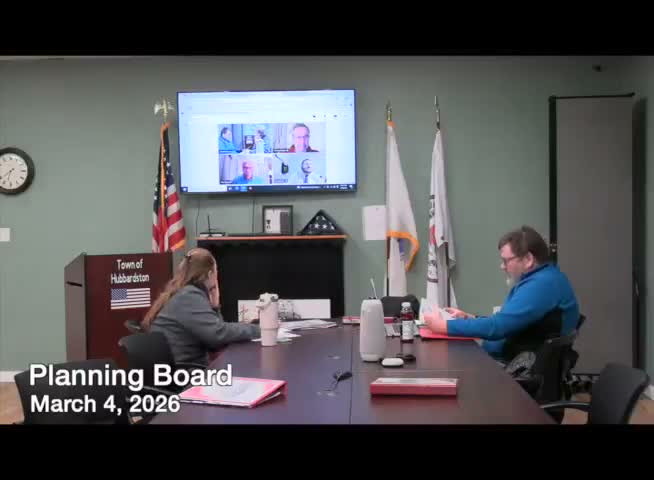
The Town of Hubbardston Planning Board discussed potential conflicts between a proposed sand‑pit overlay district and the town’s aquifer favorability (wellhead protection) district and approved targeted outreach and follow‑up steps.
Planner Alec said the board needs to decide whether the overlay’s allowed uses — including options that could enable multifamily housing — should be adjusted where they overlap the aquifer protection area. "It's my understanding that either tomorrow or Friday, MRPC will be meeting to review the first round of submissions for DLTA projects," Alec said, and he added that the town was "still on track to start up procurement process in March" for related grant projects.
Why it matters: the aquifer favorability district was created to limit uses perceived to risk drinking‑water supplies, and the draft overlay's allowances could conflict with those restrictions. Alec noted multifamily housing is disallowed in the aquifer protection zone; the board must choose whether to change the overlay, modify the aquifer rules, or apply other design controls.
Board members focused first on outreach and scope. Alec outlined two practical approaches to notifying neighbors: "You can either go a depth of 1 parcel or 2 parcels out" or create a simple buffer such as 500 feet using GIS. He warned a distance buffer can split parcels and complicate zoning lines. "The best way to probably go about doing this is a simple focus group setting," Alec said, recommending direct mail and a short staff‑led focus group rather than a broad open survey.
Several members favored a one‑parcel depth approach as the simplest and most inclusive option. The board asked staff to generate parcel lists from GIS so members can see how each method would perform in practice. Alec estimated the outreach would affect roughly "15 to 25" parcels and offered to prepare mailing materials and a one‑ to two‑page memo summarizing results.
On technical drafting, Alan (a board member who provided written feedback) recommended clarifying that the RT2GO overlay is an overlay district superimposed on the existing underlying Ag/Res zone and that the overlay should be described as providing "alternative uses" rather than saying it would "supersede" the underlying rules. Alan also suggested adding language recommending a preliminary conceptual or predevelopment presentation to the planning board so applicants and the board can discuss review standards before formal submission.
Members asked for more detail about the aquifer map and its supporting studies. The packet included a pictorial map; several members said the map lacked background documentation. Alec agreed to request the original reference materials from the consultant and to invite Bill Murray back to the planning board to explain the map and hydrological basis.
Other technical issues raised included density and buffer standards: the draft’s perimeter buffer is 75 feet, and some members suggested 40–50 feet might be adequate if vegetated. The board asked Alec to model several density and buffer scenarios (Alec offered to use simple SketchUp or plan sketches) so members could visualize tradeoffs.
Action items: Alec will prepare outreach materials and a parcel list, coordinate mailings with Leanne, request and ask the consultant Bill Murray to return with supporting materials, and produce draft modeling of density/buffer scenarios for a future meeting. The board accepted the previous meeting minutes by roll call and adjourned at 7:43 p.m.
The board will revisit the overlay draft after staff returns with GIS parcel lists, the consultant's materials, and modeled scenarios.
Planner Alec said the board needs to decide whether the overlay’s allowed uses — including options that could enable multifamily housing — should be adjusted where they overlap the aquifer protection area. "It's my understanding that either tomorrow or Friday, MRPC will be meeting to review the first round of submissions for DLTA projects," Alec said, and he added that the town was "still on track to start up procurement process in March" for related grant projects.
Why it matters: the aquifer favorability district was created to limit uses perceived to risk drinking‑water supplies, and the draft overlay's allowances could conflict with those restrictions. Alec noted multifamily housing is disallowed in the aquifer protection zone; the board must choose whether to change the overlay, modify the aquifer rules, or apply other design controls.
Board members focused first on outreach and scope. Alec outlined two practical approaches to notifying neighbors: "You can either go a depth of 1 parcel or 2 parcels out" or create a simple buffer such as 500 feet using GIS. He warned a distance buffer can split parcels and complicate zoning lines. "The best way to probably go about doing this is a simple focus group setting," Alec said, recommending direct mail and a short staff‑led focus group rather than a broad open survey.
Several members favored a one‑parcel depth approach as the simplest and most inclusive option. The board asked staff to generate parcel lists from GIS so members can see how each method would perform in practice. Alec estimated the outreach would affect roughly "15 to 25" parcels and offered to prepare mailing materials and a one‑ to two‑page memo summarizing results.
On technical drafting, Alan (a board member who provided written feedback) recommended clarifying that the RT2GO overlay is an overlay district superimposed on the existing underlying Ag/Res zone and that the overlay should be described as providing "alternative uses" rather than saying it would "supersede" the underlying rules. Alan also suggested adding language recommending a preliminary conceptual or predevelopment presentation to the planning board so applicants and the board can discuss review standards before formal submission.
Members asked for more detail about the aquifer map and its supporting studies. The packet included a pictorial map; several members said the map lacked background documentation. Alec agreed to request the original reference materials from the consultant and to invite Bill Murray back to the planning board to explain the map and hydrological basis.
Other technical issues raised included density and buffer standards: the draft’s perimeter buffer is 75 feet, and some members suggested 40–50 feet might be adequate if vegetated. The board asked Alec to model several density and buffer scenarios (Alec offered to use simple SketchUp or plan sketches) so members could visualize tradeoffs.
Action items: Alec will prepare outreach materials and a parcel list, coordinate mailings with Leanne, request and ask the consultant Bill Murray to return with supporting materials, and produce draft modeling of density/buffer scenarios for a future meeting. The board accepted the previous meeting minutes by roll call and adjourned at 7:43 p.m.
The board will revisit the overlay draft after staff returns with GIS parcel lists, the consultant's materials, and modeled scenarios.
View the Full Meeting & All Its Details
This article offers just a summary. Unlock complete video, transcripts, and insights as a Founder Member.
✓
Watch full, unedited meeting videos
✓
Search every word spoken in unlimited transcripts
✓
AI summaries & real-time alerts (all government levels)
✓
Permanent access to expanding government content
30-day money-back guarantee
