Council adopts in‑season increases for commercial canary rockfish limits and Oregon recreational changes
March 08, 2026 | Fishery Management Council, Pacific, Governor's Office - Boards & Commissions, Executive, Washington
This article was created by AI summarizing key points discussed. AI makes mistakes, so for full details and context, please refer to the video of the full meeting. Please report any errors so we can fix them. Report an error »
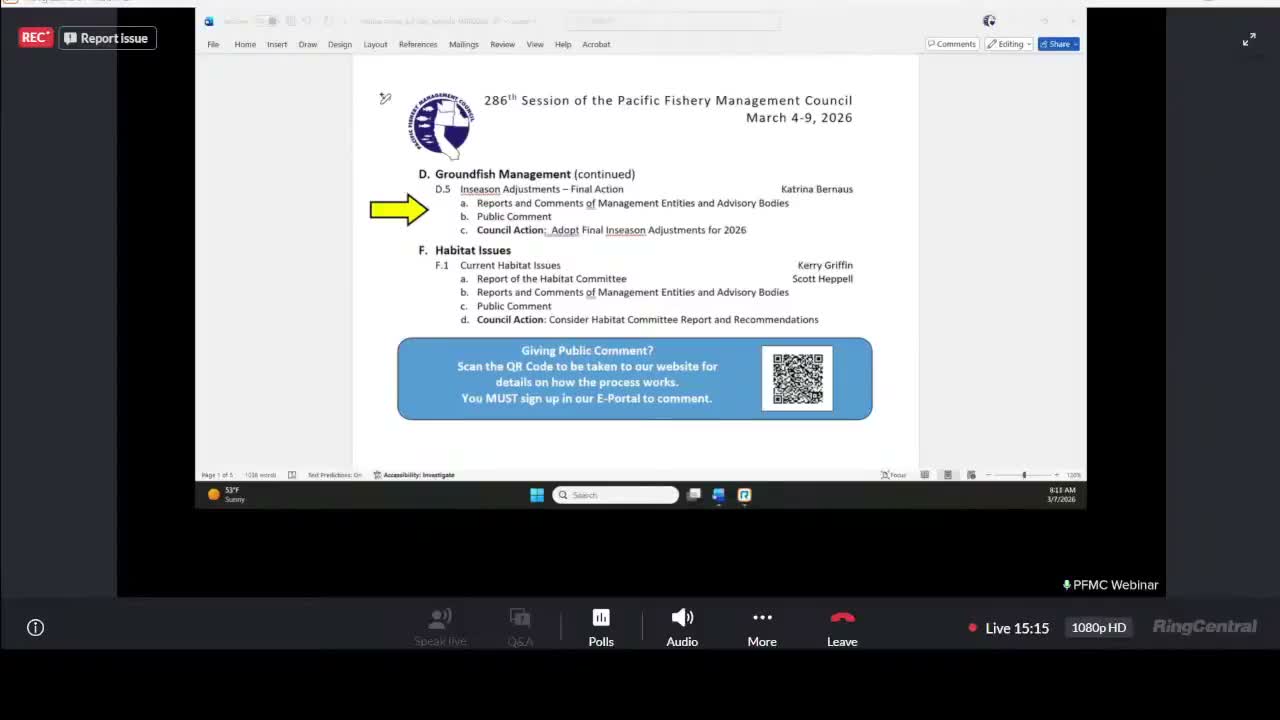
The Pacific Fishery Management Council on March 7 unanimously approved in‑season adjustments to 2026 groundfish rules that increase commercial trip limits for canary rockfish and change Oregon's recreational long‑leader limits.
Katrina Bernhouse, staff for the council, opened the item by saying the GMT's and GAP's recommendations were based on recent landings data and observer program information and intended to keep total catch at or below annual catch limits while reducing regulatory discards.
The Groundfish Management Team recommended Option 2: coastwide commercial non‑trawl trip limits of 4,000 pounds per two months for limited‑entry fixed gear and 2,000 pounds per two months for open‑access vessels, both north and south of the 40°10' N latitude line. The GMT said the change would improve access to shelf rockfish, reduce discards of canary rockfish and increase attainment of the commercial non‑trawl harvest guideline.
Oregon representatives asked the council to align federal rules with recent state rule changes, including increasing the canary sub‑bag limit in the long‑leader recreational fishery to two fish and lowering the long‑leader daily bag from 12 to 10 fish. The Groundfish Advisory Panel supported the GMT recommendations.
Council member Lynn Mattis moved adoption of the GMT/GAP package as shown in Option 2 and specifically cited the tables in the advisory reports. After a brief check that the language displayed matched the motion, the council chair called the question and the motion passed unanimously.
Why it matters: The changes are designed to reduce regulatory discards in both commercial and recreational fisheries while allowing increased access to target species. The adjustments are described by council staff as routine in‑season management to keep fisheries within ACLs.
What happens next: The council adopted the in‑season changes to be implemented for the remainder of 2026. Council staff thanked the GAP and GMT for their work on the item and closed the agenda item.
Katrina Bernhouse, staff for the council, opened the item by saying the GMT's and GAP's recommendations were based on recent landings data and observer program information and intended to keep total catch at or below annual catch limits while reducing regulatory discards.
The Groundfish Management Team recommended Option 2: coastwide commercial non‑trawl trip limits of 4,000 pounds per two months for limited‑entry fixed gear and 2,000 pounds per two months for open‑access vessels, both north and south of the 40°10' N latitude line. The GMT said the change would improve access to shelf rockfish, reduce discards of canary rockfish and increase attainment of the commercial non‑trawl harvest guideline.
Oregon representatives asked the council to align federal rules with recent state rule changes, including increasing the canary sub‑bag limit in the long‑leader recreational fishery to two fish and lowering the long‑leader daily bag from 12 to 10 fish. The Groundfish Advisory Panel supported the GMT recommendations.
Council member Lynn Mattis moved adoption of the GMT/GAP package as shown in Option 2 and specifically cited the tables in the advisory reports. After a brief check that the language displayed matched the motion, the council chair called the question and the motion passed unanimously.
Why it matters: The changes are designed to reduce regulatory discards in both commercial and recreational fisheries while allowing increased access to target species. The adjustments are described by council staff as routine in‑season management to keep fisheries within ACLs.
What happens next: The council adopted the in‑season changes to be implemented for the remainder of 2026. Council staff thanked the GAP and GMT for their work on the item and closed the agenda item.
View the Full Meeting & All Its Details
This article offers just a summary. Unlock complete video, transcripts, and insights as a Founder Member.
✓
Watch full, unedited meeting videos
✓
Search every word spoken in unlimited transcripts
✓
AI summaries & real-time alerts (all government levels)
✓
Permanent access to expanding government content
30-day money-back guarantee
