Council hears California Current ecosystem report, team warns early upwelling kept heat wave offshore
March 07, 2026 | Fishery Management Council, Pacific, Governor's Office - Boards & Commissions, Executive, Washington
This article was created by AI summarizing key points discussed. AI makes mistakes, so for full details and context, please refer to the video of the full meeting. Please report any errors so we can fix them. Report an error »
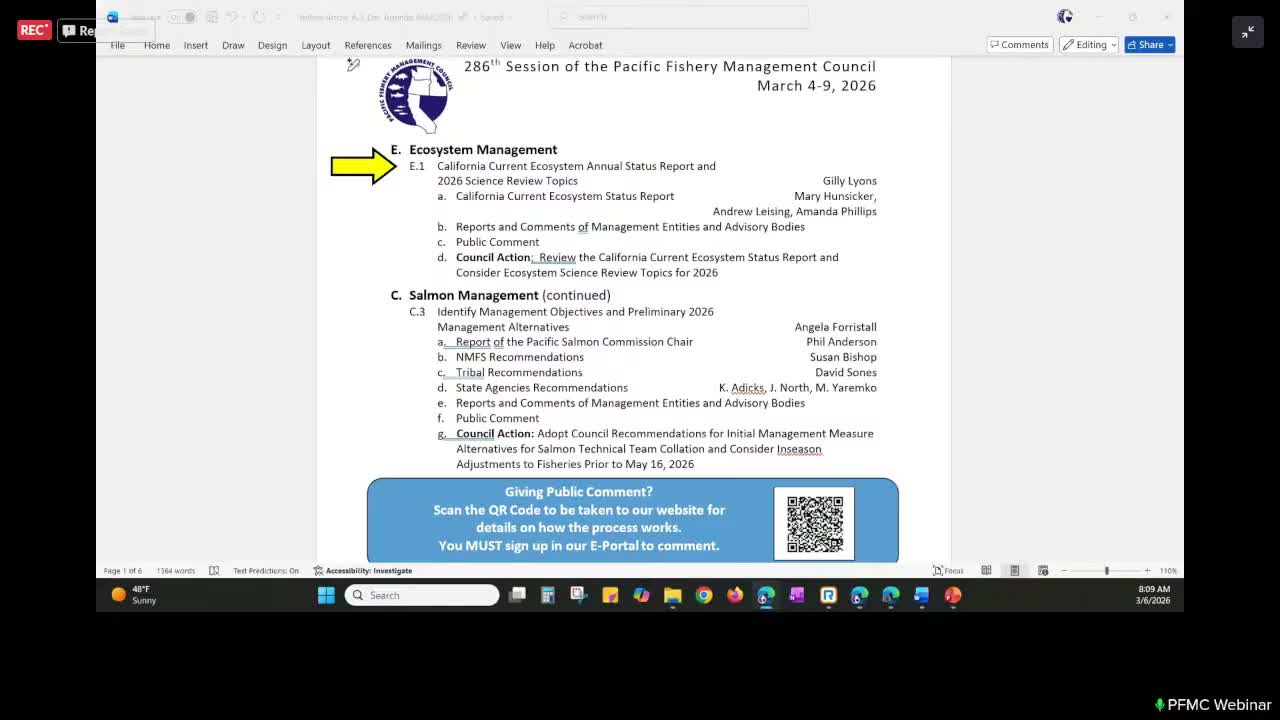
The Pacific Fishery Management Council on March 5 reviewed the California Current Integrated Ecosystem Assessment (CCIEA) team’s 2025–26 State of the Ecosystem Report, hearing scientists describe generally productive upwelling last year that helped keep a massive marine heat wave offshore but warned of lingering warm coastal temperatures and regionally severe harmful algal blooms.
CCIEA team lead Dr. Andrew Leising told the council that large‑scale climate indicators—La Niña last year and a negative Pacific Decadal Oscillation—combined with strong coastwide upwelling to support productivity. “Upwelling sort of saved the day,” Leising said, adding that a very large offshore heat wave nonetheless existed and that coastal waters remain unusually warm.
Why it matters: the report mixes encouraging biological signals—high krill and juvenile rockfish abundances noted in surveys in the northern California current and British Columbia—with acute regional problems. CCIEA presenter Mary Hunsicker noted exceptionally high pyrosome counts in central and southern California surveys and recorded domoic‑acid events in Southern California that led to marine mammal strandings and shellfish closures.
Council members pressed the scientists on how the CCIEA uses fishery and community data. Amanda Phillips, who presented human‑wellbeing indicators, said coastwide landings and revenue rose slightly in 2025 (driven by Pacific whiting and market squid) but warned that revenue concentration in groundfish was the highest on record, likely linked to processor closures in several ports. “We saw 44% more Pacific Whiting revenue relative to 2024, yet some smaller‑boat fisheries continue to lose ground,” Phillips said.
Several advisory bodies and council members pressed for stronger ties between the CCIEA and fishing communities. Oregon Department of Fish and Wildlife and the Ecosystem Workgroup urged expansion of fishermen roundtables and the retention or restoration of long‑running diet datasets (for example, highly migratory species stomach samples and sea‑lion diet analysis). The Ecosystem Advisory Subpanel and Habitat Committee both emphasized that the loss of diet data would hinder predator‑prey assessments and essential fish habitat work.
Public comment from Oceana and others echoed the advisory bodies: commenters thanked CCIEA staff for the report’s breadth but warned that staffing and funding losses—exacerbated by a federal furlough and program reductions—have created data gaps that threaten the continuity of long‑term indicators.
What’s next: the council endorsed several advisory‑body recommendations and asked staff to consider how CCIEA products (including mini‑ESRs and dashboards) can be used more directly in management settings. Scientists said short‑term forecasts and more frequent, targeted “mini” reports could be added to future ESRs to support in‑season decisions and bolster communication with advisory panels and fishing communities.
The CCIEA team will continue to refine indicators and produce outreach products; the council requested that advisory bodies and staff develop options for how short‑term forecasts and fishermen’s observations could be integrated into forthcoming council work.
Provenance: The presentation and exchanges are summarized from CCIEA presentations and council discussion beginning with the CCIEA introduction (SEG 052) and scientists’ presentations and Q&A through advisory reports and public comment (SEG 119–539 and SEG 547–735).
CCIEA team lead Dr. Andrew Leising told the council that large‑scale climate indicators—La Niña last year and a negative Pacific Decadal Oscillation—combined with strong coastwide upwelling to support productivity. “Upwelling sort of saved the day,” Leising said, adding that a very large offshore heat wave nonetheless existed and that coastal waters remain unusually warm.
Why it matters: the report mixes encouraging biological signals—high krill and juvenile rockfish abundances noted in surveys in the northern California current and British Columbia—with acute regional problems. CCIEA presenter Mary Hunsicker noted exceptionally high pyrosome counts in central and southern California surveys and recorded domoic‑acid events in Southern California that led to marine mammal strandings and shellfish closures.
Council members pressed the scientists on how the CCIEA uses fishery and community data. Amanda Phillips, who presented human‑wellbeing indicators, said coastwide landings and revenue rose slightly in 2025 (driven by Pacific whiting and market squid) but warned that revenue concentration in groundfish was the highest on record, likely linked to processor closures in several ports. “We saw 44% more Pacific Whiting revenue relative to 2024, yet some smaller‑boat fisheries continue to lose ground,” Phillips said.
Several advisory bodies and council members pressed for stronger ties between the CCIEA and fishing communities. Oregon Department of Fish and Wildlife and the Ecosystem Workgroup urged expansion of fishermen roundtables and the retention or restoration of long‑running diet datasets (for example, highly migratory species stomach samples and sea‑lion diet analysis). The Ecosystem Advisory Subpanel and Habitat Committee both emphasized that the loss of diet data would hinder predator‑prey assessments and essential fish habitat work.
Public comment from Oceana and others echoed the advisory bodies: commenters thanked CCIEA staff for the report’s breadth but warned that staffing and funding losses—exacerbated by a federal furlough and program reductions—have created data gaps that threaten the continuity of long‑term indicators.
What’s next: the council endorsed several advisory‑body recommendations and asked staff to consider how CCIEA products (including mini‑ESRs and dashboards) can be used more directly in management settings. Scientists said short‑term forecasts and more frequent, targeted “mini” reports could be added to future ESRs to support in‑season decisions and bolster communication with advisory panels and fishing communities.
The CCIEA team will continue to refine indicators and produce outreach products; the council requested that advisory bodies and staff develop options for how short‑term forecasts and fishermen’s observations could be integrated into forthcoming council work.
Provenance: The presentation and exchanges are summarized from CCIEA presentations and council discussion beginning with the CCIEA introduction (SEG 052) and scientists’ presentations and Q&A through advisory reports and public comment (SEG 119–539 and SEG 547–735).
View the Full Meeting & All Its Details
This article offers just a summary. Unlock complete video, transcripts, and insights as a Founder Member.
✓
Watch full, unedited meeting videos
✓
Search every word spoken in unlimited transcripts
✓
AI summaries & real-time alerts (all government levels)
✓
Permanent access to expanding government content
30-day money-back guarantee
