Council backs testing hookless ring terminal tackle under EFPs and asks NMFS to prioritize flexible terms
March 08, 2026 | Fishery Management Council, Pacific, Governor's Office - Boards & Commissions, Executive, Washington
This article was created by AI summarizing key points discussed. AI makes mistakes, so for full details and context, please refer to the video of the full meeting. Please report any errors so we can fix them. Report an error »
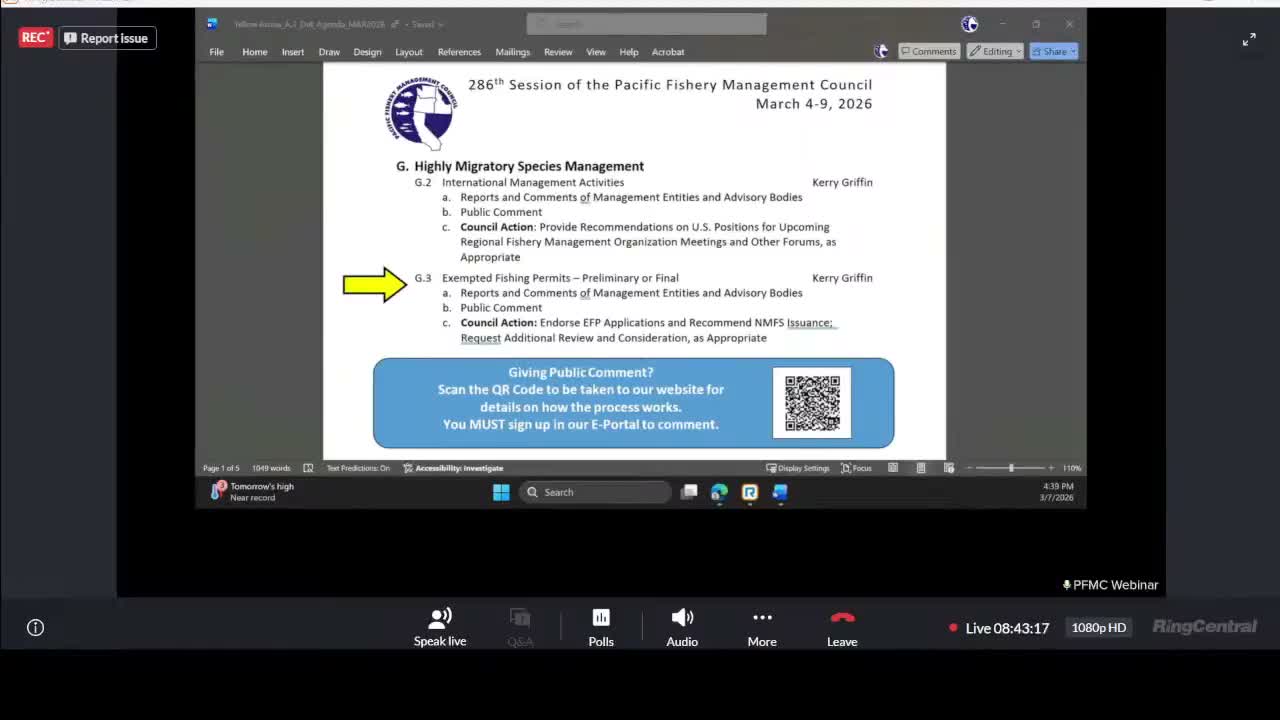
The Pacific Fishery Management Council on March 7 endorsed testing hookless ring terminal tackle under experimental fishing permits and urged NMFS/NIMS to prioritize flexibility in EFP terms for existing HMS EFPs, provided any changes remain within the environmental review'ed effort limits.
Piers Sepulveda of the Pflueger Institute presented the hookless ring gear EFP application and answered questions from council members and advisory bodies about risk, expected catch performance and the potential to reduce interactions with protected species. Management and advisory bodies reviewed literature from the Mediterranean and Japan showing ring terminal tackle can maintain swordfish catch while reducing bycatch in some settings, though catch effects vary by fishery configuration.
The council passed two related motions. The first (unanimous support) recommended NMFS proceed with approval of EFPs to test hookless ring gear and requested broad environmental analysis so the terminal tackle may be tested in varied configurations beyond the Pflueger proposal. The second motion asked NIMS to prioritize flexibility in operative terms and conditions of existing approved HMS EFPs to build on lessons learned and support continued participation, including consideration of adding vessels, so long as any flexibility fits within effort limits considered by the FEIS and prior environmental analyses.
Why it matters: Ring terminal tackle is an innovation aimed at maintaining target catch while reducing hooking of non‑target species; allowing flexible tests could speed iteration and adoption if results are promising. Council guidance emphasizes staying within analyzed effort limits to protect protected resources while enabling experimentation.
What happens next: NMFS/NIMS will evaluate the hookless ring EFP application and other related requests, and the council will be updated on findings and any changes to EFP terms.
Piers Sepulveda of the Pflueger Institute presented the hookless ring gear EFP application and answered questions from council members and advisory bodies about risk, expected catch performance and the potential to reduce interactions with protected species. Management and advisory bodies reviewed literature from the Mediterranean and Japan showing ring terminal tackle can maintain swordfish catch while reducing bycatch in some settings, though catch effects vary by fishery configuration.
The council passed two related motions. The first (unanimous support) recommended NMFS proceed with approval of EFPs to test hookless ring gear and requested broad environmental analysis so the terminal tackle may be tested in varied configurations beyond the Pflueger proposal. The second motion asked NIMS to prioritize flexibility in operative terms and conditions of existing approved HMS EFPs to build on lessons learned and support continued participation, including consideration of adding vessels, so long as any flexibility fits within effort limits considered by the FEIS and prior environmental analyses.
Why it matters: Ring terminal tackle is an innovation aimed at maintaining target catch while reducing hooking of non‑target species; allowing flexible tests could speed iteration and adoption if results are promising. Council guidance emphasizes staying within analyzed effort limits to protect protected resources while enabling experimentation.
What happens next: NMFS/NIMS will evaluate the hookless ring EFP application and other related requests, and the council will be updated on findings and any changes to EFP terms.
Don't Miss a Word: See the Full Meeting!
Go beyond summaries. Unlock every video, transcript, and key insight with a Founder Membership.
✓
Get instant access to full meeting videos
✓
Search and clip any phrase from complete transcripts
✓
Receive AI-powered summaries & custom alerts
✓
Enjoy lifetime, unrestricted access to government data
30-day money-back guarantee
