IFAD president urges co-financing and accountability to boost Africa’s rural livelihoods
March 07, 2026 | United Nations, International
This article was created by AI summarizing key points discussed. AI makes mistakes, so for full details and context, please refer to the video of the full meeting. Please report any errors so we can fix them. Report an error »
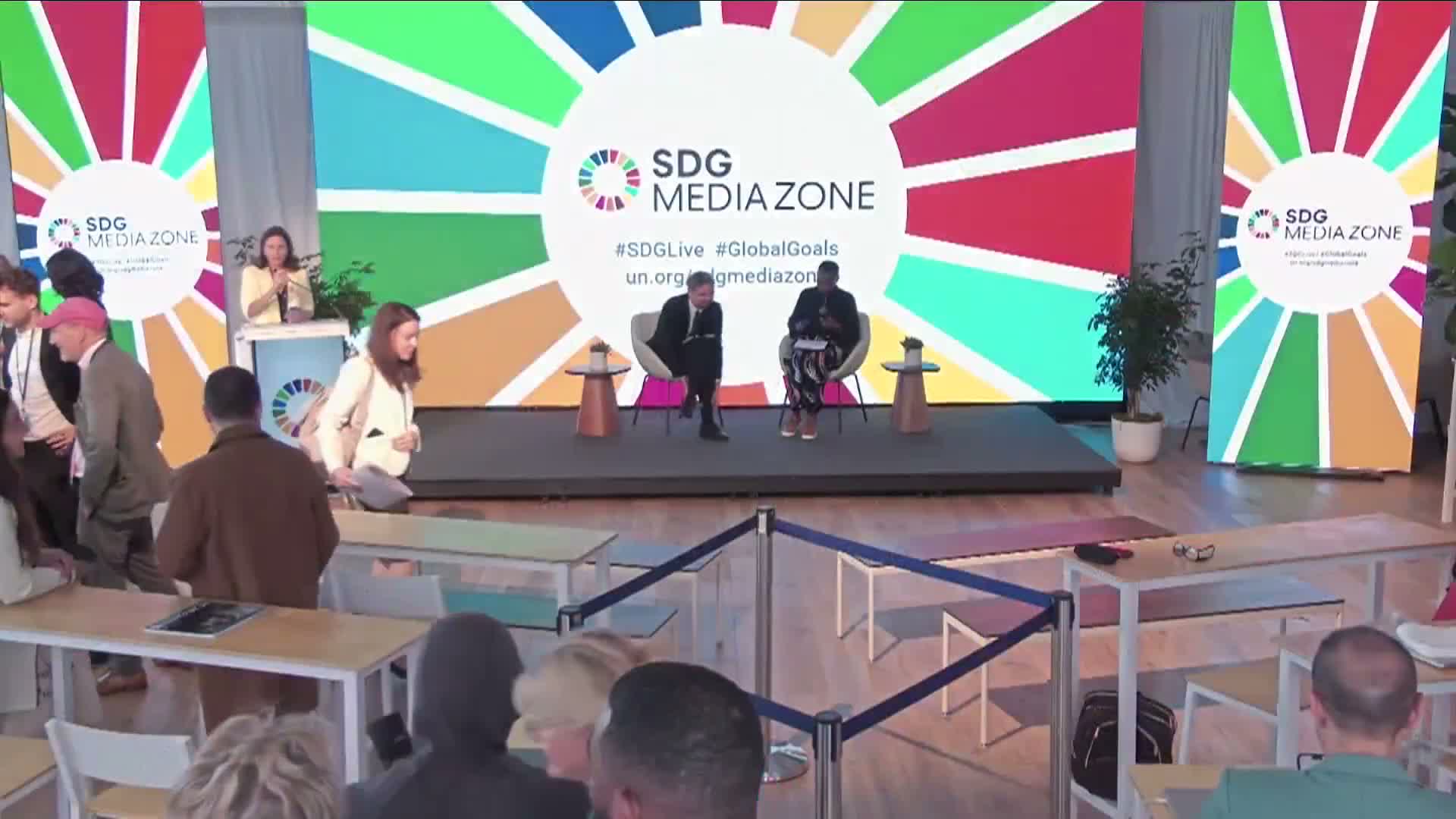
Monica Ndungu, a journalist with Nation Media Group, hosted a fireside chat at the SDG Media Zone during the United Nations General Assembly in which Alvaro, president of the International Fund for Agricultural Development (IFAD), outlined how the agency is working to turn rural agriculture into sustainable businesses and raise incomes across Africa.
Alvaro said about “80% of poverty is concentrated in rural areas,” and described IFAD’s focus on the “first mile” — investing in remote areas to create income opportunities through value addition, logistics, storage and certification rather than only primary production. “We bring finance from governments, from other multilateral financial institutions,” he said, “and we create actual opportunities of raising their income and opportunities to just, be able to stay where they are and lead a decent livelihood.”
The IFAD president argued that meeting needs will require far more than current official development assistance for agriculture, which he estimated at roughly $10 billion to $15 billion per year; he said demand for investment runs into the “hundreds of billions.” To bridge that gap, IFAD is pursuing public–private partnerships and co-investment models and aims to mobilize financing for agriculture’s early-stage value chains through 2030.
Gender equity and land rights featured prominently. Alvaro cited land-title disparities (he referenced estimates that only about 20–25% of land titles belong to women in many contexts) and described how lack of collateral constrains women’s access to credit and leadership roles in agricultural enterprises. “The moment that the women start to earn the money… it changes completely the relationship also in the families,” he said, arguing that income for women improves nutrition and education outcomes.
On technology, Alvaro warned that advanced tools such as large language models and other AI systems are limited where connectivity and reliable data are lacking. He gave a practical example of a low-cost soil-moisture sensor with green/yellow/red indicators imported from Australian research centers; when farmers observed the sensor’s signals, they adjusted water use and reduced input costs. He said IFAD seeks technologies that are “adapted, accessible, and solve a specific challenge.”
Scaling remains a core challenge: IFAD invests in agro-processing zones, rural roads and market connections to aggregate millions of smallholders so innovations can reach tens of millions. Alvaro said that in a typical three-year cycle IFAD increased incomes for about 77 million small-scale farmers, showing the potential scale of impact when interventions are aggregated effectively.
On accountability, Alvaro said IFAD measures impact using rigorous methodologies on a subset of projects (he noted 15 projects undergo complex impact measurement) so the agency can report results on production, resilience and income to donors and partner governments. The session closed with the moderator urging continued co-financing and improved impact reporting so rural communities ultimately benefit from investments.
The fireside chat ran at the SDG Media Zone during the UN General Assembly and did not include any formal votes or policy decisions; it concluded with a call for scaled financing, practical technology adoption and stronger measures to ensure women and young people benefit from rural development investments.
Alvaro said about “80% of poverty is concentrated in rural areas,” and described IFAD’s focus on the “first mile” — investing in remote areas to create income opportunities through value addition, logistics, storage and certification rather than only primary production. “We bring finance from governments, from other multilateral financial institutions,” he said, “and we create actual opportunities of raising their income and opportunities to just, be able to stay where they are and lead a decent livelihood.”
The IFAD president argued that meeting needs will require far more than current official development assistance for agriculture, which he estimated at roughly $10 billion to $15 billion per year; he said demand for investment runs into the “hundreds of billions.” To bridge that gap, IFAD is pursuing public–private partnerships and co-investment models and aims to mobilize financing for agriculture’s early-stage value chains through 2030.
Gender equity and land rights featured prominently. Alvaro cited land-title disparities (he referenced estimates that only about 20–25% of land titles belong to women in many contexts) and described how lack of collateral constrains women’s access to credit and leadership roles in agricultural enterprises. “The moment that the women start to earn the money… it changes completely the relationship also in the families,” he said, arguing that income for women improves nutrition and education outcomes.
On technology, Alvaro warned that advanced tools such as large language models and other AI systems are limited where connectivity and reliable data are lacking. He gave a practical example of a low-cost soil-moisture sensor with green/yellow/red indicators imported from Australian research centers; when farmers observed the sensor’s signals, they adjusted water use and reduced input costs. He said IFAD seeks technologies that are “adapted, accessible, and solve a specific challenge.”
Scaling remains a core challenge: IFAD invests in agro-processing zones, rural roads and market connections to aggregate millions of smallholders so innovations can reach tens of millions. Alvaro said that in a typical three-year cycle IFAD increased incomes for about 77 million small-scale farmers, showing the potential scale of impact when interventions are aggregated effectively.
On accountability, Alvaro said IFAD measures impact using rigorous methodologies on a subset of projects (he noted 15 projects undergo complex impact measurement) so the agency can report results on production, resilience and income to donors and partner governments. The session closed with the moderator urging continued co-financing and improved impact reporting so rural communities ultimately benefit from investments.
The fireside chat ran at the SDG Media Zone during the UN General Assembly and did not include any formal votes or policy decisions; it concluded with a call for scaled financing, practical technology adoption and stronger measures to ensure women and young people benefit from rural development investments.
Don't Miss a Word: See the Full Meeting!
Go beyond summaries. Unlock every video, transcript, and key insight with a Founder Membership.
✓
Get instant access to full meeting videos
✓
Search and clip any phrase from complete transcripts
✓
Receive AI-powered summaries & custom alerts
✓
Enjoy lifetime, unrestricted access to government data
30-day money-back guarantee
