ABM tells Cass County buildings could cut energy costs with solar, guaranteed savings
November 08, 2024 | Cass County, Michigan
This article was created by AI summarizing key points discussed. AI makes mistakes, so for full details and context, please refer to the video of the full meeting. Please report any errors so we can fix them. Report an error »
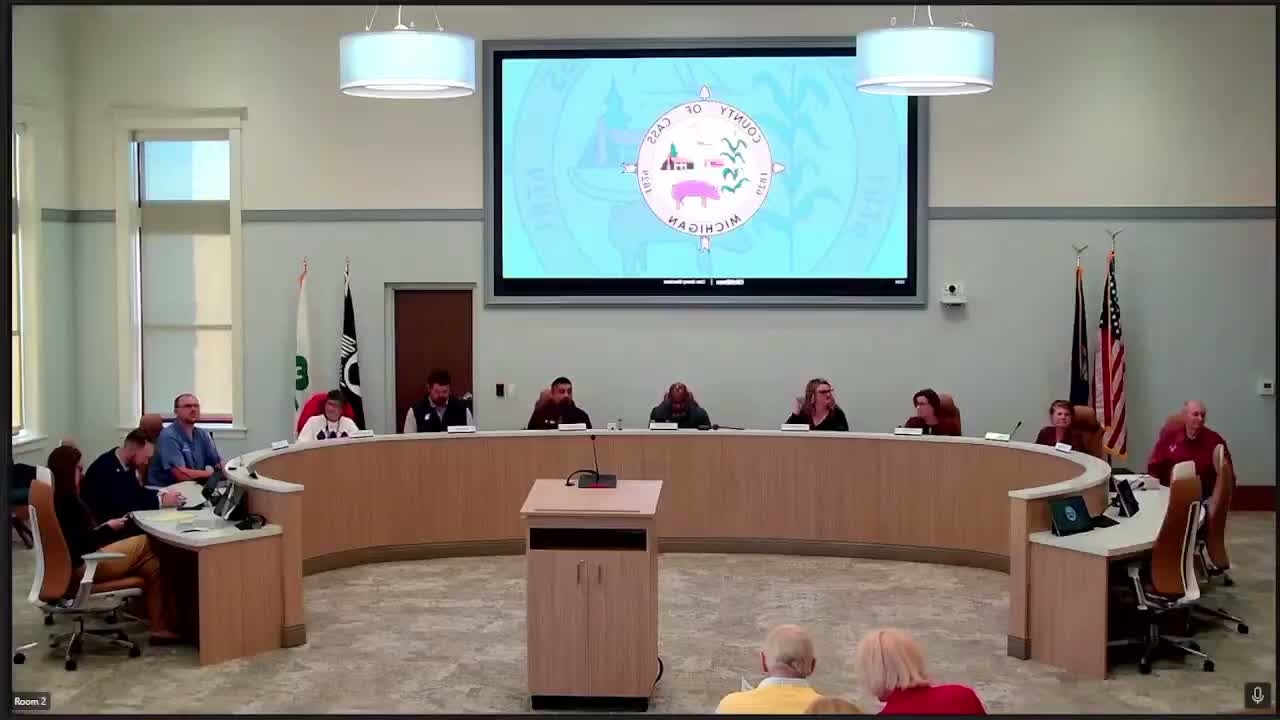
Veil Davis, an ABM Industries representative, told the Cass County Board of Commissioners that a preliminary facilities assessment of four county buildings found multiple opportunities to reduce energy use and repair aging equipment.
"We looked at HVAC, roofing, lighting improvements, building envelope and renewables," Davis said, and estimated that solar on the four buildings reviewed could offset "about 25% of utility cost." He also presented a 20-year extrapolation showing roughly $4,900,000 in capital infrastructure funds generated from energy savings and on-site generation under conservative assumptions.
Davis described ABM's typical financing approach as a "pay-from-savings" program: the county would finance upgrades and use projected energy savings to cover payments, while ABM would provide fixed pricing and a guarantee. "If we guarantee you're gonna save $100,000 a year and we save 80, we're gonna write a check to the county for $20,000," Davis said, describing the company's commitment to measure and verify annual savings.
Commissioners asked about initial funding sources and long-term responsibilities, raising concerns about battery storage disposal and who would maintain new systems. Davis said ABM usually designs solar systems without battery storage and that routine inverter replacement (typically around year 15) is accounted for in project planning. He also said the county's maintenance director would be enlisted during design and implementation and that ABM would pursue available federal incentives, including provisions of the Inflation Reduction Act.
The presentation included a feasibility plan and a proposed next step: a letter of intent and a more detailed procurement process, which would be returned to the board or a Committee of the Whole for consideration. Commissioners did not make a procurement decision at the meeting; they were asked to consider whether to direct staff to pursue a formal agreement and further analysis.
The ABM presentation emphasized cost‑avoidance from replacing aging equipment, potential revenue from EV charging (through paid parking rather than electricity fees where restricted), and guarantees to cover shortfalls if projected savings are not met.
"We looked at HVAC, roofing, lighting improvements, building envelope and renewables," Davis said, and estimated that solar on the four buildings reviewed could offset "about 25% of utility cost." He also presented a 20-year extrapolation showing roughly $4,900,000 in capital infrastructure funds generated from energy savings and on-site generation under conservative assumptions.
Davis described ABM's typical financing approach as a "pay-from-savings" program: the county would finance upgrades and use projected energy savings to cover payments, while ABM would provide fixed pricing and a guarantee. "If we guarantee you're gonna save $100,000 a year and we save 80, we're gonna write a check to the county for $20,000," Davis said, describing the company's commitment to measure and verify annual savings.
Commissioners asked about initial funding sources and long-term responsibilities, raising concerns about battery storage disposal and who would maintain new systems. Davis said ABM usually designs solar systems without battery storage and that routine inverter replacement (typically around year 15) is accounted for in project planning. He also said the county's maintenance director would be enlisted during design and implementation and that ABM would pursue available federal incentives, including provisions of the Inflation Reduction Act.
The presentation included a feasibility plan and a proposed next step: a letter of intent and a more detailed procurement process, which would be returned to the board or a Committee of the Whole for consideration. Commissioners did not make a procurement decision at the meeting; they were asked to consider whether to direct staff to pursue a formal agreement and further analysis.
The ABM presentation emphasized cost‑avoidance from replacing aging equipment, potential revenue from EV charging (through paid parking rather than electricity fees where restricted), and guarantees to cover shortfalls if projected savings are not met.
View the Full Meeting & All Its Details
This article offers just a summary. Unlock complete video, transcripts, and insights as a Founder Member.
✓
Watch full, unedited meeting videos
✓
Search every word spoken in unlimited transcripts
✓
AI summaries & real-time alerts (all government levels)
✓
Permanent access to expanding government content
30-day money-back guarantee
