Advocates urge committee to back bill expanding animal-fund flexibility and reporting
March 03, 2026 | 2026 Legislature MA, Massachusetts
This article was created by AI summarizing key points discussed. AI makes mistakes, so for full details and context, please refer to the video of the full meeting. Please report any errors so we can fix them. Report an error »
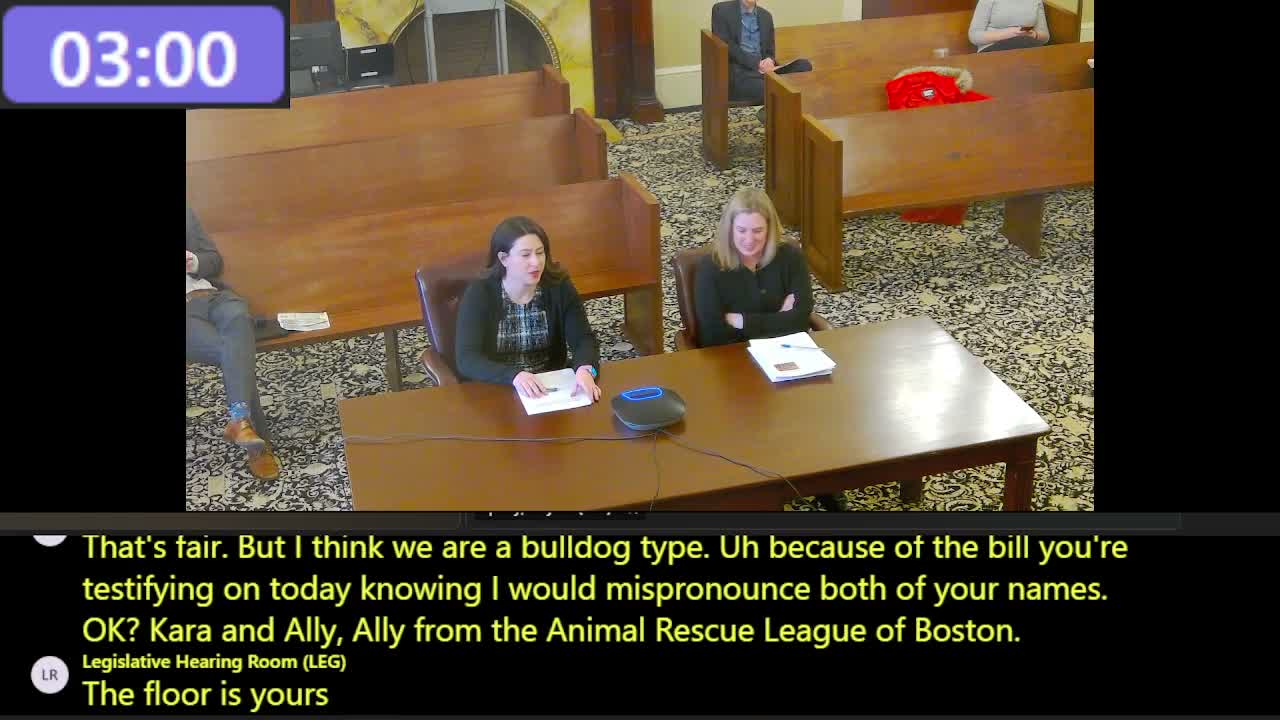
Advocates for animal welfare urged the Joint Committee on Municipalities and Regional Government to give House Bill 4849 a favorable report, saying the bill would make state animal-control laws more practical to implement and expand access to low-cost spay and neuter services.
Ali Blank, director of advocacy for the Bridal Rescue League of Boston, told the committee the bill would allow a modest pet-owner contribution (for example via a sliding scale) to the Massachusetts Animal Fund and would direct certain fines under Chapter 129 into the fund, an action she said is estimated to bring in about $40,000 per year. She said the fund, created in 2012, currently has a four-year waitlist for services and lacks sufficient resources to meet demand.
"The fund just does not have the resources," Blank said. "So this does two things: allow for a small amount of payment by pet owners and bring fines into the fund so we can help more individuals across the Commonwealth." She added that increased capacity would help keep more pets in homes and reduce municipal shelter burdens.
Kara Holmquist of the MSPCA described several technical fixes the bill would make to Chapter 140 statutes tied to recent changes known in testimony as Ollie's Law. Holmquist said the bill would permit alternative forms of identification for kenneled animals (such as microchips), noting that collar tags sometimes become trapped or are unsafe in modern commingled boarding facilities. She also said the measure would require more detailed reporting to the Massachusetts Department of Agricultural Resources (MDAR), including better tracking of kennel counts and last-inspection dates, to support enforcement and oversight.
Committee members pressed for the source behind a cited "3:1" municipal return-on-investment figure for spay/neuter programs. Holmquist said the number came from a municipal-association technical report that analyzed costs municipalities incur when animals are not spayed or neutered — including sheltering, animal-control responses, and associated care — and she offered to provide the citation to committee members.
A committee member asked whether added MDAR reporting requirements would preclude regional animal-control arrangements used by smaller communities. Holmquist said the bill would not preclude regionalization and that regional approaches have worked well for many municipalities, particularly for holding facilities.
Blank and Holmquist said MDAR has been involved in drafting and supports many provisions of the bill; Holmquist said the bill's adjustments are intended to make enforcement more achievable and reporting more informative as Ollie's Law moves from statute to practice.
No committee action or vote on the bill occurred at the hearing; proponents were asked to submit written, section-by-section testimony and citations requested by members.
Ali Blank, director of advocacy for the Bridal Rescue League of Boston, told the committee the bill would allow a modest pet-owner contribution (for example via a sliding scale) to the Massachusetts Animal Fund and would direct certain fines under Chapter 129 into the fund, an action she said is estimated to bring in about $40,000 per year. She said the fund, created in 2012, currently has a four-year waitlist for services and lacks sufficient resources to meet demand.
"The fund just does not have the resources," Blank said. "So this does two things: allow for a small amount of payment by pet owners and bring fines into the fund so we can help more individuals across the Commonwealth." She added that increased capacity would help keep more pets in homes and reduce municipal shelter burdens.
Kara Holmquist of the MSPCA described several technical fixes the bill would make to Chapter 140 statutes tied to recent changes known in testimony as Ollie's Law. Holmquist said the bill would permit alternative forms of identification for kenneled animals (such as microchips), noting that collar tags sometimes become trapped or are unsafe in modern commingled boarding facilities. She also said the measure would require more detailed reporting to the Massachusetts Department of Agricultural Resources (MDAR), including better tracking of kennel counts and last-inspection dates, to support enforcement and oversight.
Committee members pressed for the source behind a cited "3:1" municipal return-on-investment figure for spay/neuter programs. Holmquist said the number came from a municipal-association technical report that analyzed costs municipalities incur when animals are not spayed or neutered — including sheltering, animal-control responses, and associated care — and she offered to provide the citation to committee members.
A committee member asked whether added MDAR reporting requirements would preclude regional animal-control arrangements used by smaller communities. Holmquist said the bill would not preclude regionalization and that regional approaches have worked well for many municipalities, particularly for holding facilities.
Blank and Holmquist said MDAR has been involved in drafting and supports many provisions of the bill; Holmquist said the bill's adjustments are intended to make enforcement more achievable and reporting more informative as Ollie's Law moves from statute to practice.
No committee action or vote on the bill occurred at the hearing; proponents were asked to submit written, section-by-section testimony and citations requested by members.
View the Full Meeting & All Its Details
This article offers just a summary. Unlock complete video, transcripts, and insights as a Founder Member.
✓
Watch full, unedited meeting videos
✓
Search every word spoken in unlimited transcripts
✓
AI summaries & real-time alerts (all government levels)
✓
Permanent access to expanding government content
30-day money-back guarantee
