House passes bill to change contract‑pharmacy rules, reporting and limits on 340B revenues after heated debate
March 06, 2026 | Legislative Sessions, Washington
This article was created by AI summarizing key points discussed. AI makes mistakes, so for full details and context, please refer to the video of the full meeting. Please report any errors so we can fix them. Report an error »
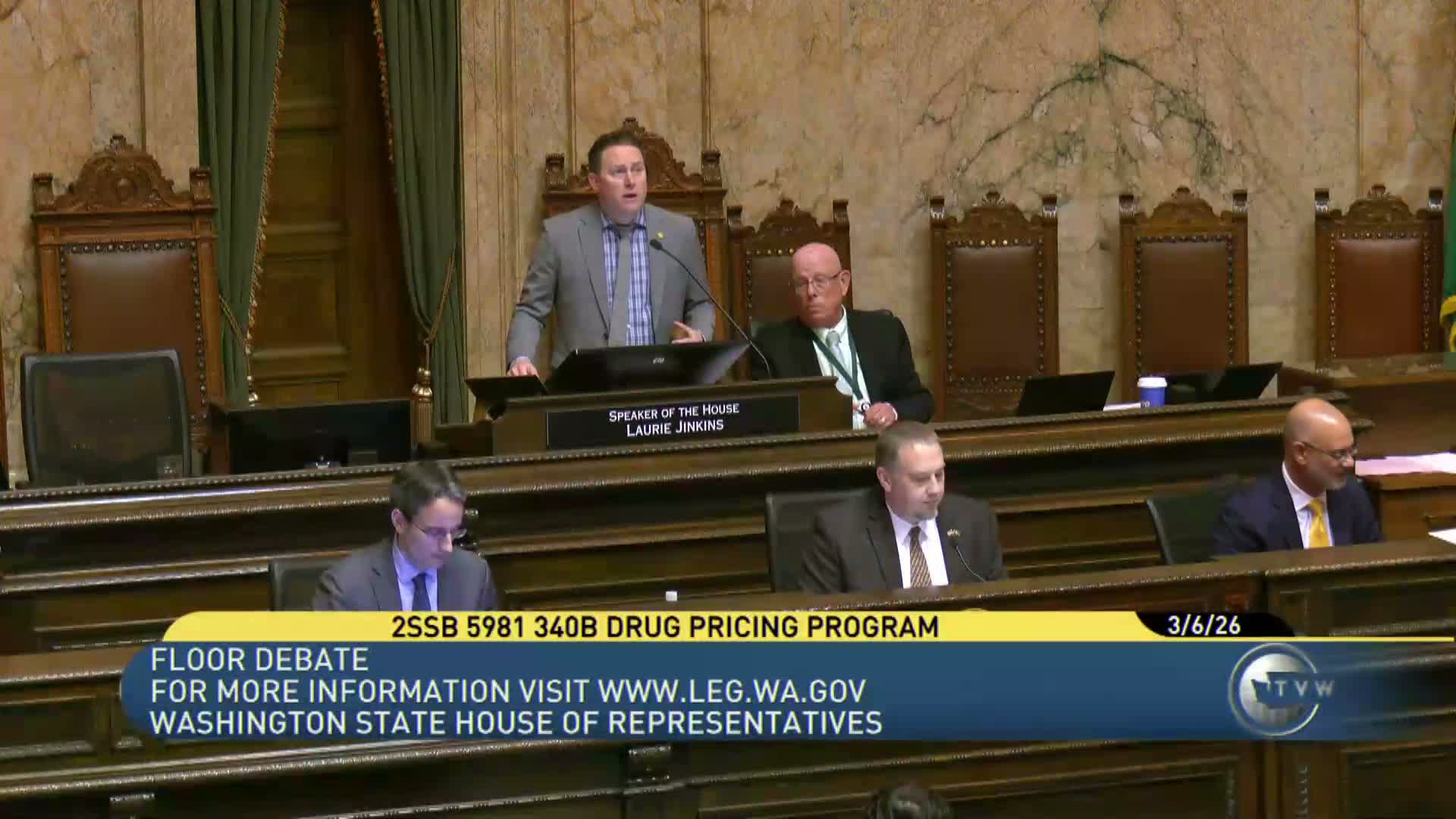
The House passed Engrossed Second Substitute Senate Bill 59 81, a bill described by sponsors as intended to protect the integrity of the federal 340B drug pricing program while opponents said it risks litigation and could fail to help rural hospitals.
Clerk: The bill was introduced and the Health Care & Wellness Committee's amendment was placed before the body. Representative Engel, sponsor of an early amendment, described the 340B expansion as a safety net for rural hospitals and federally qualified health centers (FQHCs) and supported removing fee and reporting requirements that would saddle entities unable to use program expansions. Representative Tai urged a no vote on that particular amendment, saying transparency provisions are important for lawmakers to understand support for safety‑net providers.
Multiple amendments were debated in detail. Representative Dafoe (moving amendment 2432) sought to limit program expansions to FQHCs such as Yakima Valley Farm Workers Clinic and Yakima Neighborhood Health Services to target dollars to clinics serving low‑income patients. Representative Abel proposed an "Back to Your Roots" amendment to require 80% of profits from covered entities go directly to medication cost reductions for low‑income people; opponents including Representative Bernofsky and others warned that inflexible percentages could reduce charity care and create administrative burdens. Representative Marshall proposed amendments to constrain expansion to rural and underserved areas and to require reporting or delay implementation pending federal court decisions; his proposals gained both support and opposition during floor debate.
Representative Santos highlighted Harborview Hospital's role as a regional level‑1 trauma center and reported that 340B savings enable the hospital to provide substantial uncompensated care, giving specific figures cited on the floor. Opponents warned that the bill could be subject to immediate federal litigation because the 340B program is a federal program; supporters argued transparency and reporting requirements would improve oversight.
After a long series of roll calls on amendments (many amendments were not adopted), the House adopted the Health Care & Wellness Committee amendment and advanced the bill to third reading, then voted on final passage. The clerk reported final passage: 67 yays, 30 nays, 1 excused; the presiding officer declared Engrossed Second Substitute Senate Bill 59 81 passed.
The floor record shows several substantive policy tradeoffs remained unresolved (percentages of proceeds to patients, constraints on contract pharmacies, PBM reporting, and the risk of federal legal challenge). Several members urged study or delay; others urged passage to provide immediate support to providers facing restrictions.
Clerk: The bill was introduced and the Health Care & Wellness Committee's amendment was placed before the body. Representative Engel, sponsor of an early amendment, described the 340B expansion as a safety net for rural hospitals and federally qualified health centers (FQHCs) and supported removing fee and reporting requirements that would saddle entities unable to use program expansions. Representative Tai urged a no vote on that particular amendment, saying transparency provisions are important for lawmakers to understand support for safety‑net providers.
Multiple amendments were debated in detail. Representative Dafoe (moving amendment 2432) sought to limit program expansions to FQHCs such as Yakima Valley Farm Workers Clinic and Yakima Neighborhood Health Services to target dollars to clinics serving low‑income patients. Representative Abel proposed an "Back to Your Roots" amendment to require 80% of profits from covered entities go directly to medication cost reductions for low‑income people; opponents including Representative Bernofsky and others warned that inflexible percentages could reduce charity care and create administrative burdens. Representative Marshall proposed amendments to constrain expansion to rural and underserved areas and to require reporting or delay implementation pending federal court decisions; his proposals gained both support and opposition during floor debate.
Representative Santos highlighted Harborview Hospital's role as a regional level‑1 trauma center and reported that 340B savings enable the hospital to provide substantial uncompensated care, giving specific figures cited on the floor. Opponents warned that the bill could be subject to immediate federal litigation because the 340B program is a federal program; supporters argued transparency and reporting requirements would improve oversight.
After a long series of roll calls on amendments (many amendments were not adopted), the House adopted the Health Care & Wellness Committee amendment and advanced the bill to third reading, then voted on final passage. The clerk reported final passage: 67 yays, 30 nays, 1 excused; the presiding officer declared Engrossed Second Substitute Senate Bill 59 81 passed.
The floor record shows several substantive policy tradeoffs remained unresolved (percentages of proceeds to patients, constraints on contract pharmacies, PBM reporting, and the risk of federal legal challenge). Several members urged study or delay; others urged passage to provide immediate support to providers facing restrictions.
View the Full Meeting & All Its Details
This article offers just a summary. Unlock complete video, transcripts, and insights as a Founder Member.
✓
Watch full, unedited meeting videos
✓
Search every word spoken in unlimited transcripts
✓
AI summaries & real-time alerts (all government levels)
✓
Permanent access to expanding government content
30-day money-back guarantee
