Federal loan-rule changes cited as risk to graduate and part-time students at Assembly hearing
March 03, 2026 | California State Assembly, House, Legislative, California
This article was created by AI summarizing key points discussed. AI makes mistakes, so for full details and context, please refer to the video of the full meeting. Please report any errors so we can fix them. Report an error »
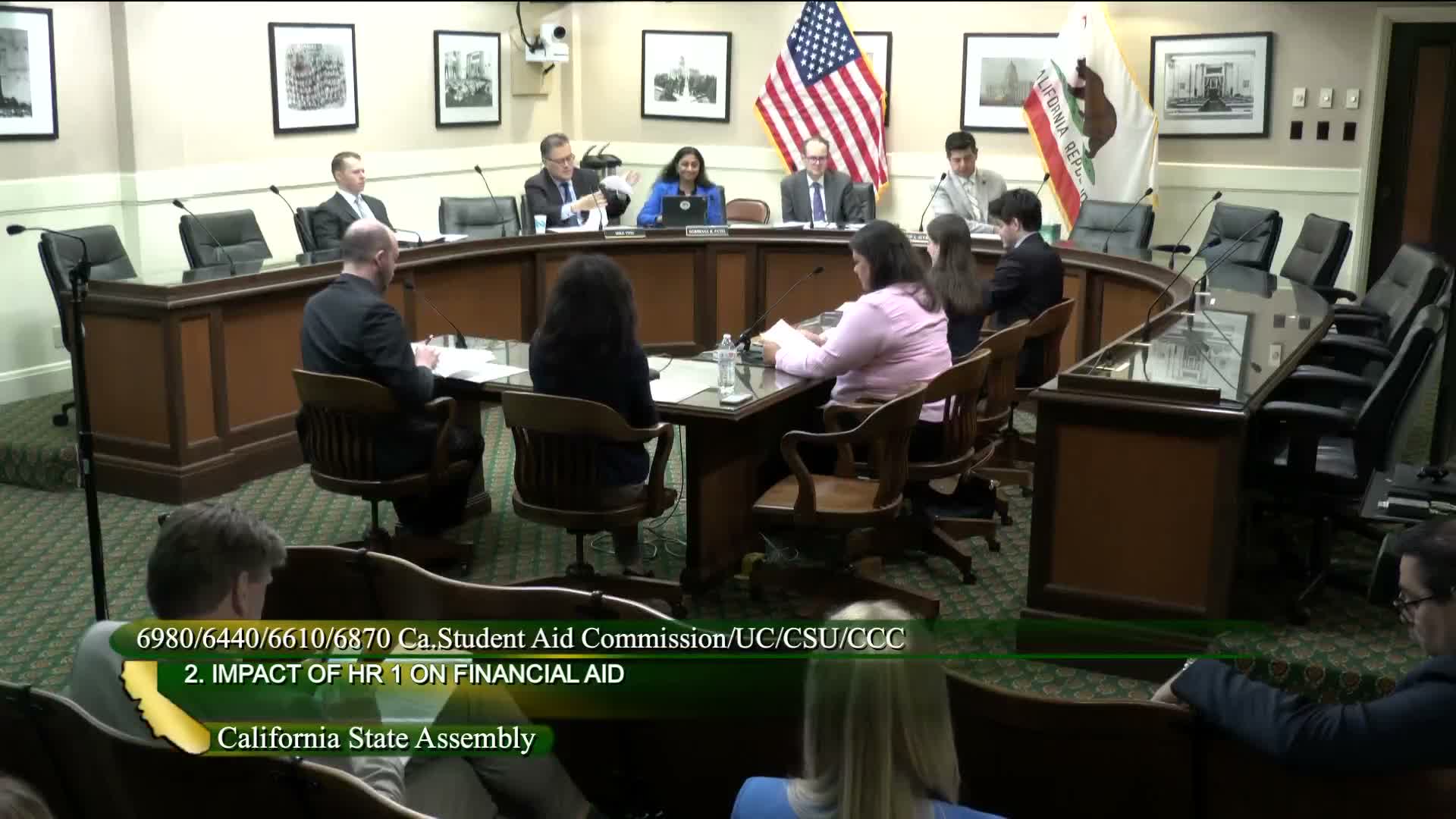
Legislators heard testimony that recent and proposed federal changes to student lending could reduce borrowing options for graduate and part-time students and could have downstream effects on workforce pipelines.
Natalie Gonzalez of the Legislative Analyst's Office summarized the federal actions included in HR1: annual and lifetime caps on Parent PLUS loans, elimination of Grad PLUS loans, and changes to Pell eligibility plus a new "workforce Pell" for short-term programs. "Some borrowers will now have to turn to the private market," she said, warning that lower-income borrowers could face higher interest rates or difficulty accessing private credit.
California State University officials said the loss of Grad PLUS borrowing would particularly affect graduate students in high-cost professional programs. CSU reported that in 2024-25 about 2,600 students borrowed roughly $38 million in Grad PLUS loans; those borrowers would lose that eligibility if the program sunsets. CSU also flagged a potential $97 million annual reduction in federal direct loans for part-time borrowers if loan amounts become prorated by enrollment intensity.
A University of California official described similar graduate-level risks and provided system estimates that thousands of graduate borrowers could be affected and that gaps in loan eligibility could total tens of millions of dollars under the new limits. "The University does not have the funds to backfill for this lost graduate loan eligibility," the UC witness said.
Community college representatives emphasized that far fewer of their students borrow federal loans, but they are tracking the new workforce Pell rules as a potential opportunity to expand short-term upskilling for some students.
Committee members asked whether segments have seen application declines tied to anticipated loan caps; UC and CSU said they have not observed a measurable drop yet but will monitor fall enrollment and applicant behavior. Lawmakers asked segments for more detailed breakdowns of which graduate fields and programs would be most affected by eliminated Grad PLUS eligibility.
The subcommittee held the issue open and asked staff and segments for follow-up data on affected borrowers and program-level impacts.
Natalie Gonzalez of the Legislative Analyst's Office summarized the federal actions included in HR1: annual and lifetime caps on Parent PLUS loans, elimination of Grad PLUS loans, and changes to Pell eligibility plus a new "workforce Pell" for short-term programs. "Some borrowers will now have to turn to the private market," she said, warning that lower-income borrowers could face higher interest rates or difficulty accessing private credit.
California State University officials said the loss of Grad PLUS borrowing would particularly affect graduate students in high-cost professional programs. CSU reported that in 2024-25 about 2,600 students borrowed roughly $38 million in Grad PLUS loans; those borrowers would lose that eligibility if the program sunsets. CSU also flagged a potential $97 million annual reduction in federal direct loans for part-time borrowers if loan amounts become prorated by enrollment intensity.
A University of California official described similar graduate-level risks and provided system estimates that thousands of graduate borrowers could be affected and that gaps in loan eligibility could total tens of millions of dollars under the new limits. "The University does not have the funds to backfill for this lost graduate loan eligibility," the UC witness said.
Community college representatives emphasized that far fewer of their students borrow federal loans, but they are tracking the new workforce Pell rules as a potential opportunity to expand short-term upskilling for some students.
Committee members asked whether segments have seen application declines tied to anticipated loan caps; UC and CSU said they have not observed a measurable drop yet but will monitor fall enrollment and applicant behavior. Lawmakers asked segments for more detailed breakdowns of which graduate fields and programs would be most affected by eliminated Grad PLUS eligibility.
The subcommittee held the issue open and asked staff and segments for follow-up data on affected borrowers and program-level impacts.
Don't Miss a Word: See the Full Meeting!
Go beyond summaries. Unlock every video, transcript, and key insight with a Founder Membership.
✓
Get instant access to full meeting videos
✓
Search and clip any phrase from complete transcripts
✓
Receive AI-powered summaries & custom alerts
✓
Enjoy lifetime, unrestricted access to government data
30-day money-back guarantee
