Senate committee presses CPUC on runaway wildfire costs, utility returns and affordability
March 03, 2026 | California State Senate, Senate, Legislative, California
This article was created by AI summarizing key points discussed. AI makes mistakes, so for full details and context, please refer to the video of the full meeting. Please report any errors so we can fix them. Report an error »
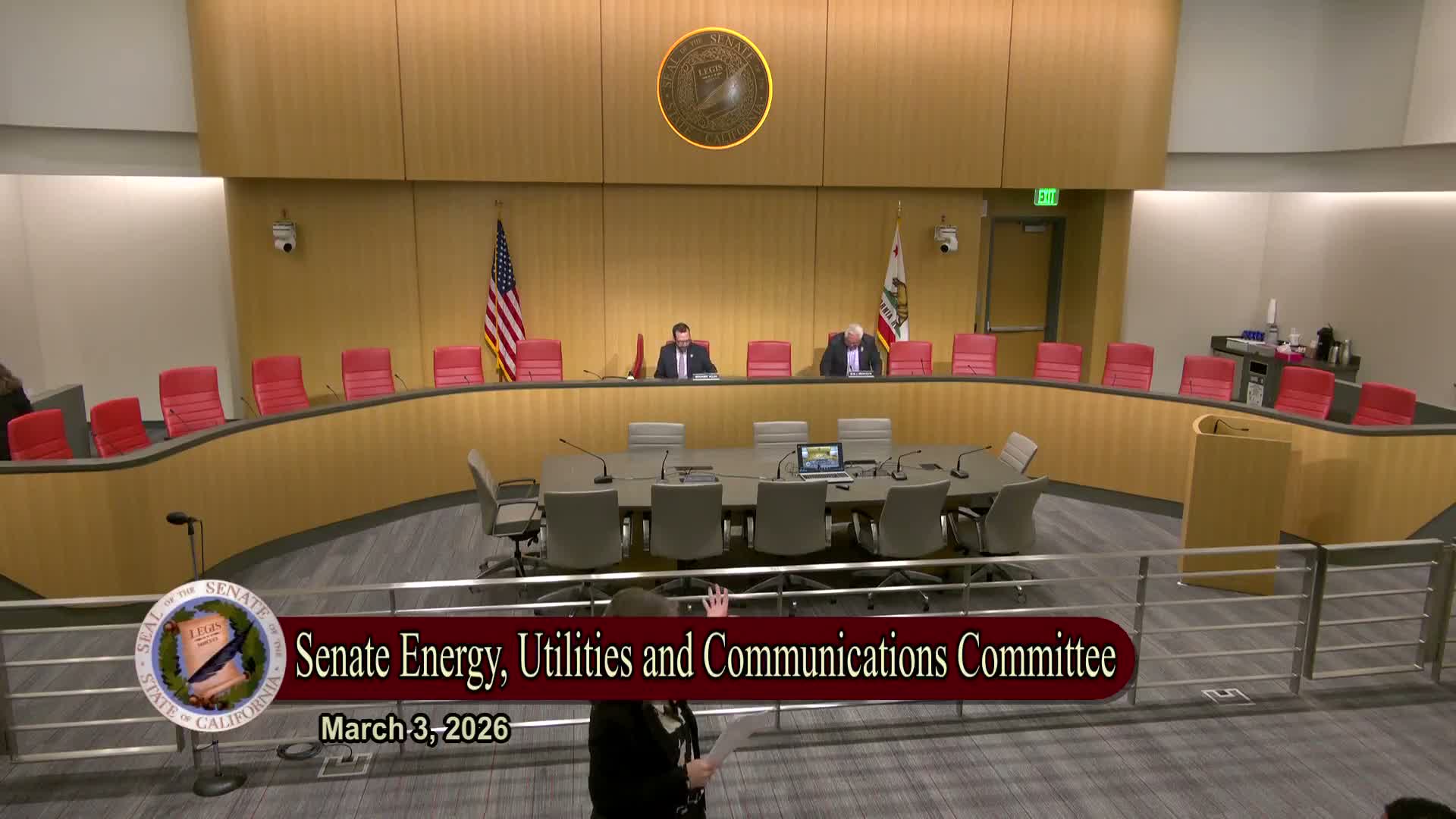
Chair Allen convened the California State Senate Committee on Energy, Utilities and Communications in Sacramento to examine the California Public Utilities Commission’s oversight of investor‑owned utilities and what is driving recent increases in household electric bills.
Professor Severin Borenstein, invited as a primer witness, told the committee that the core regulatory tradeoffs are efficiency, incentives and information asymmetry. "There is no silver bullet solution," Borenstein said, explaining that regulators must balance service quality against cost and that high allowed returns on equity can encourage utilities to favor capital‑intensive fixes. He calculated that a hypothetical 3‑percentage‑point cut in the allowed return on equity would reduce the three major utilities’ combined revenue requirement by about $1,000,000,000 a year, while noting that a move that large would be "a huge decline." (Professor Severin Borenstein)
President‑designee Reynolds, testifying for the California Public Utilities Commission, gave an agency overview and agreed that wildfire liabilities and mitigation have been major cost drivers. He said the CPUC is implementing recent legislative direction, including provisions of SB 254 that enable securitization of up to $6,000,000,000 in wildfire mitigation capital to reduce ratepayer costs. "We are looking to rapidly implement that legislation," Reynolds said, and described ongoing reforms to strengthen front‑end scrutiny and post‑spend accountability.
Linda Serrazzella, director of the CPUC Public Advocates Office, told the committee her office participated in roughly 160 proceedings in 2025 and pushed for lower company requests in general rate cases. She framed affordability as a multiyear challenge and set out four policy levers: return capital spending to the general rate case where practical, pursue lower‑cost financing, phase out ratepayer funding for programs whose costs exceed benefits, and modernize rate design so costs are allocated more equitably. "Concrete durable solutions that bend the cost curve down over the long term will determine sustained rate and bill relief," Serrazzella said. (Linda Serrazzella)
Committee members pressed both witnesses on several recurring points: whether price caps or strict performance‑based regulation can ensure affordability without undermining reliability; how the CPUC should account for wildfire risk when setting allowed returns on equity; whether the proliferation of balancing and memo accounts has shifted costs onto ratepayers without adequate scrutiny; and how load growth, interconnection reform and electrification planning affect future cost trajectories.
On the data: witnesses offered figures that lawmakers flagged repeatedly. Borenstein noted the three investor‑owned utilities together carry an annual revenue requirement in the range of roughly $60–$70 billion; the CPUC and the Public Advocates Office highlighted roughly $27,000,000,000 in authorized wildfire mitigation collections and about $14,000,000,000 for wildfire insurance and catastrophic costs — roughly $40,000,000,000 in total wildfire‑related costs authorized in recent years. Serrazzella added that more than $2,000,000,000 in wildfire‑related costs were already incurred but not yet proposed into rates in filings the CPUC was tracking. Committee members also cited a 2022 auditor figure of about $16,800,000,000 in accumulated balancing accounts as a transparency and accountability concern.
Reynolds and Serrazzella both described procedural tools the CPUC now uses — more robust risk assessments ahead of general rate cases, targeted proceedings, and evidence‑based, litigated cost‑of‑capital analyses — and committed to follow up with committee staff on specific data requests. Reynolds said the CPUC reduced authorized return on equity by 30 basis points in its most recent decision and is continuing to evaluate cost‑of‑capital issues against California’s unique wildfire liability regime.
The hearing concluded with the committee asking the CPUC and the Public Advocates Office for documents and follow‑up briefings on several topics, including a CPUC report requested by lawmakers on drivers of recent bill increases, implementation timelines for SB 254 securitization, and additional detail about balancing account totals and staffing for CPUC functions.
The committee scheduled additional oversight as the policy conversation continues; no formal votes were taken during this hearing.
Professor Severin Borenstein, invited as a primer witness, told the committee that the core regulatory tradeoffs are efficiency, incentives and information asymmetry. "There is no silver bullet solution," Borenstein said, explaining that regulators must balance service quality against cost and that high allowed returns on equity can encourage utilities to favor capital‑intensive fixes. He calculated that a hypothetical 3‑percentage‑point cut in the allowed return on equity would reduce the three major utilities’ combined revenue requirement by about $1,000,000,000 a year, while noting that a move that large would be "a huge decline." (Professor Severin Borenstein)
President‑designee Reynolds, testifying for the California Public Utilities Commission, gave an agency overview and agreed that wildfire liabilities and mitigation have been major cost drivers. He said the CPUC is implementing recent legislative direction, including provisions of SB 254 that enable securitization of up to $6,000,000,000 in wildfire mitigation capital to reduce ratepayer costs. "We are looking to rapidly implement that legislation," Reynolds said, and described ongoing reforms to strengthen front‑end scrutiny and post‑spend accountability.
Linda Serrazzella, director of the CPUC Public Advocates Office, told the committee her office participated in roughly 160 proceedings in 2025 and pushed for lower company requests in general rate cases. She framed affordability as a multiyear challenge and set out four policy levers: return capital spending to the general rate case where practical, pursue lower‑cost financing, phase out ratepayer funding for programs whose costs exceed benefits, and modernize rate design so costs are allocated more equitably. "Concrete durable solutions that bend the cost curve down over the long term will determine sustained rate and bill relief," Serrazzella said. (Linda Serrazzella)
Committee members pressed both witnesses on several recurring points: whether price caps or strict performance‑based regulation can ensure affordability without undermining reliability; how the CPUC should account for wildfire risk when setting allowed returns on equity; whether the proliferation of balancing and memo accounts has shifted costs onto ratepayers without adequate scrutiny; and how load growth, interconnection reform and electrification planning affect future cost trajectories.
On the data: witnesses offered figures that lawmakers flagged repeatedly. Borenstein noted the three investor‑owned utilities together carry an annual revenue requirement in the range of roughly $60–$70 billion; the CPUC and the Public Advocates Office highlighted roughly $27,000,000,000 in authorized wildfire mitigation collections and about $14,000,000,000 for wildfire insurance and catastrophic costs — roughly $40,000,000,000 in total wildfire‑related costs authorized in recent years. Serrazzella added that more than $2,000,000,000 in wildfire‑related costs were already incurred but not yet proposed into rates in filings the CPUC was tracking. Committee members also cited a 2022 auditor figure of about $16,800,000,000 in accumulated balancing accounts as a transparency and accountability concern.
Reynolds and Serrazzella both described procedural tools the CPUC now uses — more robust risk assessments ahead of general rate cases, targeted proceedings, and evidence‑based, litigated cost‑of‑capital analyses — and committed to follow up with committee staff on specific data requests. Reynolds said the CPUC reduced authorized return on equity by 30 basis points in its most recent decision and is continuing to evaluate cost‑of‑capital issues against California’s unique wildfire liability regime.
The hearing concluded with the committee asking the CPUC and the Public Advocates Office for documents and follow‑up briefings on several topics, including a CPUC report requested by lawmakers on drivers of recent bill increases, implementation timelines for SB 254 securitization, and additional detail about balancing account totals and staffing for CPUC functions.
The committee scheduled additional oversight as the policy conversation continues; no formal votes were taken during this hearing.
Don't Miss a Word: See the Full Meeting!
Go beyond summaries. Unlock every video, transcript, and key insight with a Founder Membership.
✓
Get instant access to full meeting videos
✓
Search and clip any phrase from complete transcripts
✓
Receive AI-powered summaries & custom alerts
✓
Enjoy lifetime, unrestricted access to government data
30-day money-back guarantee
