Council holds first reading of amplified-sound ordinance after heated debate over hours and enforcement
March 02, 2026 | City of Lake Jackson, Brazoria County, Texas
This article was created by AI summarizing key points discussed. AI makes mistakes, so for full details and context, please refer to the video of the full meeting. Please report any errors so we can fix them. Report an error »
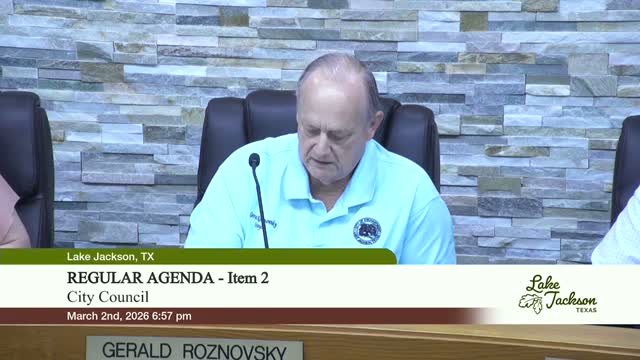
Lake Jackson’s City Council conducted a lengthy first reading March 2 of a proposed ordinance amending Chapter 62 of the city code to prohibit amplified sound from emanating beyond property lines beginning at 10 p.m. Sunday through Thursday and 11 p.m. Friday and Saturday, and to set decibel limits at other times.
Staff and police representatives framed the measure as a targeted tool to address repeated neighborhood complaints about late-night amplified music from a small number of downtown businesses. “This gives PD the tools then to pursue the bad actors,” a council member said, describing the policy as a way to avoid requiring neighbors to file repeated complaints.
Business owners and live-music promoters urged the council to narrow or revise time limits so the city would not unduly penalize responsible venues. Richard Wood, owner of Worst House restaurant, said he has provided downtown live music for more than 15 years and urged enforcement focused on problem actors rather than blanket curfews. “I’m all for some kind of noise ordinance,” Wood said, “but what I’m against is targeting businesses as opposed to making it apply to all citizens.”
A local sound engineer, Mitch Jacobs, urged the council to consider how sound travels and to use decibel metrics carefully. Staff clarified the draft uses state-guideline hours and decibel levels (the ordinance references 70–75 decibels at property lines as benchmarks) and noted the city can require permits only under the state framework when guidelines are exceeded.
Council members debated whether the hour restrictions would weaken enforcement or are needed to provide police with a clear standard. Police leadership said the ordinance would allow officers to use meters during proactive patrols rather than wait for multiple citizen complaints; officers also described prior incidents that led to arrests and that previous measures had not fully resolved recurrences.
Council approved the ordinance on first reading and scheduled a second reading at a future meeting, leaving room for adjustments to hours, decibel thresholds or permit language before final adoption.
Staff and police representatives framed the measure as a targeted tool to address repeated neighborhood complaints about late-night amplified music from a small number of downtown businesses. “This gives PD the tools then to pursue the bad actors,” a council member said, describing the policy as a way to avoid requiring neighbors to file repeated complaints.
Business owners and live-music promoters urged the council to narrow or revise time limits so the city would not unduly penalize responsible venues. Richard Wood, owner of Worst House restaurant, said he has provided downtown live music for more than 15 years and urged enforcement focused on problem actors rather than blanket curfews. “I’m all for some kind of noise ordinance,” Wood said, “but what I’m against is targeting businesses as opposed to making it apply to all citizens.”
A local sound engineer, Mitch Jacobs, urged the council to consider how sound travels and to use decibel metrics carefully. Staff clarified the draft uses state-guideline hours and decibel levels (the ordinance references 70–75 decibels at property lines as benchmarks) and noted the city can require permits only under the state framework when guidelines are exceeded.
Council members debated whether the hour restrictions would weaken enforcement or are needed to provide police with a clear standard. Police leadership said the ordinance would allow officers to use meters during proactive patrols rather than wait for multiple citizen complaints; officers also described prior incidents that led to arrests and that previous measures had not fully resolved recurrences.
Council approved the ordinance on first reading and scheduled a second reading at a future meeting, leaving room for adjustments to hours, decibel thresholds or permit language before final adoption.
View the Full Meeting & All Its Details
This article offers just a summary. Unlock complete video, transcripts, and insights as a Founder Member.
✓
Watch full, unedited meeting videos
✓
Search every word spoken in unlimited transcripts
✓
AI summaries & real-time alerts (all government levels)
✓
Permanent access to expanding government content
30-day money-back guarantee
