House approves expedited permitting for Sound Transit after rejecting owner‑consent, seismic and setback amendments
March 04, 2026 | Legislative Sessions, Washington
This article was created by AI summarizing key points discussed. AI makes mistakes, so for full details and context, please refer to the video of the full meeting. Please report any errors so we can fix them. Report an error »
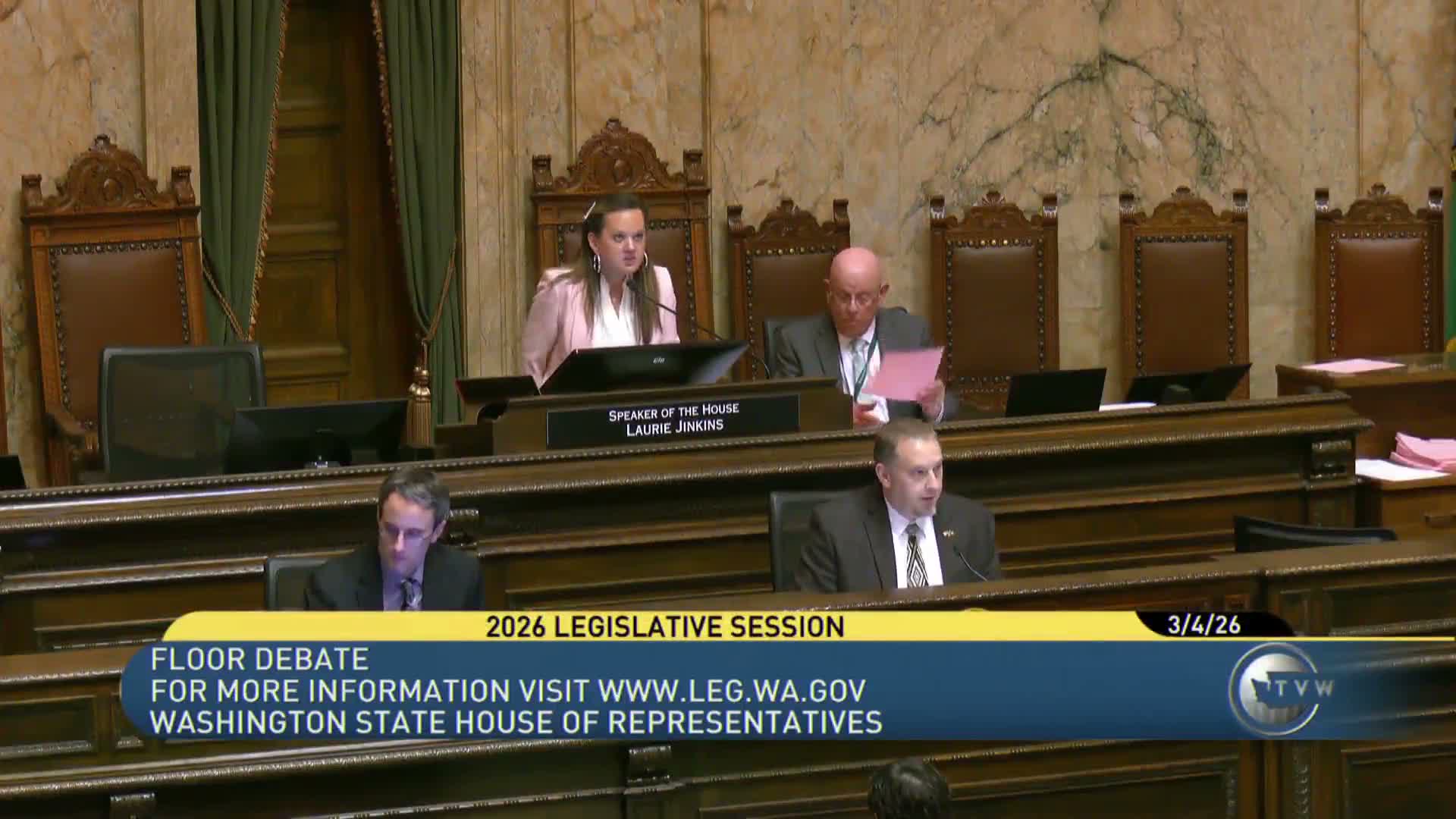
The Washington State House approved Substitute Senate Bill 6309, a measure to streamline municipal permitting tools for high‑capacity transit projects, after rejecting several floor amendments that would have imposed written‑consent requirements for abutting property owners and required compliance with specific critical‑area and seismic protections.
Representative Griffey moved Amendment 2193, which would have required Sound Transit to obtain written consent from abutting property owners if the bill’s design standards would overlook ordinary drip‑line setback rules. Griffey said the amendment protects “the little guy” from a large regional authority and argued property owners should not be bypassed. Representative Connors and others supported amendments (including 2334) that sought to preserve compliance with steep‑slope, seismic, landslide and liquefaction rules, saying life‑safety protections must not be waived.
Opponents — including members who emphasized regional project delivery and the cost of permit delays — argued the proposed written‑consent requirement and some critical‑area language would give individual property owners veto power over large projects and could create impractical obstacles to completing voter‑approved regional transit work. Representative Jacobson warned that letting a large agency ignore setbacks could amount to a taking; Representative Penner, among critics, said an agency that can write its own rules risks public safety.
The Speaker ruled on several points of order that some amendments were beyond the title of the bill; committee amendments were adopted and the bill was advanced. On third reading the House recorded 56 yays, 38 nays and 4 excused; the Speaker declared Substitute Senate Bill 6309 passed as amended by the House.
Supporters framed the legislation as a cost‑saving streamlining effort that would help complete a multidecade, $54 billion regional transit plan voters approved in 2016, while critics argued it disproportionately empowers a large regional agency to vary standards and could undercut local environmental and safety rules. The transcript records no administrative implementation detail beyond the floor actions recorded.
Representative Griffey moved Amendment 2193, which would have required Sound Transit to obtain written consent from abutting property owners if the bill’s design standards would overlook ordinary drip‑line setback rules. Griffey said the amendment protects “the little guy” from a large regional authority and argued property owners should not be bypassed. Representative Connors and others supported amendments (including 2334) that sought to preserve compliance with steep‑slope, seismic, landslide and liquefaction rules, saying life‑safety protections must not be waived.
Opponents — including members who emphasized regional project delivery and the cost of permit delays — argued the proposed written‑consent requirement and some critical‑area language would give individual property owners veto power over large projects and could create impractical obstacles to completing voter‑approved regional transit work. Representative Jacobson warned that letting a large agency ignore setbacks could amount to a taking; Representative Penner, among critics, said an agency that can write its own rules risks public safety.
The Speaker ruled on several points of order that some amendments were beyond the title of the bill; committee amendments were adopted and the bill was advanced. On third reading the House recorded 56 yays, 38 nays and 4 excused; the Speaker declared Substitute Senate Bill 6309 passed as amended by the House.
Supporters framed the legislation as a cost‑saving streamlining effort that would help complete a multidecade, $54 billion regional transit plan voters approved in 2016, while critics argued it disproportionately empowers a large regional agency to vary standards and could undercut local environmental and safety rules. The transcript records no administrative implementation detail beyond the floor actions recorded.
Don't Miss a Word: See the Full Meeting!
Go beyond summaries. Unlock every video, transcript, and key insight with a Founder Membership.
✓
Get instant access to full meeting videos
✓
Search and clip any phrase from complete transcripts
✓
Receive AI-powered summaries & custom alerts
✓
Enjoy lifetime, unrestricted access to government data
30-day money-back guarantee
