Panel advances bill tightening rules for private-equity-owned nursing homes after debate
March 06, 2026 | Aging, House of Representatives, Committees, Legislative, Connecticut
This article was created by AI summarizing key points discussed. AI makes mistakes, so for full details and context, please refer to the video of the full meeting. Please report any errors so we can fix them. Report an error »
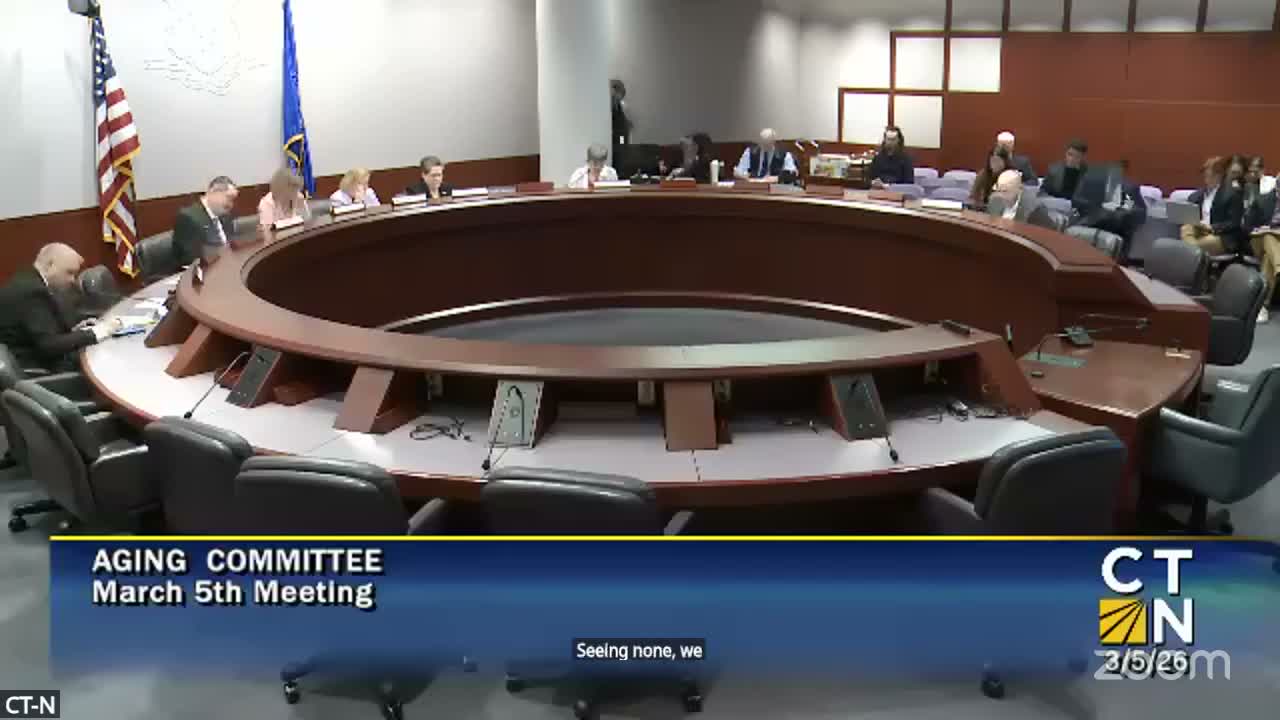
A legislative committee on aging voted to advance SB 125, a bill that would tighten oversight of nursing-home ownership and require operators to provide timely data to the Department of Social Services and demonstrate a performance bond equal to 90 days of operating costs at application or renewal.
Supporters said the measure is aimed at preventing abrupt failures by some private-equity owners that leave the state or families responsible for unpaid liabilities. "We have seen so many private equities that just collapse and the state is left holding the monies owed," the chair said during debate, describing the bill's purpose. Representative Fortier, who supported the bill, said the rules would apply broadly and could help identify best practices across owners.
Opponents and cautious members warned that not all private owners are bad actors and that some facilities need capital investment. Representative Case said facilities in his district need rebuilding and warned that overly restrictive rules could aggravate closure risks: "If we block this all out ... we have to be careful what we do," he said, adding he would vote against the measure on that principle.
Other members pressed for a balanced approach. Representative Repulinski pointed to past private-equity transactions—singling out Prospect as an example of problematic behavior—and said enforcement and a fair scoring formula for acquisitions were needed to distinguish responsible buyers from those that over-lever transactions.
The clerk called a roll-call vote. Several members voted in the affirmative; Representative Case recorded a no vote. The clerk concluded the roll call and noted votes would be held open per committee practice.
What happens next: SB 125 will go to the floor for further consideration. The committee discussion made clear members intend continuing work on enforcement details and the scoring/formula used to vet ownership changes.
Supporters said the measure is aimed at preventing abrupt failures by some private-equity owners that leave the state or families responsible for unpaid liabilities. "We have seen so many private equities that just collapse and the state is left holding the monies owed," the chair said during debate, describing the bill's purpose. Representative Fortier, who supported the bill, said the rules would apply broadly and could help identify best practices across owners.
Opponents and cautious members warned that not all private owners are bad actors and that some facilities need capital investment. Representative Case said facilities in his district need rebuilding and warned that overly restrictive rules could aggravate closure risks: "If we block this all out ... we have to be careful what we do," he said, adding he would vote against the measure on that principle.
Other members pressed for a balanced approach. Representative Repulinski pointed to past private-equity transactions—singling out Prospect as an example of problematic behavior—and said enforcement and a fair scoring formula for acquisitions were needed to distinguish responsible buyers from those that over-lever transactions.
The clerk called a roll-call vote. Several members voted in the affirmative; Representative Case recorded a no vote. The clerk concluded the roll call and noted votes would be held open per committee practice.
What happens next: SB 125 will go to the floor for further consideration. The committee discussion made clear members intend continuing work on enforcement details and the scoring/formula used to vet ownership changes.
Don't Miss a Word: See the Full Meeting!
Go beyond summaries. Unlock every video, transcript, and key insight with a Founder Membership.
✓
Get instant access to full meeting videos
✓
Search and clip any phrase from complete transcripts
✓
Receive AI-powered summaries & custom alerts
✓
Enjoy lifetime, unrestricted access to government data
30-day money-back guarantee
