Escondido council narrows school buffer, sets residential vending hours and advances sidewalk vending ordinance after heated debate
March 06, 2026 | Escondido, San Diego County, California
This article was created by AI summarizing key points discussed. AI makes mistakes, so for full details and context, please refer to the video of the full meeting. Please report any errors so we can fix them. Report an error »
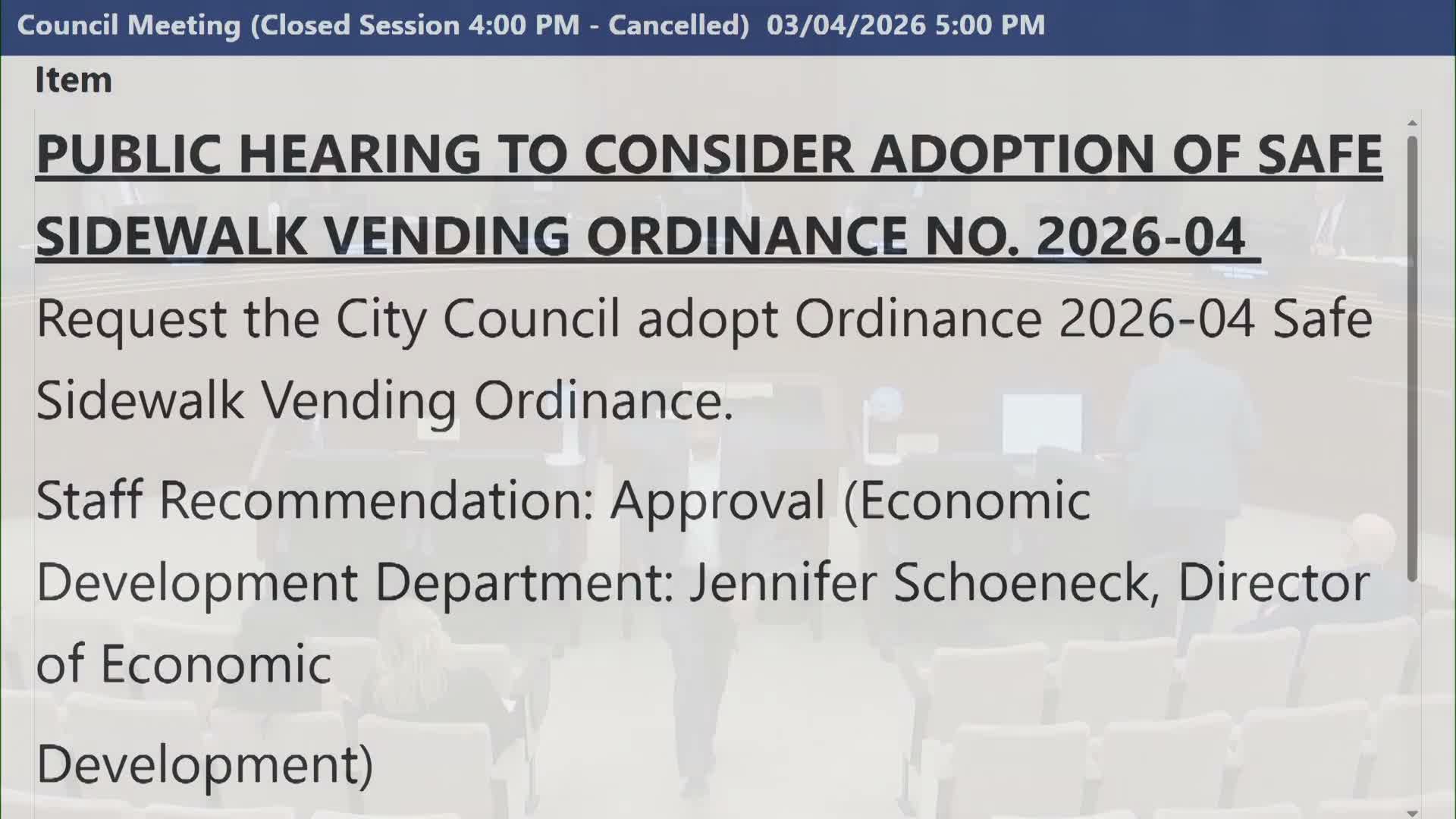
Escondido City Council members advanced a local sidewalk vending ordinance on a 3–2 vote after extensive staff presentations and council debate about enforcement, vendor IDs and protections for immigrant entrepreneurs.
City economic development director Jennifer Schenick and City Attorney Mike McGinnis presented the ordinance and described state constraints from the Safe Sidewalk Vending Act (SB 946). McGinnis told the council that state law limits local governments’ power to restrict vending unless the restrictions address objective health, safety and welfare concerns and that cities may not impose criminal penalties or arbitrary caps on the number of vendors. He also summarized permitted local controls such as requiring business licenses, reasonable hours, sanitation and ADA compliance.
Council debate focused on key operational elements recommended by staff: a 500‑foot buffer from K–12 schools, vendor identification requirements, hours in residential areas and a tiered fine structure. Several councilmembers said they wanted more targeted outreach to immigrant vendor communities and clarity on fee and ID logistics before final adoption. One councilmember urged caution about requiring photo ID for mobile vendors; staff said the proposed seller’s permit would include a photograph to streamline on‑street enforcement without forcing code officers to request a government ID in the field.
Mayor White moved several amendments during deliberations, including reducing the school buffer from 500 feet to 100 feet and setting residential roaming vendor hours to 8 a.m. to 8 p.m.; that motion, with the final amendment language as stated by staff, passed 3–2. According to the roll call recorded at the meeting, Council member Martinez and Deputy Mayor Joe Garcia voted no.
Staff said the ordinance would be accompanied by an education campaign, a vendor permit and fee schedule to be adopted later and that enforcement would be phased in after outreach. McGinnis and Schenick said the city will exempt collection of sensitive information (criminal history, immigration status) in line with recent state legislation protecting vendor data. The ordinance would establish a tiered administrative fine schedule that mirrors state statute, with an added first‑offense written warning for both permitted and unpermitted vendors.
Next steps: staff will return with the final ordinance language (second reading and adoption), a proposed fee schedule and an outreach plan, including targeted engagement with vendors and community leaders to explain permit requirements and assist with enrollment.
Quote attributable to a speaker in the record: "You cannot require a sidewalk vendor to operate in specific parts of the public right of way except when there are objective health, safety, and welfare concerns," City Attorney Mike McGinnis said during the presentation.
The council’s amendments narrow some restrictions and set implementation parameters, but councilmembers and staff agreed to continue community outreach before full enforcement begins.
City economic development director Jennifer Schenick and City Attorney Mike McGinnis presented the ordinance and described state constraints from the Safe Sidewalk Vending Act (SB 946). McGinnis told the council that state law limits local governments’ power to restrict vending unless the restrictions address objective health, safety and welfare concerns and that cities may not impose criminal penalties or arbitrary caps on the number of vendors. He also summarized permitted local controls such as requiring business licenses, reasonable hours, sanitation and ADA compliance.
Council debate focused on key operational elements recommended by staff: a 500‑foot buffer from K–12 schools, vendor identification requirements, hours in residential areas and a tiered fine structure. Several councilmembers said they wanted more targeted outreach to immigrant vendor communities and clarity on fee and ID logistics before final adoption. One councilmember urged caution about requiring photo ID for mobile vendors; staff said the proposed seller’s permit would include a photograph to streamline on‑street enforcement without forcing code officers to request a government ID in the field.
Mayor White moved several amendments during deliberations, including reducing the school buffer from 500 feet to 100 feet and setting residential roaming vendor hours to 8 a.m. to 8 p.m.; that motion, with the final amendment language as stated by staff, passed 3–2. According to the roll call recorded at the meeting, Council member Martinez and Deputy Mayor Joe Garcia voted no.
Staff said the ordinance would be accompanied by an education campaign, a vendor permit and fee schedule to be adopted later and that enforcement would be phased in after outreach. McGinnis and Schenick said the city will exempt collection of sensitive information (criminal history, immigration status) in line with recent state legislation protecting vendor data. The ordinance would establish a tiered administrative fine schedule that mirrors state statute, with an added first‑offense written warning for both permitted and unpermitted vendors.
Next steps: staff will return with the final ordinance language (second reading and adoption), a proposed fee schedule and an outreach plan, including targeted engagement with vendors and community leaders to explain permit requirements and assist with enrollment.
Quote attributable to a speaker in the record: "You cannot require a sidewalk vendor to operate in specific parts of the public right of way except when there are objective health, safety, and welfare concerns," City Attorney Mike McGinnis said during the presentation.
The council’s amendments narrow some restrictions and set implementation parameters, but councilmembers and staff agreed to continue community outreach before full enforcement begins.
View the Full Meeting & All Its Details
This article offers just a summary. Unlock complete video, transcripts, and insights as a Founder Member.
✓
Watch full, unedited meeting videos
✓
Search every word spoken in unlimited transcripts
✓
AI summaries & real-time alerts (all government levels)
✓
Permanent access to expanding government content
30-day money-back guarantee
