Escondido council advances sidewalk-vending ordinance after months of debate over school buffers, IDs and hours
March 06, 2026 | Escondido, San Diego County, California
This article was created by AI summarizing key points discussed. AI makes mistakes, so for full details and context, please refer to the video of the full meeting. Please report any errors so we can fix them. Report an error »
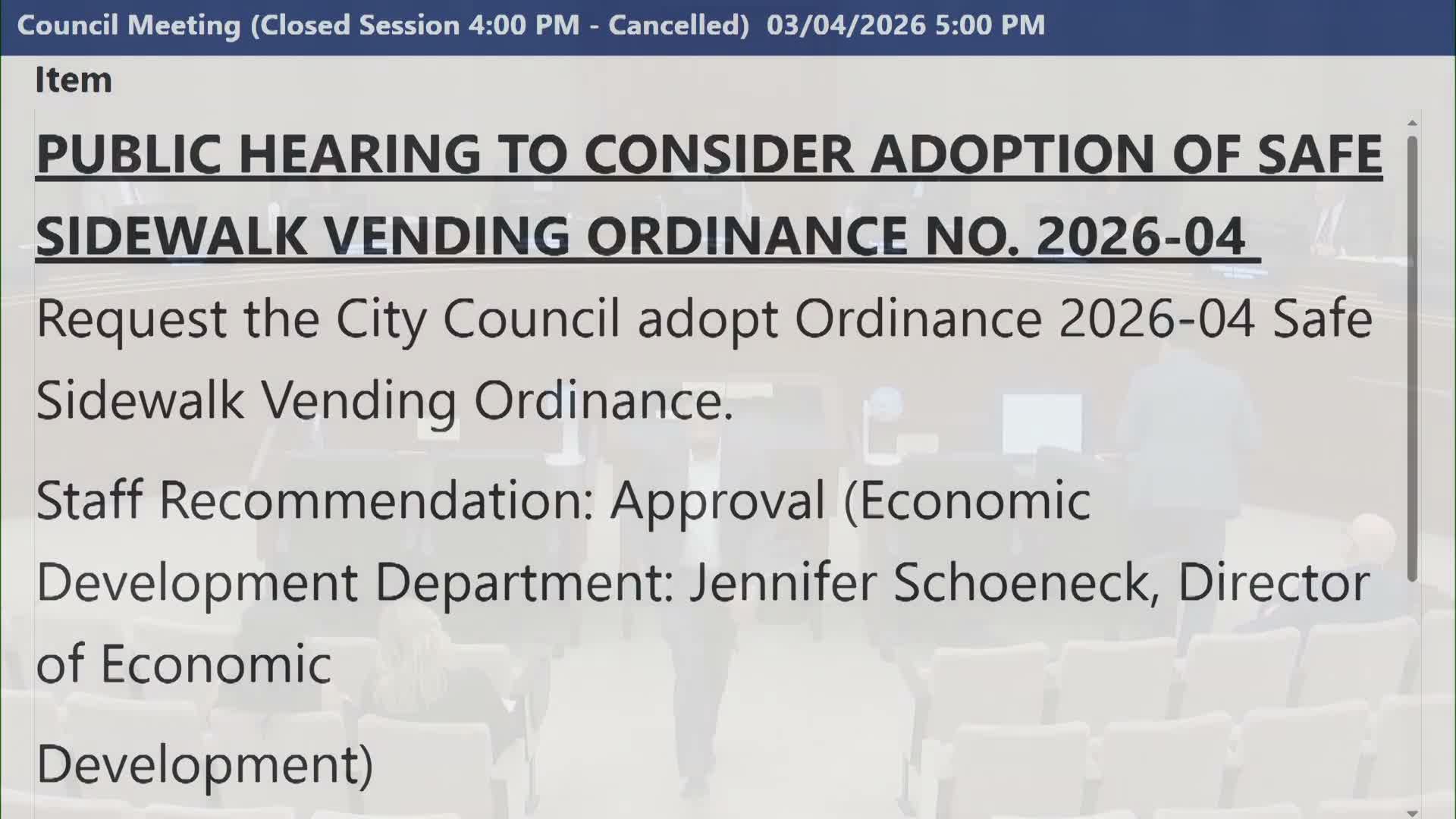
Mayor White and city staff presented the first reading of a local sidewalk-vending ordinance intended to implement California’s Safe Sidewalk Vending Act and create a city-run vendor permit and education program.
Jennifer Schenick, the city’s economic development director, told the council the ordinance aims to protect public health and safety, provide a fair regulatory path for entrepreneurs and create a step for sidewalk vendors to grow into permanent retail. She said the city identified roughly 15 vendors operating without permits and that staff will pair a permit program with a proactive outreach and education campaign before enforcement begins.
City Attorney Mike McGinnis summarized state limits on local rules, telling the council it cannot broadly ban vending or force vendors into a single designated area except for objective health and safety reasons. “You may not require a sidewalk vendor to first obtain consent from an adjacent business owner,” McGinnis said, and he described allowable local tools such as time and place restrictions, sanitary requirements, and an administrative fine structure with ability-to-pay determinations.
Council members pressed staff on several specifics: a proposed 500-foot buffer near K–12 schools; whether roaming vendors should have fixed hours in residential areas; permit fees; and a proposed city-issued seller’s permit with a photo that would be displayed while vending. Some members worried a photo ID requirement could bar undocumented vendors or create barriers to enrollment; others said a visible seller’s permit would make enforcement more efficient without requiring officers to ask for other identification on-site.
Public commenters and vendor advocates urged a program that lowers barriers to participation and prioritizes outreach. Multiple council members called for further vendor engagement during the implementation phase.
After debate the council approved a motion amending the draft ordinance to change the school buffer from 500 to 100 feet, set roaming vending hours in residential areas to 8 a.m.–8 p.m. (with staff to clarify illumination requirements in guidelines), and clarified the city-issued permit language (the adopted motion as summarized by staff removed the requirement that the on-street credential display an individual’s legal name while retaining a seller’s permit mechanism tied to a business account). The amended first reading advanced on a 3–2 vote; Council member Martinez and Deputy Mayor Joe Garcia voted no.
Staff said the ordinance will return for a second reading and that they will pair the regulation with a vendor education campaign and a community-guided fee schedule before enforcement. McGinnis reiterated legal limits on enforcement and data collection, including prohibitions on collecting immigration or criminal-history information as part of vendor records.
Jennifer Schenick, the city’s economic development director, told the council the ordinance aims to protect public health and safety, provide a fair regulatory path for entrepreneurs and create a step for sidewalk vendors to grow into permanent retail. She said the city identified roughly 15 vendors operating without permits and that staff will pair a permit program with a proactive outreach and education campaign before enforcement begins.
City Attorney Mike McGinnis summarized state limits on local rules, telling the council it cannot broadly ban vending or force vendors into a single designated area except for objective health and safety reasons. “You may not require a sidewalk vendor to first obtain consent from an adjacent business owner,” McGinnis said, and he described allowable local tools such as time and place restrictions, sanitary requirements, and an administrative fine structure with ability-to-pay determinations.
Council members pressed staff on several specifics: a proposed 500-foot buffer near K–12 schools; whether roaming vendors should have fixed hours in residential areas; permit fees; and a proposed city-issued seller’s permit with a photo that would be displayed while vending. Some members worried a photo ID requirement could bar undocumented vendors or create barriers to enrollment; others said a visible seller’s permit would make enforcement more efficient without requiring officers to ask for other identification on-site.
Public commenters and vendor advocates urged a program that lowers barriers to participation and prioritizes outreach. Multiple council members called for further vendor engagement during the implementation phase.
After debate the council approved a motion amending the draft ordinance to change the school buffer from 500 to 100 feet, set roaming vending hours in residential areas to 8 a.m.–8 p.m. (with staff to clarify illumination requirements in guidelines), and clarified the city-issued permit language (the adopted motion as summarized by staff removed the requirement that the on-street credential display an individual’s legal name while retaining a seller’s permit mechanism tied to a business account). The amended first reading advanced on a 3–2 vote; Council member Martinez and Deputy Mayor Joe Garcia voted no.
Staff said the ordinance will return for a second reading and that they will pair the regulation with a vendor education campaign and a community-guided fee schedule before enforcement. McGinnis reiterated legal limits on enforcement and data collection, including prohibitions on collecting immigration or criminal-history information as part of vendor records.
Don't Miss a Word: See the Full Meeting!
Go beyond summaries. Unlock every video, transcript, and key insight with a Founder Membership.
✓
Get instant access to full meeting videos
✓
Search and clip any phrase from complete transcripts
✓
Receive AI-powered summaries & custom alerts
✓
Enjoy lifetime, unrestricted access to government data
30-day money-back guarantee
