St. Pete Beach historic board presses staff to clarify how rooftop 'non‑habitable' space affects height limits
March 06, 2026 | St. Pete Beach, Pinellas County, Florida
This article was created by AI summarizing key points discussed. AI makes mistakes, so for full details and context, please refer to the video of the full meeting. Please report any errors so we can fix them. Report an error »
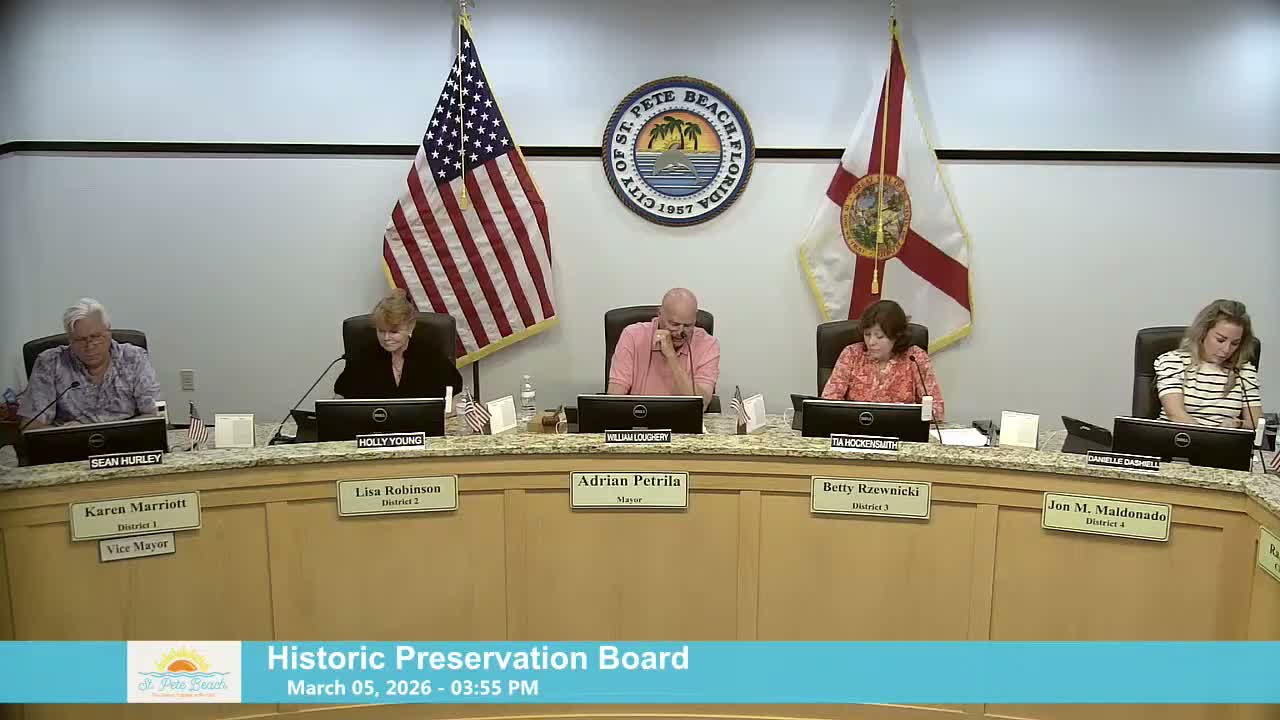
St. Pete Beach’s Historic Preservation Board devoted more than an hour on March 5 to a debate over how the city measures building height in the Pass‑a‑Grille overlay, with members warning that rooftop enclosures labeled “non‑habitable” are being used to gain additional vertical space.
Board Chair Lowery said the example of a nearly completed Gulf Way residence — which staff showed as reaching roughly 32 feet from the defined 8‑foot above‑grade baseline — undercuts the plain reading of the 28‑foot limit for a flat roof. “It’s 32 feet. It’s got a flat roof. That’s higher than 28 feet,” Chair Lowery said. “I say it is 4 feet higher than it’s supposed to be. End of story.”
Staff planner Brandon told the board the contested top level was shown on the construction plans as “storage and rooftop access space” and that, under the Florida Building Code, those elements can qualify as non‑habitable. “At least as shown on the plans, this would qualify as nonhabitable space under the Florida Building Code,” Brandon said, explaining the office’s current interpretation.
Why it matters: Board members said the practical effect is a taller perceived neighborhood scale on Gulf Way and other Pass‑a‑Grille blocks. Several members urged clearer rules so future projects cannot exploit definitional gaps. One member suggested tightening how the city defines “habitable” and “occupiable”; another recommended city‑level action. Board members asked staff to pursue a joint workshop with the city manager and other stakeholders to develop a consistent interpretation or a code amendment.
What staff proposed: Laura Canary, the city’s community development director, recommended bringing the issue to the city manager and convening a joint workshop that would include staff, board members and elected officials. Canary said consistent, documented guidance is needed so future reviewers apply the same standard.
Board concerns and staff responses: Members repeatedly noted that the overlay’s historical code language (1993–1999) used different phrasing and that the present practice relies on Florida Building Code distinctions such as “habitable” versus “non‑habitable.” Chair Lowery and others argued those distinctions can be used to create fully enclosed rooftop spaces that function like an additional floor. Staff responded that the city’s interpretation follows current code language and that a policy or code amendment could resolve ambiguity.
Next steps: Staff agreed to bring the idea of a joint workshop to the city manager and to provide the board with the underlying definitions and early application materials for the Gulf Way project so members can assess how the measurements were computed. The board requested to be included in any such workshop.
Context: The board raised the issue after reviewing recent design reviews and elevation projects intended to protect homes from flood risk; the same meeting also considered multiple certificates of appropriateness and design review items for properties on 1st and 4th avenues and Gulf Way.
Board Chair Lowery said the example of a nearly completed Gulf Way residence — which staff showed as reaching roughly 32 feet from the defined 8‑foot above‑grade baseline — undercuts the plain reading of the 28‑foot limit for a flat roof. “It’s 32 feet. It’s got a flat roof. That’s higher than 28 feet,” Chair Lowery said. “I say it is 4 feet higher than it’s supposed to be. End of story.”
Staff planner Brandon told the board the contested top level was shown on the construction plans as “storage and rooftop access space” and that, under the Florida Building Code, those elements can qualify as non‑habitable. “At least as shown on the plans, this would qualify as nonhabitable space under the Florida Building Code,” Brandon said, explaining the office’s current interpretation.
Why it matters: Board members said the practical effect is a taller perceived neighborhood scale on Gulf Way and other Pass‑a‑Grille blocks. Several members urged clearer rules so future projects cannot exploit definitional gaps. One member suggested tightening how the city defines “habitable” and “occupiable”; another recommended city‑level action. Board members asked staff to pursue a joint workshop with the city manager and other stakeholders to develop a consistent interpretation or a code amendment.
What staff proposed: Laura Canary, the city’s community development director, recommended bringing the issue to the city manager and convening a joint workshop that would include staff, board members and elected officials. Canary said consistent, documented guidance is needed so future reviewers apply the same standard.
Board concerns and staff responses: Members repeatedly noted that the overlay’s historical code language (1993–1999) used different phrasing and that the present practice relies on Florida Building Code distinctions such as “habitable” versus “non‑habitable.” Chair Lowery and others argued those distinctions can be used to create fully enclosed rooftop spaces that function like an additional floor. Staff responded that the city’s interpretation follows current code language and that a policy or code amendment could resolve ambiguity.
Next steps: Staff agreed to bring the idea of a joint workshop to the city manager and to provide the board with the underlying definitions and early application materials for the Gulf Way project so members can assess how the measurements were computed. The board requested to be included in any such workshop.
Context: The board raised the issue after reviewing recent design reviews and elevation projects intended to protect homes from flood risk; the same meeting also considered multiple certificates of appropriateness and design review items for properties on 1st and 4th avenues and Gulf Way.
View the Full Meeting & All Its Details
This article offers just a summary. Unlock complete video, transcripts, and insights as a Founder Member.
✓
Watch full, unedited meeting videos
✓
Search every word spoken in unlimited transcripts
✓
AI summaries & real-time alerts (all government levels)
✓
Permanent access to expanding government content
30-day money-back guarantee
