Historic board approves demolition and three certificates of appropriateness for Pass‑a‑Grille properties
March 06, 2026 | St. Pete Beach, Pinellas County, Florida
This article was created by AI summarizing key points discussed. AI makes mistakes, so for full details and context, please refer to the video of the full meeting. Please report any errors so we can fix them. Report an error »
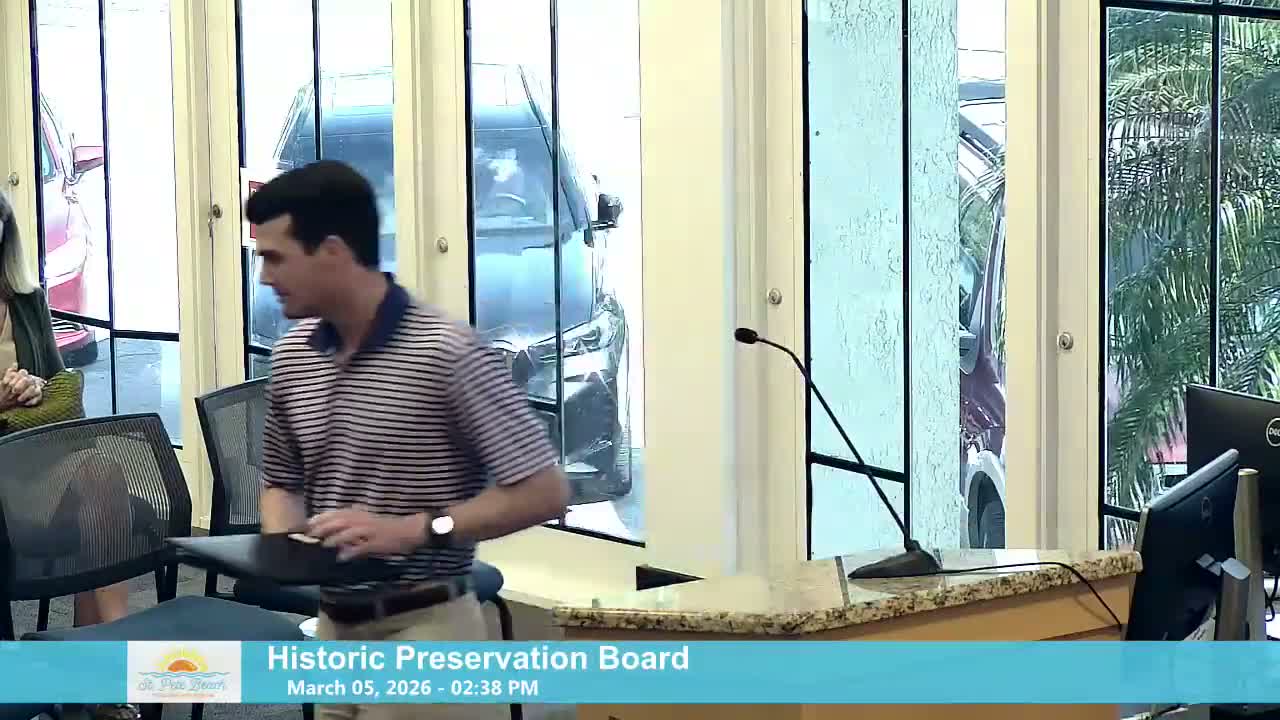
The St. Pete Beach Historic Preservation Board on March 5 approved several formal actions affecting historically designated properties in the Pass‑a‑Grille area.
Demolition approved: The board voted to grant a certificate of appropriateness to demolish the primary residence at 103 1st Avenue (case 26021) without imposing a 90‑day stay. Staff told the board the owner, Marilyn Nolan, presented testimony that she cannot repair the storm‑damaged house and that salvageable interior items will be collected for the local museum. Staff had noted the board may impose a stay of up to 90 days to seek preservation incentives but recommended approval without a stay if the applicant provides adequate testimony.
Certificates of appropriateness for elevation: The board also granted certificates of appropriateness for two nearby properties that plan to elevate their residences to reduce flood risk. Case 26024 (102 4th Avenue) will allow elevation of the 1963 masonry‑vernacular house by roughly 12 feet and addition of decks and stairs; staff flagged that the proposed elevation could change the house’s contributing status on future surveys but recommended approval of the COA. Owner Bill Dimola said the design keeps the house compatible with the block and that the applicant will follow staff design comments (stucco banding and vertical picket railings).
Case 26026 (104 4th Avenue) received board approval as well. Applicants, represented by Andrew Schiff for Ronald and Margaret Schiff, said they moved the garage to the front because a narrow 10‑foot alley provides insufficient rear access; staff confirmed variances for front and side encroachments will go to the Board of Adjustment. The board approved the COA and offered the option of making generalized recommendations to the Board of Adjustment to encourage alley access where practical.
What the votes mean: All three substantive approvals passed by roll call with board members voting to carry the motions. For the two elevation cases, staff and board members stressed that the COA approvals do not guarantee necessary variances for encroachments — those decisions rest with the Board of Adjustment or other permitting staff.
Administrative updates: The meeting also included a staff update that the city will centralize historic plaque procurement (bulk ordering, GL coding, 6–8 week lead time) and an update that the design‑guideline book is in progress (8–10 week lead time). Board members discussed adding historic‑district disclosure language to seller forms and flagged missing entries on the designation list for follow up.
Next steps: Variance filings and building permits for the elevated homes will proceed through the usual Board of Adjustment and permitting channels; staff will provide any additional documentation requested by the board and follow up on plaque procurement and guideline timing.
Demolition approved: The board voted to grant a certificate of appropriateness to demolish the primary residence at 103 1st Avenue (case 26021) without imposing a 90‑day stay. Staff told the board the owner, Marilyn Nolan, presented testimony that she cannot repair the storm‑damaged house and that salvageable interior items will be collected for the local museum. Staff had noted the board may impose a stay of up to 90 days to seek preservation incentives but recommended approval without a stay if the applicant provides adequate testimony.
Certificates of appropriateness for elevation: The board also granted certificates of appropriateness for two nearby properties that plan to elevate their residences to reduce flood risk. Case 26024 (102 4th Avenue) will allow elevation of the 1963 masonry‑vernacular house by roughly 12 feet and addition of decks and stairs; staff flagged that the proposed elevation could change the house’s contributing status on future surveys but recommended approval of the COA. Owner Bill Dimola said the design keeps the house compatible with the block and that the applicant will follow staff design comments (stucco banding and vertical picket railings).
Case 26026 (104 4th Avenue) received board approval as well. Applicants, represented by Andrew Schiff for Ronald and Margaret Schiff, said they moved the garage to the front because a narrow 10‑foot alley provides insufficient rear access; staff confirmed variances for front and side encroachments will go to the Board of Adjustment. The board approved the COA and offered the option of making generalized recommendations to the Board of Adjustment to encourage alley access where practical.
What the votes mean: All three substantive approvals passed by roll call with board members voting to carry the motions. For the two elevation cases, staff and board members stressed that the COA approvals do not guarantee necessary variances for encroachments — those decisions rest with the Board of Adjustment or other permitting staff.
Administrative updates: The meeting also included a staff update that the city will centralize historic plaque procurement (bulk ordering, GL coding, 6–8 week lead time) and an update that the design‑guideline book is in progress (8–10 week lead time). Board members discussed adding historic‑district disclosure language to seller forms and flagged missing entries on the designation list for follow up.
Next steps: Variance filings and building permits for the elevated homes will proceed through the usual Board of Adjustment and permitting channels; staff will provide any additional documentation requested by the board and follow up on plaque procurement and guideline timing.
View the Full Meeting & All Its Details
This article offers just a summary. Unlock complete video, transcripts, and insights as a Founder Member.
✓
Watch full, unedited meeting videos
✓
Search every word spoken in unlimited transcripts
✓
AI summaries & real-time alerts (all government levels)
✓
Permanent access to expanding government content
30-day money-back guarantee
