Transportation staff: district runs 2,000,000+ miles annually; grant-backed bus replacements underway
March 06, 2026 | Cache County School District, School Boards, Utah
This article was created by AI summarizing key points discussed. AI makes mistakes, so for full details and context, please refer to the video of the full meeting. Please report any errors so we can fix them. Report an error »
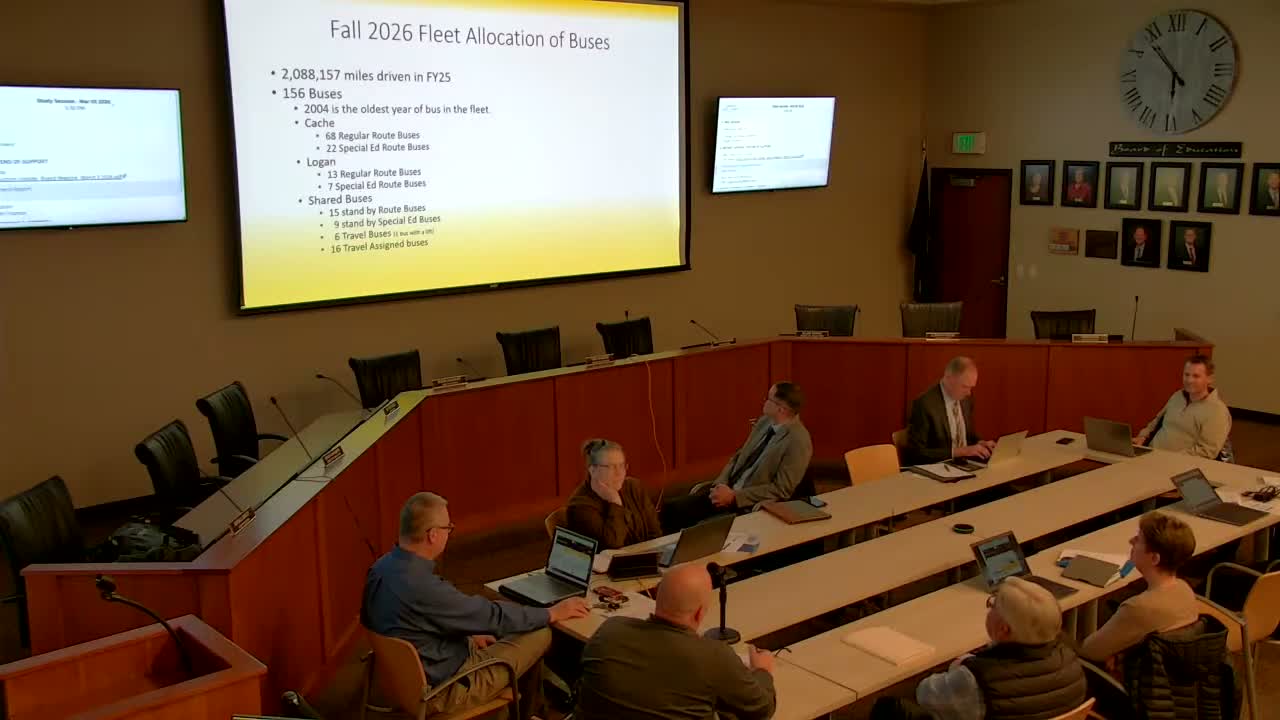
Theo Hepworth, the district’s transportation technology and data specialist, presented operations metrics and technology changes March 5, describing daily mileage, driver staffing and tools to improve routing and safety.
Hepworth said the transportation fleet covered "over 2,000,000 miles" last year and that the district currently runs 68 regular-route buses and 22 special-education buses, with 13 regular buses and seven special-needs routes in Logan. "With our drivers, we have 153 drivers. This year, we actually had 34 brand new drivers that came on because we had 34 drivers leave us last year," Hepworth said.
Hepworth walked the board through recent technology and safety improvements: a waypoint/navigation tool (Wayfinder) for turn-by-turn directions, a stop-map update process that can be pushed to drivers in roughly 30 minutes, and scheduling software (Bike Curve 360 and Zone R) that supports driver assignments and pre-trip inspections. He said approximately 2,800 parents and 2,200 students actively use the district bus-tracking app.
On vehicle replacement, Hepworth said the district obtained grant funding for seven replacement buses this year but noted grant rules require destruction and proof of disposal for replaced vehicles. He and other staff discussed fuel and power choices: roughly a dozen propane buses remain in valley service; the district is evaluating propane, diesel and electric options and watching state grant programs. Board members heard figures for vehicle pricing and grant support: a new conventional bus was cited at about $200,000, electric buses were discussed in the $500,000 range, and an example state program offering $400,000 toward an electric bus was cited in the presentation.
Board members asked about hybrid/electric adoption, special-education standby vehicle counts and routing differences between assigned travel buses and flexible travel buses. Staff explained that assigned travel buses have permanent drivers while travel buses rotate drivers and can be reallocated to fill regular standby needs.
The board did not take formal action on fleet purchases during the meeting; staff said they will continue to pursue grants and to refine routing and stop safety work ahead of the next school year.
Hepworth said the transportation fleet covered "over 2,000,000 miles" last year and that the district currently runs 68 regular-route buses and 22 special-education buses, with 13 regular buses and seven special-needs routes in Logan. "With our drivers, we have 153 drivers. This year, we actually had 34 brand new drivers that came on because we had 34 drivers leave us last year," Hepworth said.
Hepworth walked the board through recent technology and safety improvements: a waypoint/navigation tool (Wayfinder) for turn-by-turn directions, a stop-map update process that can be pushed to drivers in roughly 30 minutes, and scheduling software (Bike Curve 360 and Zone R) that supports driver assignments and pre-trip inspections. He said approximately 2,800 parents and 2,200 students actively use the district bus-tracking app.
On vehicle replacement, Hepworth said the district obtained grant funding for seven replacement buses this year but noted grant rules require destruction and proof of disposal for replaced vehicles. He and other staff discussed fuel and power choices: roughly a dozen propane buses remain in valley service; the district is evaluating propane, diesel and electric options and watching state grant programs. Board members heard figures for vehicle pricing and grant support: a new conventional bus was cited at about $200,000, electric buses were discussed in the $500,000 range, and an example state program offering $400,000 toward an electric bus was cited in the presentation.
Board members asked about hybrid/electric adoption, special-education standby vehicle counts and routing differences between assigned travel buses and flexible travel buses. Staff explained that assigned travel buses have permanent drivers while travel buses rotate drivers and can be reallocated to fill regular standby needs.
The board did not take formal action on fleet purchases during the meeting; staff said they will continue to pursue grants and to refine routing and stop safety work ahead of the next school year.
Don't Miss a Word: See the Full Meeting!
Go beyond summaries. Unlock every video, transcript, and key insight with a Founder Membership.
✓
Get instant access to full meeting videos
✓
Search and clip any phrase from complete transcripts
✓
Receive AI-powered summaries & custom alerts
✓
Enjoy lifetime, unrestricted access to government data
30-day money-back guarantee
