Montgomery County zoning compliance officer outlines enforcement steps, case counts and use of criminal summons
March 06, 2026 | Montgomery County, Virginia
This article was created by AI summarizing key points discussed. AI makes mistakes, so for full details and context, please refer to the video of the full meeting. Please report any errors so we can fix them. Report an error »
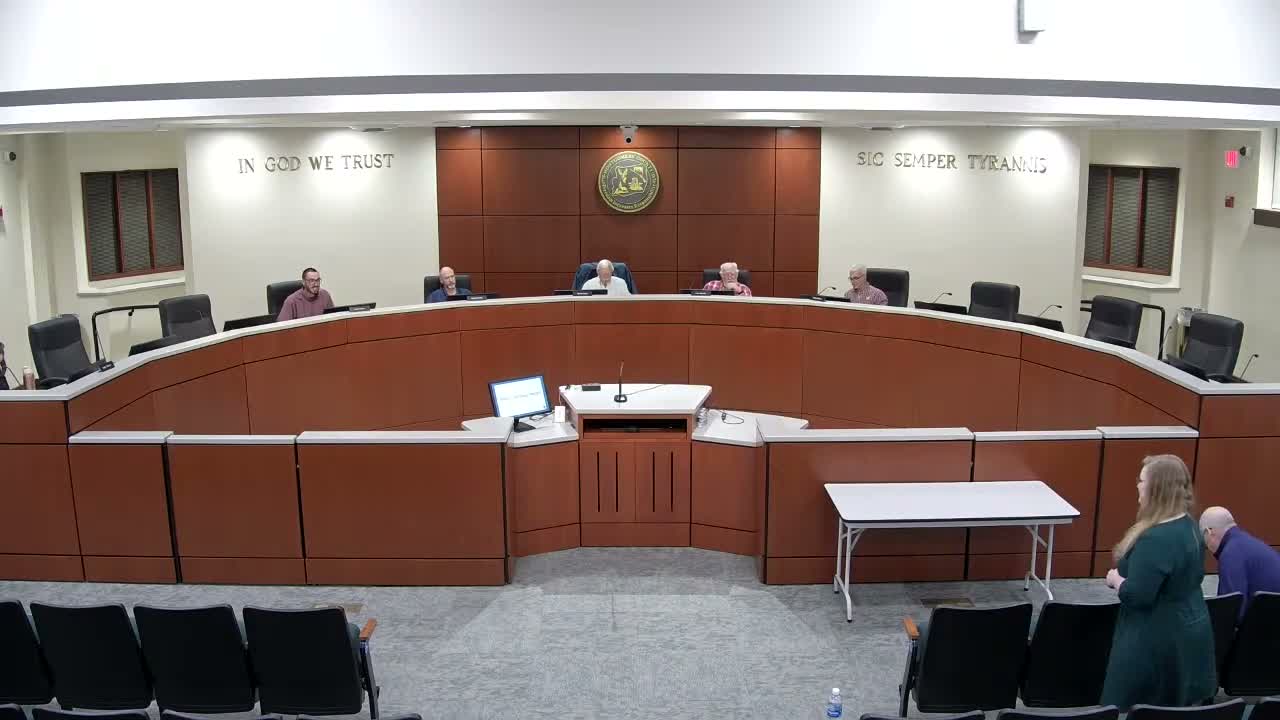
Montgomery County's zoning compliance officer told the Board of Zoning Appeals on March 5 that the county favors voluntary compliance but will escalate to criminal summons when property owners do not correct violations.
"Our ultimate goal is compliance. We're trying not to be punitive," Laura K. Rogers, the county's zoning compliance officer, said in a presentation that walked board members through intake, notices, appeals and court procedures.
Rogers, who said she has held the position for about a year and a half, cited Montgomery County Code 10-52 as authorizing her role assisting the zoning administrator. She described a multi-stage enforcement workflow that starts with complaint intake, proceeds to a letter of inquiry designed to encourage voluntary fixes, moves to a first violation notice if progress stalls, then to a final violation notice (after which the right to appeal to the board may be forfeited) and, if necessary, a criminal summons.
She provided several data points from her tenure: "Since I started in August 2024, I've had 85 [cases], I have currently 38 cases, and we have closed out 47 cases since I've been here," Rogers said. She reported separate intake-queue figures (reported in the transcript as "20 8") and said 26 active cases were at the letter-of-inquiry stage and nine cases were at the first-violation stage. Rogers also said she has one case at the final-violation stage and that the office has issued about 15 summonses since she began, with one active case involving multiple defendants and four summonses issued.
Rogers told the board the county typically pursues owners in criminal cases and may pursue tenants when applicable. The summonses Rogers described are class 2 misdemeanors; she said the county generally waives jail time and seeks a court date roughly 30 days after issuance so a judge can consider the matter. "If compliance is fully reached prior to us going to court, we can ask the judge and the court to dismiss the case," she said.
Board members questioned whether enforcement should be criminal rather than civil. Rogers and county counsel were cited in the discussion explaining that the county code authorizes criminal enforcement and that criminal and civil processes carry different burdens of proof: criminal charges require proof beyond a reasonable doubt, while civil cases rely on a preponderance of the evidence.
Much of the enforcement work, Rogers said, is complaint-driven. She told members that many complaints come from neighbors and that intake can be anonymous; complainants' names are not disclosed publicly until court. The board discussed practical limits on investigations when violations are not visible from a public right-of-way and the potential for neighbor disputes to arise from complaints.
Rogers also reviewed common categories of violations she handles: construction in flood zones or floodways, unpermitted structures, setback violations, short-term rental and bed-and-breakfast concerns, junkyards and inoperable vehicles. Citing county code (reference given in the meeting as 104113), she said agricultural and residential properties may have one inoperable vehicle without violation, while accumulation of five or more can become an automobile graveyard violation and, in some districts, require licensing or a special-use permit.
On technology and outreach, Rogers said the department has moved to the OpenGov permitting system and plans to migrate the zoning complaint form to that platform in the coming months. She also encouraged board members to take available VCA trainings through Virginia Commonwealth University in May and a follow-up session on June 29; the county will cover the cost.
Several board members and staff noted the county's emphasis on education and resource referrals rather than immediate penalties. Rogers said the office compiles packets of community resources (housing, animal-control referrals and others) and coordinates with the zoning administrator and county attorney on cases that require further action.
The board elected new officers early in the meeting. Members nominated and unanimously approved DeSalvo as chair and Steve Spradlin as vice chair. The board also approved May 1, 2025 minutes (motion by Mike Riley, second by Steve Spradlin) and adjourned after thanking staff for the briefing.
The county's zoning office did not advance new policy at the March 5 session; Rogers said staff will continue to pursue voluntary compliance where possible, pursue summonses when appropriate under county code and work to improve intake and tracking through the new permitting system.
"Our ultimate goal is compliance. We're trying not to be punitive," Laura K. Rogers, the county's zoning compliance officer, said in a presentation that walked board members through intake, notices, appeals and court procedures.
Rogers, who said she has held the position for about a year and a half, cited Montgomery County Code 10-52 as authorizing her role assisting the zoning administrator. She described a multi-stage enforcement workflow that starts with complaint intake, proceeds to a letter of inquiry designed to encourage voluntary fixes, moves to a first violation notice if progress stalls, then to a final violation notice (after which the right to appeal to the board may be forfeited) and, if necessary, a criminal summons.
She provided several data points from her tenure: "Since I started in August 2024, I've had 85 [cases], I have currently 38 cases, and we have closed out 47 cases since I've been here," Rogers said. She reported separate intake-queue figures (reported in the transcript as "20 8") and said 26 active cases were at the letter-of-inquiry stage and nine cases were at the first-violation stage. Rogers also said she has one case at the final-violation stage and that the office has issued about 15 summonses since she began, with one active case involving multiple defendants and four summonses issued.
Rogers told the board the county typically pursues owners in criminal cases and may pursue tenants when applicable. The summonses Rogers described are class 2 misdemeanors; she said the county generally waives jail time and seeks a court date roughly 30 days after issuance so a judge can consider the matter. "If compliance is fully reached prior to us going to court, we can ask the judge and the court to dismiss the case," she said.
Board members questioned whether enforcement should be criminal rather than civil. Rogers and county counsel were cited in the discussion explaining that the county code authorizes criminal enforcement and that criminal and civil processes carry different burdens of proof: criminal charges require proof beyond a reasonable doubt, while civil cases rely on a preponderance of the evidence.
Much of the enforcement work, Rogers said, is complaint-driven. She told members that many complaints come from neighbors and that intake can be anonymous; complainants' names are not disclosed publicly until court. The board discussed practical limits on investigations when violations are not visible from a public right-of-way and the potential for neighbor disputes to arise from complaints.
Rogers also reviewed common categories of violations she handles: construction in flood zones or floodways, unpermitted structures, setback violations, short-term rental and bed-and-breakfast concerns, junkyards and inoperable vehicles. Citing county code (reference given in the meeting as 104113), she said agricultural and residential properties may have one inoperable vehicle without violation, while accumulation of five or more can become an automobile graveyard violation and, in some districts, require licensing or a special-use permit.
On technology and outreach, Rogers said the department has moved to the OpenGov permitting system and plans to migrate the zoning complaint form to that platform in the coming months. She also encouraged board members to take available VCA trainings through Virginia Commonwealth University in May and a follow-up session on June 29; the county will cover the cost.
Several board members and staff noted the county's emphasis on education and resource referrals rather than immediate penalties. Rogers said the office compiles packets of community resources (housing, animal-control referrals and others) and coordinates with the zoning administrator and county attorney on cases that require further action.
The board elected new officers early in the meeting. Members nominated and unanimously approved DeSalvo as chair and Steve Spradlin as vice chair. The board also approved May 1, 2025 minutes (motion by Mike Riley, second by Steve Spradlin) and adjourned after thanking staff for the briefing.
The county's zoning office did not advance new policy at the March 5 session; Rogers said staff will continue to pursue voluntary compliance where possible, pursue summonses when appropriate under county code and work to improve intake and tracking through the new permitting system.
View the Full Meeting & All Its Details
This article offers just a summary. Unlock complete video, transcripts, and insights as a Founder Member.
✓
Watch full, unedited meeting videos
✓
Search every word spoken in unlimited transcripts
✓
AI summaries & real-time alerts (all government levels)
✓
Permanent access to expanding government content
30-day money-back guarantee
