South Berwick chief urges phased move to municipal fire/EMS as council weighs tax impacts
March 06, 2026 | South Berwick, York County, Maine
This article was created by AI summarizing key points discussed. AI makes mistakes, so for full details and context, please refer to the video of the full meeting. Please report any errors so we can fix them. Report an error »
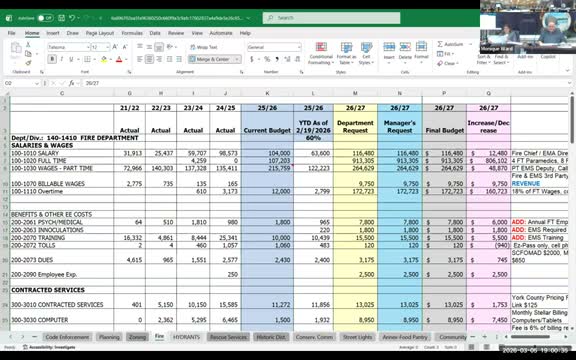
Fire Chief Adam Hamill told the Town Council Wednesday that the town’s EMS project — launched last year to shore up ambulance and fire response — is entering its second, costlier year and requires new hires and equipment to stabilize service. “So, obviously, the big change in this budget is the salary line or the payroll line, and that is due to the second year of the fire/EMS project that we started last year,” Hamill said.
Hamill said year one focused on equipment and licensing; year two would add personnel to operate municipal EMS. The proposal would keep eight full-time firefighter/EMTs already budgeted to start in May and add four more to reach staffing that supports a three-person engine and a consistent second ambulance. Hamill said the town’s ambulance handles roughly 750 calls a year and the current private provider’s load and price increases contributed to the move: “York Ambulance is up to 144 for the year… it will be just over 800,” he reported.
Councilors pressed for detail on costs and timing. Finance staff described the wage and benefits assumptions used in the budget: the draft shows the incremental cost driven largely by payroll and benefits for the additional hires, with benefits and employer taxes roughly doubling the per-person cost included in payroll projections. Hamill said the town expects offsets from avoided private-ambulance fees but that the budget must absorb up-front salary and station-modification costs.
Several councilors urged a phased approach. One member said the town should hire eight now and delay the final four to spread the tax impact; another called the service a moral obligation to residents and urged swift action. “I think the budget increase… is more of a moral obligation to the community as opposed to just a financial obligation,” a councilor said during debate.
Councilors also discussed potential external revenue or mitigation: regional collaboration, TIF/TIP funds and pending state bills on community paramedicine and non-transport reimbursements that could create new income streams for local EMS. Hamill noted legislation under consideration that would support community paramedicine programs, but cautioned those reimbursement mechanisms are not yet established.
The council did not vote on hiring or funding changes at the workshop. Members asked staff for clearer public-facing scenarios showing how municipal and school budgets, assessment changes and use of undesignated funds could affect residents’ tax bills before the public hearing. Staff agreed to prepare spreadsheets and scenario summaries and to research whether TIF funds could legally help offset the FY27 costs. The council scheduled further budget work and public hearings in the coming weeks.
Hamill said year one focused on equipment and licensing; year two would add personnel to operate municipal EMS. The proposal would keep eight full-time firefighter/EMTs already budgeted to start in May and add four more to reach staffing that supports a three-person engine and a consistent second ambulance. Hamill said the town’s ambulance handles roughly 750 calls a year and the current private provider’s load and price increases contributed to the move: “York Ambulance is up to 144 for the year… it will be just over 800,” he reported.
Councilors pressed for detail on costs and timing. Finance staff described the wage and benefits assumptions used in the budget: the draft shows the incremental cost driven largely by payroll and benefits for the additional hires, with benefits and employer taxes roughly doubling the per-person cost included in payroll projections. Hamill said the town expects offsets from avoided private-ambulance fees but that the budget must absorb up-front salary and station-modification costs.
Several councilors urged a phased approach. One member said the town should hire eight now and delay the final four to spread the tax impact; another called the service a moral obligation to residents and urged swift action. “I think the budget increase… is more of a moral obligation to the community as opposed to just a financial obligation,” a councilor said during debate.
Councilors also discussed potential external revenue or mitigation: regional collaboration, TIF/TIP funds and pending state bills on community paramedicine and non-transport reimbursements that could create new income streams for local EMS. Hamill noted legislation under consideration that would support community paramedicine programs, but cautioned those reimbursement mechanisms are not yet established.
The council did not vote on hiring or funding changes at the workshop. Members asked staff for clearer public-facing scenarios showing how municipal and school budgets, assessment changes and use of undesignated funds could affect residents’ tax bills before the public hearing. Staff agreed to prepare spreadsheets and scenario summaries and to research whether TIF funds could legally help offset the FY27 costs. The council scheduled further budget work and public hearings in the coming weeks.
Don't Miss a Word: See the Full Meeting!
Go beyond summaries. Unlock every video, transcript, and key insight with a Founder Membership.
✓
Get instant access to full meeting videos
✓
Search and clip any phrase from complete transcripts
✓
Receive AI-powered summaries & custom alerts
✓
Enjoy lifetime, unrestricted access to government data
30-day money-back guarantee
