Staff propose reallocating roughly $700,000 in HUD funds to a residential rehab program; public comment open
March 06, 2026 | Anchorage Municipality, Alaska
This article was created by AI summarizing key points discussed. AI makes mistakes, so for full details and context, please refer to the video of the full meeting. Please report any errors so we can fix them. Report an error »
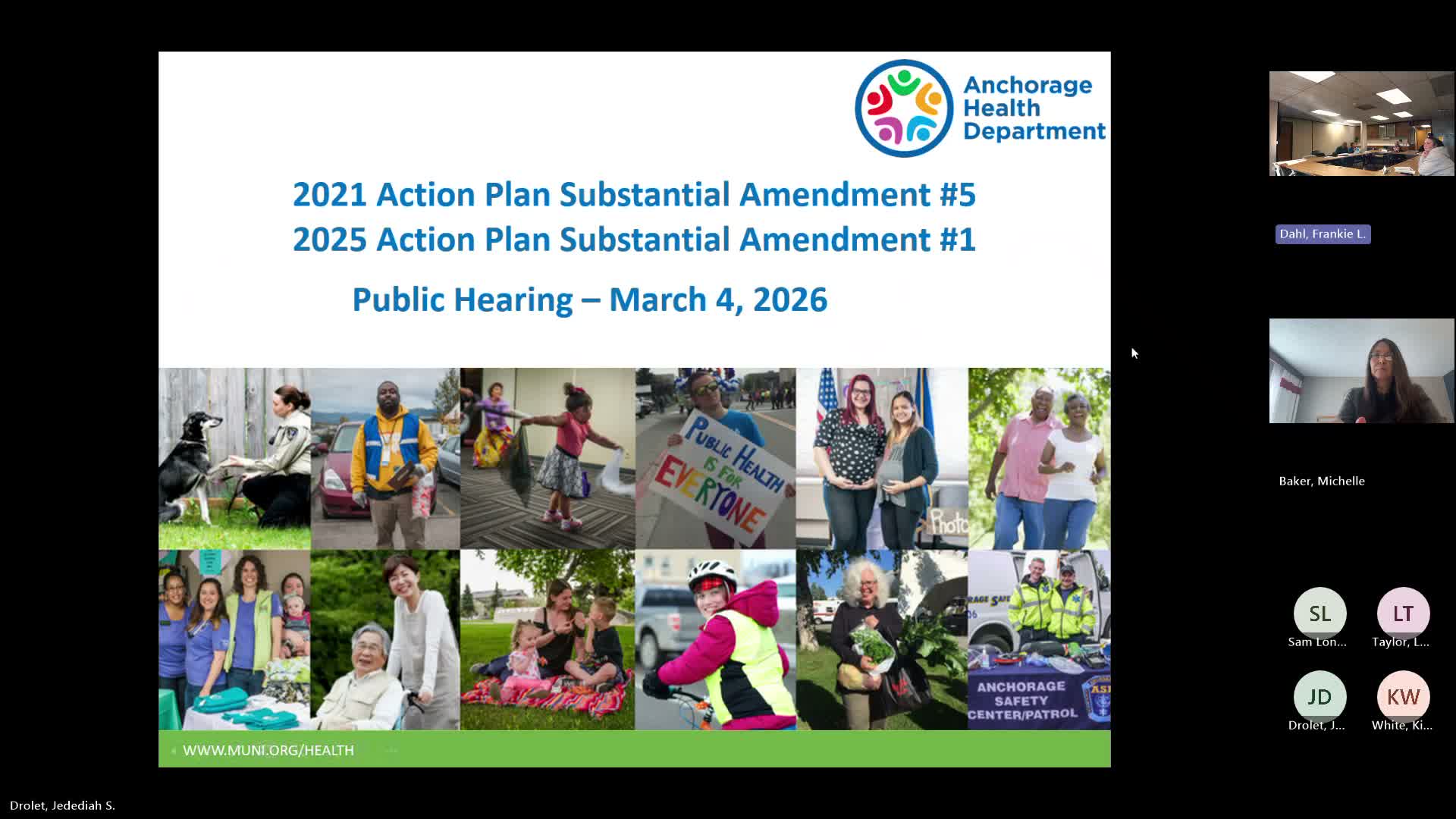
Municipal staff presented a public hearing on substantial amendments to the 2021 and 2025 HUD action plans to create a residential rehab and repair program and reallocate roughly $700,000 in prior HUD funds.
The proposed reallocation would use about $500,000 from 2021 CDBG funds and about $200,000 from 2025 HOME funds as a baseline to stand up a program that could include multiple financing tiers (grants for minor repairs, forgivable loans, deferred loans, and amortized loans for larger renovations). Staff said the proposal is preliminary and sought community input on caps, eligibility, program priorities and contractor roles.
The community-systems program manager described operational design concepts: a single intake point; an independent assessment/estimator contractor to classify properties for demolition, minor repair (grant tier) or major renovation (loan tier); nonprofit operators for grant-tier work; and a lending-oriented contractor for the loan tier. Staff noted coordination with code enforcement for demolition referrals and with other programs (weatherization, HFC) to avoid duplication.
Staff provided several concrete program and timeline items: a supportive-housing RFP for operating funds was described as roughly $1,350,000 and expected to be released imminently with a 21‑day window; a voucher carve-out with Alaska Housing Finance Corporation was expected to offer about 40 vouchers per year to households moving directly from homelessness; and the substantial-amendment public comment period runs through March 6. If the assembly approves the amendments (staff said submission to the assembly is expected in May), staff planned to procure contractors in April and aim for program start in May, subject to HUD approval.
Commissioners and attendees raised practical questions about per-unit caps (staff noted a mobile-home repair cap of $20,000 per unit as a reference and said caps would likely be set), application prioritization, and whether program eligibility would be constrained by HUD income rules (CDBG eligibility generally uses 80% area median income benchmarks). Staff said they would seek community input and look to examples in other jurisdictions to set caps and structures.
Panelists also discussed HUD quality standards: staff cited HUD’s new INSPIRE standard and said it could help align rehab work with voucher habitability requirements and prioritize work that brings units up to required inspection standards. Public commenters flagged concerns about older housing stock (mold, air quality, asbestos) and the limits of inspections.
Next steps: the comment period remains open; staff will collect input, finalize program details including caps and eligibility, send the substantial amendments to the assembly for review, and submit to HUD for final approval before procurement and program launch.
The proposed reallocation would use about $500,000 from 2021 CDBG funds and about $200,000 from 2025 HOME funds as a baseline to stand up a program that could include multiple financing tiers (grants for minor repairs, forgivable loans, deferred loans, and amortized loans for larger renovations). Staff said the proposal is preliminary and sought community input on caps, eligibility, program priorities and contractor roles.
The community-systems program manager described operational design concepts: a single intake point; an independent assessment/estimator contractor to classify properties for demolition, minor repair (grant tier) or major renovation (loan tier); nonprofit operators for grant-tier work; and a lending-oriented contractor for the loan tier. Staff noted coordination with code enforcement for demolition referrals and with other programs (weatherization, HFC) to avoid duplication.
Staff provided several concrete program and timeline items: a supportive-housing RFP for operating funds was described as roughly $1,350,000 and expected to be released imminently with a 21‑day window; a voucher carve-out with Alaska Housing Finance Corporation was expected to offer about 40 vouchers per year to households moving directly from homelessness; and the substantial-amendment public comment period runs through March 6. If the assembly approves the amendments (staff said submission to the assembly is expected in May), staff planned to procure contractors in April and aim for program start in May, subject to HUD approval.
Commissioners and attendees raised practical questions about per-unit caps (staff noted a mobile-home repair cap of $20,000 per unit as a reference and said caps would likely be set), application prioritization, and whether program eligibility would be constrained by HUD income rules (CDBG eligibility generally uses 80% area median income benchmarks). Staff said they would seek community input and look to examples in other jurisdictions to set caps and structures.
Panelists also discussed HUD quality standards: staff cited HUD’s new INSPIRE standard and said it could help align rehab work with voucher habitability requirements and prioritize work that brings units up to required inspection standards. Public commenters flagged concerns about older housing stock (mold, air quality, asbestos) and the limits of inspections.
Next steps: the comment period remains open; staff will collect input, finalize program details including caps and eligibility, send the substantial amendments to the assembly for review, and submit to HUD for final approval before procurement and program launch.
View the Full Meeting & All Its Details
This article offers just a summary. Unlock complete video, transcripts, and insights as a Founder Member.
✓
Watch full, unedited meeting videos
✓
Search every word spoken in unlimited transcripts
✓
AI summaries & real-time alerts (all government levels)
✓
Permanent access to expanding government content
30-day money-back guarantee
