Charlottesville staff detail tax‑relief programs as council weighs proposed increase
March 06, 2026 | Charlottesville, Albemarle County, Virginia
This article was created by AI summarizing key points discussed. AI makes mistakes, so for full details and context, please refer to the video of the full meeting. Please report any errors so we can fix them. Report an error »
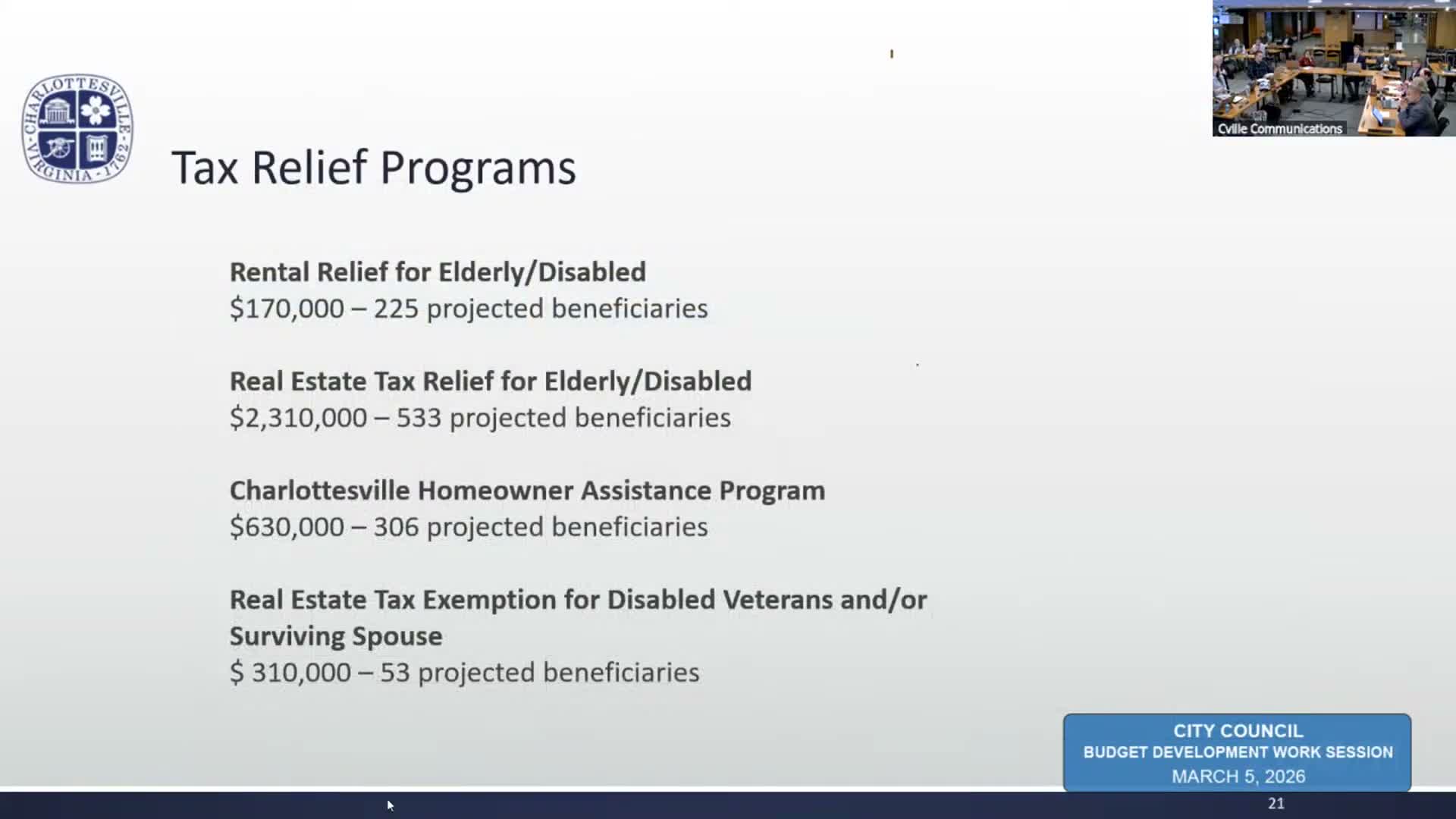
Todd (Commissioner of Revenue) explained the city’s three tax‑relief programs and how they are structured to adjust automatically with income and assessed‑value measurements.
Todd said the programs are pegged to HUD median family income (MFI) and that thresholds move with local incomes and assessed values, which reduces the need for annual administrative adjustments. He described the CHAP program’s home‑value threshold (set at the assessor’s average residential value) and said grant amounts are tiered at $1,000, $1,500, $2,000 or $2,500 depending on household income relative to the threshold.
Todd and staff said the programs are generally well used and that the office comes close to spending allocated amounts each year; they maintain data on the number of households using each tier and can provide detailed counts and distribution on request. Todd also cautioned that relief programs mitigate but do not eliminate the fiscal effect of a tax increase: “you can’t relieve your way out of a tax increase,” he said.
Council asked for additional statistics on take‑up and the share of eligible households reached; staff said they can provide that information and projections for budgeting purposes.
The work session closed with council direction to advertise a 2¢ real‑estate tax rate and for staff to prepare alternate scenarios in case councilors choose different revenue paths before adoption.
Todd said the programs are pegged to HUD median family income (MFI) and that thresholds move with local incomes and assessed values, which reduces the need for annual administrative adjustments. He described the CHAP program’s home‑value threshold (set at the assessor’s average residential value) and said grant amounts are tiered at $1,000, $1,500, $2,000 or $2,500 depending on household income relative to the threshold.
Todd and staff said the programs are generally well used and that the office comes close to spending allocated amounts each year; they maintain data on the number of households using each tier and can provide detailed counts and distribution on request. Todd also cautioned that relief programs mitigate but do not eliminate the fiscal effect of a tax increase: “you can’t relieve your way out of a tax increase,” he said.
Council asked for additional statistics on take‑up and the share of eligible households reached; staff said they can provide that information and projections for budgeting purposes.
The work session closed with council direction to advertise a 2¢ real‑estate tax rate and for staff to prepare alternate scenarios in case councilors choose different revenue paths before adoption.
View the Full Meeting & All Its Details
This article offers just a summary. Unlock complete video, transcripts, and insights as a Founder Member.
✓
Watch full, unedited meeting videos
✓
Search every word spoken in unlimited transcripts
✓
AI summaries & real-time alerts (all government levels)
✓
Permanent access to expanding government content
30-day money-back guarantee
