City staff outlines draft DDA for downtown Boulder; merchants and Hill residents press for clarity on costs and near-term wins
March 06, 2026 | Boulder, Boulder County, Colorado
This article was created by AI summarizing key points discussed. AI makes mistakes, so for full details and context, please refer to the video of the full meeting. Please report any errors so we can fix them. Report an error »
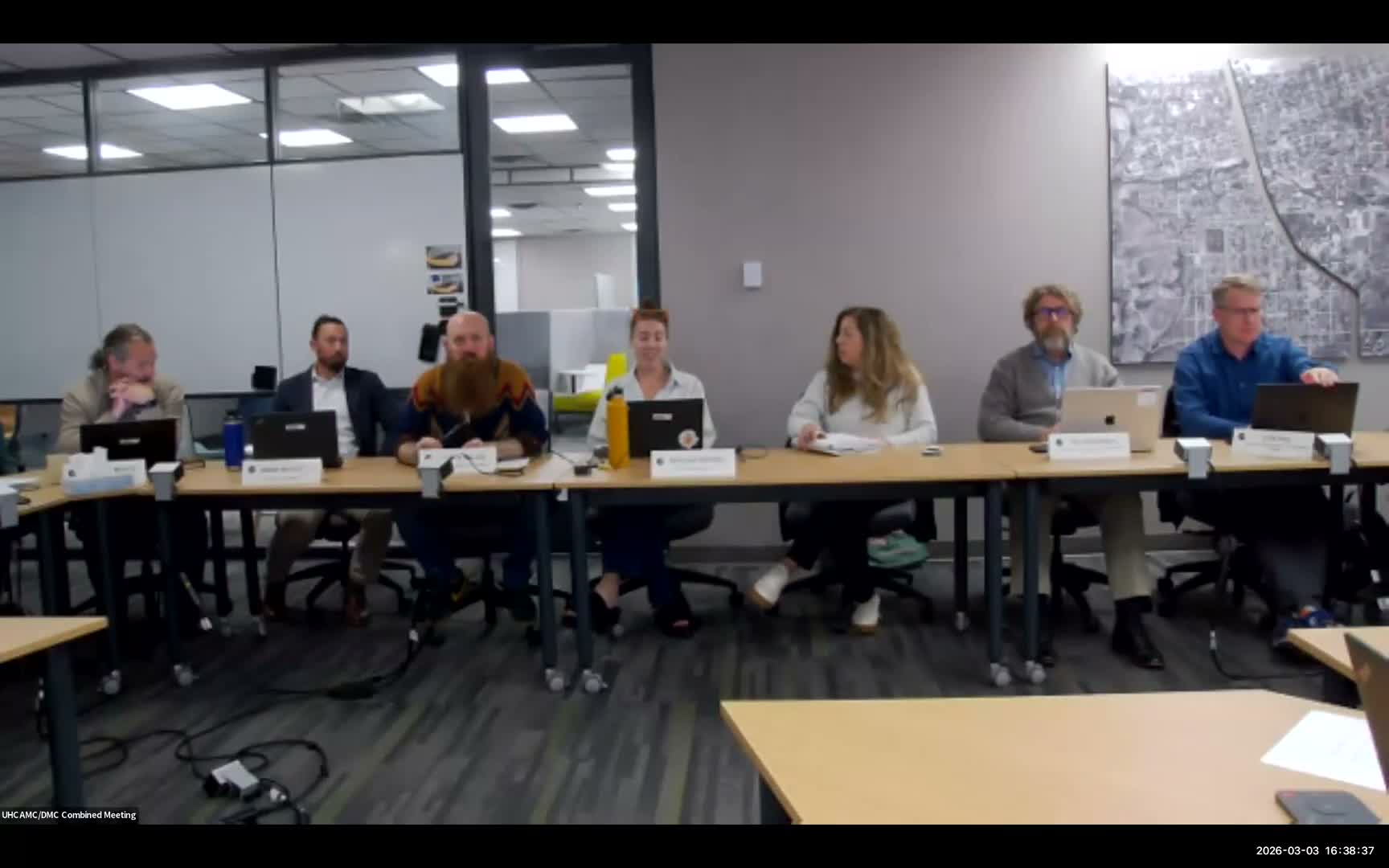
City staff and outside consultants laid out preliminary plans on March 3 for forming a Downtown Development Authority (DDA) that could finance downtown revitalization through tax-increment financing (TIF) and an optional mill levy, saying the work will go to a city council study session next week and could return in June for a decision on whether to refer measures to the ballot.
"A DDA is a long term place based steward for a central business district," said Ricky Brown, the city's economic development strategy manager, introducing the presentation and emphasizing that policy recommendations are preliminary and "subject to further financial and legal analysis." The team said the district would use TIF — capturing growth in property and sales taxes above a 2026 base year — and could bond against that future revenue to fund capital projects.
Consultants walking through the financial modeling described two real-growth scenarios. Under a conservative 1% real-growth assumption, the presentation showed just over $140,000,000 in cumulative property and sales tax increment over a 30-year period; under a more aggressive 2.5% scenario the model produced a figure above $400,000,000. The consultant noted a $5,000,000 annual threshold on the chart as an illustrative reference point.
Consultants and staff repeatedly cautioned that TIF takes time to build and that a mill levy is often used as gap financing in the early years. "A mill levy, when it is used by a DDA, is often used almost as gap financing so that in those first several years the DDA does have a dedicated funding source while the TIF is building," the consultant said, explaining why staff is exploring a coordinated funding strategy combining a mill levy with property- and sales-tax increment.
Commissioners and members of the planning group pressed for clearer near-term examples and for how the Hill (University Hill) would avoid being treated as a penalty. One commissioner said the Hill will "want to see that upfront" and urged staff to identify specific short-term projects the district could deliver to build trust. Planning-group participants urged staff to present concrete examples showing how small wins would reach merchants and property owners in the Hill.
Dakota, representing The Hill Boulder (the merchants association), said merchants are "really excited" about being part of a larger funding pool and stressed ensuring Hill representation and visible short-term objectives in the plan of development so merchants can see tangible benefits.
At the same time, a public participant, Lynne Segal, used the public-comment period to press a different point of view, saying Boulder residents are shouldering rising fees and that the university and large developments have increased pressure on public infrastructure. "CU owns Boulder," Segal said, urging the commissions to consider the financial impacts on taxpayers and to seek more meaningful public input on those effects. Staff responded that they would "take that under advisement."
Staff also outlined governance options and statutory basics under Colorado law: a DDA board must have between 5 and 11 members and a majority must live in or own property within the district; a city council member must sit on the board and council would appoint and confirm members. Staff said an initial direction under consideration is a standalone DDA model with a planned one- to two-year transition period during which city staff would provide administrative and financial support.
The presentation described three options for handling existing GID (general improvement district) assets and parking: that the DDA could (1) own and operate some or all assets, (2) operate city-owned assets through an intergovernmental agreement, or (3) leave the GIDs as owners while the DDA focuses on reinvestment. Staff emphasized that parking "should function as an enterprise" and that any ownership or transfer would require a structured transition and further analysis.
Presenters warned that including large assets in the DDA's bonding capacity affects how quickly transformational projects can be funded; they also said revenue-sharing agreements would be an important policy conversation if sales-tax increment capture is pursued, because sales-tax bases do not automatically grow with property values as property-tax bases do.
Next steps outlined by staff include additional legal and financial analysis, targeted outreach to property owners and businesses, and a planned return to council in June to confirm priorities and determine whether to refer formation and funding questions to the November ballot.
The commissions also discussed other business: The Hill Merchants Association reported work on a marketing partnership and eagerness to support the DDA planning effort, and Downtown staff described efforts to make ambassador (clean-and-safe) program work more transparent through daily logs and regular pulse surveys. The commissions set future meeting dates and adjourned.
What happens next: staff will present a largely similar slide deck to council in a study session next week and said they expect to return in June for council direction on ballot referral and on refining the plan of development. If measures are referred, staff said the election would be November.
(Reporting note: the presentation used illustrative projections and repeatedly described the figures as modeling assumptions rather than final commitments.)
"A DDA is a long term place based steward for a central business district," said Ricky Brown, the city's economic development strategy manager, introducing the presentation and emphasizing that policy recommendations are preliminary and "subject to further financial and legal analysis." The team said the district would use TIF — capturing growth in property and sales taxes above a 2026 base year — and could bond against that future revenue to fund capital projects.
Consultants walking through the financial modeling described two real-growth scenarios. Under a conservative 1% real-growth assumption, the presentation showed just over $140,000,000 in cumulative property and sales tax increment over a 30-year period; under a more aggressive 2.5% scenario the model produced a figure above $400,000,000. The consultant noted a $5,000,000 annual threshold on the chart as an illustrative reference point.
Consultants and staff repeatedly cautioned that TIF takes time to build and that a mill levy is often used as gap financing in the early years. "A mill levy, when it is used by a DDA, is often used almost as gap financing so that in those first several years the DDA does have a dedicated funding source while the TIF is building," the consultant said, explaining why staff is exploring a coordinated funding strategy combining a mill levy with property- and sales-tax increment.
Commissioners and members of the planning group pressed for clearer near-term examples and for how the Hill (University Hill) would avoid being treated as a penalty. One commissioner said the Hill will "want to see that upfront" and urged staff to identify specific short-term projects the district could deliver to build trust. Planning-group participants urged staff to present concrete examples showing how small wins would reach merchants and property owners in the Hill.
Dakota, representing The Hill Boulder (the merchants association), said merchants are "really excited" about being part of a larger funding pool and stressed ensuring Hill representation and visible short-term objectives in the plan of development so merchants can see tangible benefits.
At the same time, a public participant, Lynne Segal, used the public-comment period to press a different point of view, saying Boulder residents are shouldering rising fees and that the university and large developments have increased pressure on public infrastructure. "CU owns Boulder," Segal said, urging the commissions to consider the financial impacts on taxpayers and to seek more meaningful public input on those effects. Staff responded that they would "take that under advisement."
Staff also outlined governance options and statutory basics under Colorado law: a DDA board must have between 5 and 11 members and a majority must live in or own property within the district; a city council member must sit on the board and council would appoint and confirm members. Staff said an initial direction under consideration is a standalone DDA model with a planned one- to two-year transition period during which city staff would provide administrative and financial support.
The presentation described three options for handling existing GID (general improvement district) assets and parking: that the DDA could (1) own and operate some or all assets, (2) operate city-owned assets through an intergovernmental agreement, or (3) leave the GIDs as owners while the DDA focuses on reinvestment. Staff emphasized that parking "should function as an enterprise" and that any ownership or transfer would require a structured transition and further analysis.
Presenters warned that including large assets in the DDA's bonding capacity affects how quickly transformational projects can be funded; they also said revenue-sharing agreements would be an important policy conversation if sales-tax increment capture is pursued, because sales-tax bases do not automatically grow with property values as property-tax bases do.
Next steps outlined by staff include additional legal and financial analysis, targeted outreach to property owners and businesses, and a planned return to council in June to confirm priorities and determine whether to refer formation and funding questions to the November ballot.
The commissions also discussed other business: The Hill Merchants Association reported work on a marketing partnership and eagerness to support the DDA planning effort, and Downtown staff described efforts to make ambassador (clean-and-safe) program work more transparent through daily logs and regular pulse surveys. The commissions set future meeting dates and adjourned.
What happens next: staff will present a largely similar slide deck to council in a study session next week and said they expect to return in June for council direction on ballot referral and on refining the plan of development. If measures are referred, staff said the election would be November.
(Reporting note: the presentation used illustrative projections and repeatedly described the figures as modeling assumptions rather than final commitments.)
Don't Miss a Word: See the Full Meeting!
Go beyond summaries. Unlock every video, transcript, and key insight with a Founder Membership.
✓
Get instant access to full meeting videos
✓
Search and clip any phrase from complete transcripts
✓
Receive AI-powered summaries & custom alerts
✓
Enjoy lifetime, unrestricted access to government data
30-day money-back guarantee
