Town counsel warns Brookline school leaders against using public resources to influence an override
March 05, 2026 | Brookline Public Schools, School Boards, Massachusetts
This article was created by AI summarizing key points discussed. AI makes mistakes, so for full details and context, please refer to the video of the full meeting. Please report any errors so we can fix them. Report an error »
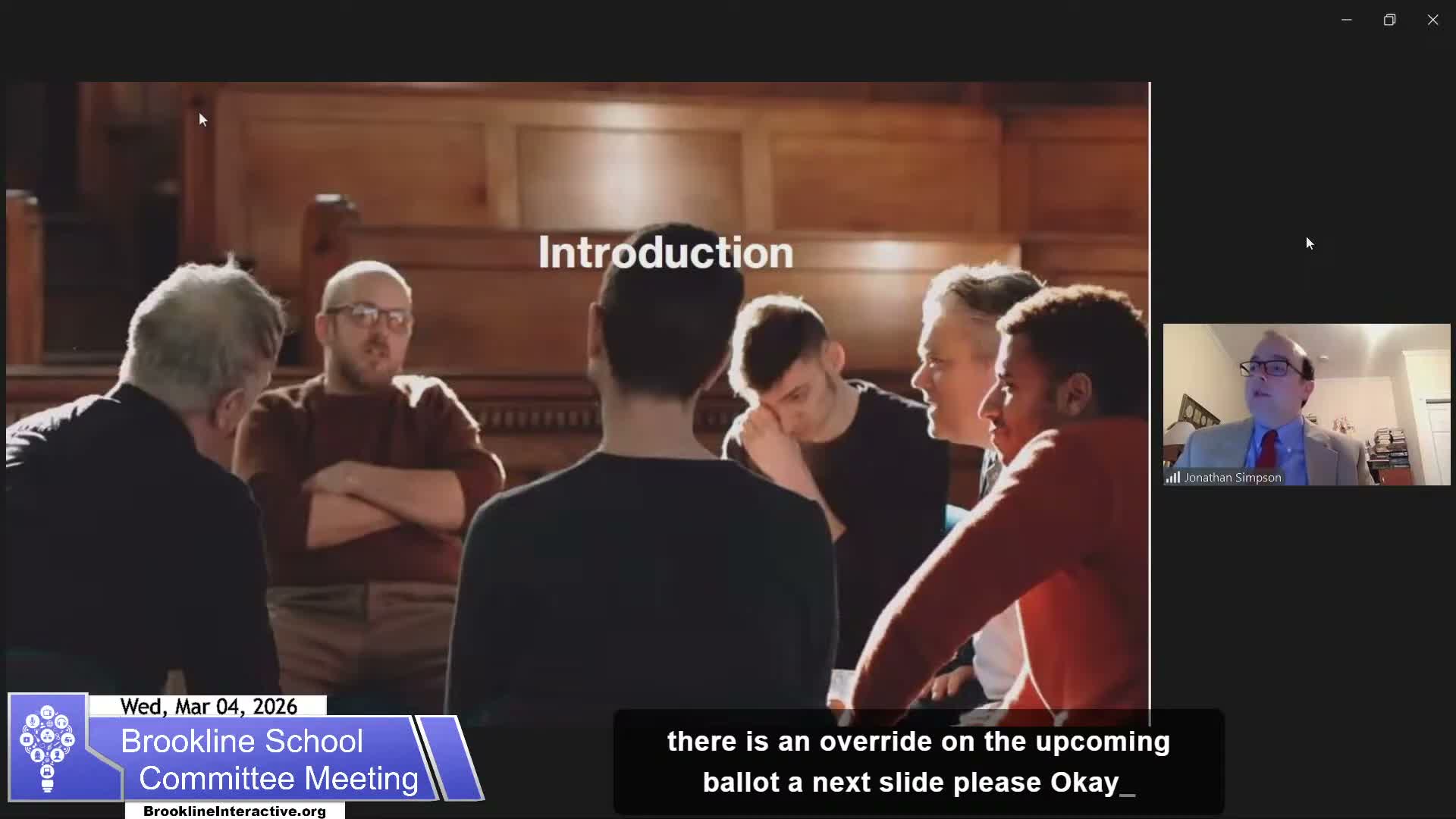
Jonathan Simpson, First Assistant Town Counsel, briefed School Committee members and district staff on campaign finance constraints around ballot questions, warning that public resources — broadly construed — cannot be used to influence voters even if materials appear informational. His main points were: avoid mass emails to parent lists acquired through school channels; do not use school or town letterhead, staff time, or official social media accounts to advocate for or against a ballot question; fundraising connected to public schools is generally prohibited; and elected officials may speak in their private capacity but should avoid implying they speak for the committee or using the "weight of the office."
Simpson said earlier litigation and OCPF rulings found that seemingly informational mass emails can be a violation if they are unsolicited and distributed via public resources. He described permitted activities: discussing ballot questions at public meetings, posting informational material to the town website (provided it is informational and not advocacy), and responding to solicited requests for information. He also explained that PTOs and private groups can share district-provided informational materials with their own opt‑in lists, provided the lists were not handed over by the schools.
Committee members asked practical questions: whether staff can discuss the override during work hours (Simpson said policy-making staff can prepare analyses within their purview and share them in solicited forums), whether teachers may be active in campaigns on personal time (yes, but they must avoid using their office or school-provided contact lists), and how to handle events hosted by private committees in school buildings (private events may be allowed if equal access is extended to the opposing side). Simpson emphasized a conservative approach and offered to circulate a memo and answer follow‑up compliance questions.
No formal committee action was taken; members requested a circulation of guidance to staff and an FAQ to reduce inadvertent violations.
Simpson said earlier litigation and OCPF rulings found that seemingly informational mass emails can be a violation if they are unsolicited and distributed via public resources. He described permitted activities: discussing ballot questions at public meetings, posting informational material to the town website (provided it is informational and not advocacy), and responding to solicited requests for information. He also explained that PTOs and private groups can share district-provided informational materials with their own opt‑in lists, provided the lists were not handed over by the schools.
Committee members asked practical questions: whether staff can discuss the override during work hours (Simpson said policy-making staff can prepare analyses within their purview and share them in solicited forums), whether teachers may be active in campaigns on personal time (yes, but they must avoid using their office or school-provided contact lists), and how to handle events hosted by private committees in school buildings (private events may be allowed if equal access is extended to the opposing side). Simpson emphasized a conservative approach and offered to circulate a memo and answer follow‑up compliance questions.
No formal committee action was taken; members requested a circulation of guidance to staff and an FAQ to reduce inadvertent violations.
Don't Miss a Word: See the Full Meeting!
Go beyond summaries. Unlock every video, transcript, and key insight with a Founder Membership.
✓
Get instant access to full meeting videos
✓
Search and clip any phrase from complete transcripts
✓
Receive AI-powered summaries & custom alerts
✓
Enjoy lifetime, unrestricted access to government data
30-day money-back guarantee
