Stakeholders press SBCC to formalize meeting notices and document posting in bylaws
March 06, 2026 | Building Code Council, Governor's Office - Boards & Commissions, Executive, Washington
This article was created by AI summarizing key points discussed. AI makes mistakes, so for full details and context, please refer to the video of the full meeting. Please report any errors so we can fix them. Report an error »
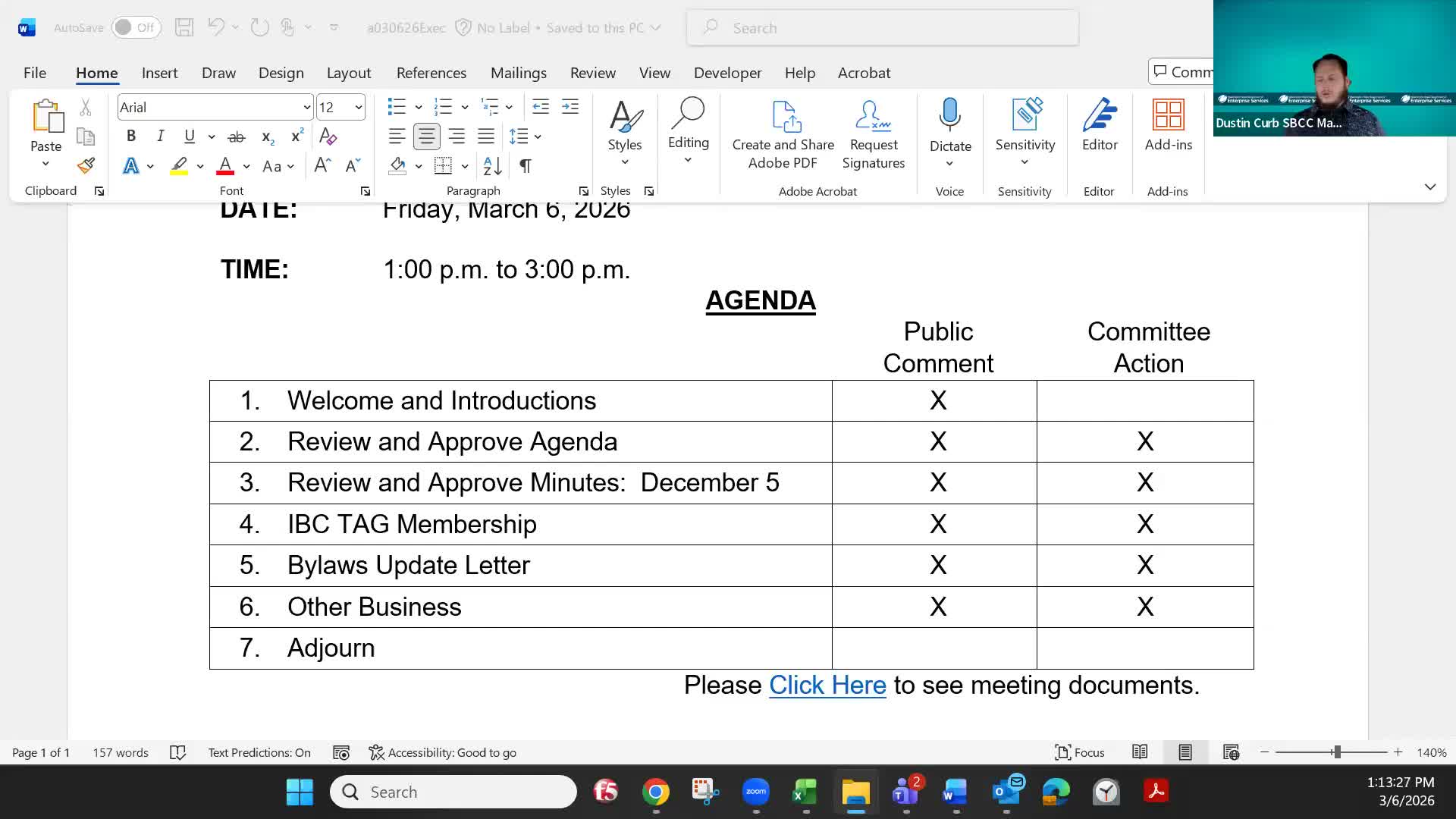
The SBCC executive committee spent much of its March 6 meeting discussing proposed bylaws changes aimed at improving public notice and document transparency under the Open Public Meetings Act (OPMA).
Patrick Hanks (Building Industry Association of Washington), who submitted the suggested amendments, told the committee he based the recommendations on recent experience with special meeting notices and missing or unclear calendar entries. "My goal was to provide suggestions that improve current processes to provide better notice for stakeholders in the public and ensure that current practices are aligned with the bylaws without making overly drastic changes," he said.
Patrick asked the council to ensure that special meetings trigger a gov-delivery/email notice with context (not just a website event), and suggested limiting the posting of substantial language that will be subject to a final vote to at least 24 hours before that meeting. He said his intent was not to eliminate the tags' flexibility to make minor or editorial changes on the fly, but to avoid substantive code changes being introduced at the moment of a final vote.
"When you're making final action, then everybody knows, oh, if I have an amendment I want proposed, if I have a major section I want changed, I need to get that to them — the substantial language should be given out 24 hours in advance," Patrick said.
Staff (Dustin) responded that SBCC already uses gov-delivery notices for most meetings and that the agendas meet OPMA's 24-hour minimum. He said uploads of large or late documents can be operationally challenging when proponents submit updates the same day as a meeting, but staff is trying to display updates in a way that makes revisions clear rather than simply overwriting files.
"We're doing that. The OPMA requires that the agendas be put out a minimum of 24 hours before the start of the meeting. We're doing that," Dustin said, while acknowledging a small number of missed notices in the past two years.
Committee members and stakeholders broadly agreed there is value in better contextual notices; several cautioned against hard deadlines that could impede volunteer-driven tag work. Elizabeth Torske (Cascade Natural Gas) and Ken Broulette (Farcode Consultant LLC) said more consistent official notices and clearer agendas would help stakeholders reliably participate.
Members agreed to defer formal bylaw changes and plan a more comprehensive review this fall tied to the 2027 code-cycle planning. The committee took no action on bylaws at the March 6 meeting, but the chair said staff will try to improve notice practices and the committee will revisit the issue in a planned review process.
The discussion referenced "RCW1927033" and broader OPMA compliance; no new rulemaking or bylaw adoption occurred at this meeting.
Patrick Hanks (Building Industry Association of Washington), who submitted the suggested amendments, told the committee he based the recommendations on recent experience with special meeting notices and missing or unclear calendar entries. "My goal was to provide suggestions that improve current processes to provide better notice for stakeholders in the public and ensure that current practices are aligned with the bylaws without making overly drastic changes," he said.
Patrick asked the council to ensure that special meetings trigger a gov-delivery/email notice with context (not just a website event), and suggested limiting the posting of substantial language that will be subject to a final vote to at least 24 hours before that meeting. He said his intent was not to eliminate the tags' flexibility to make minor or editorial changes on the fly, but to avoid substantive code changes being introduced at the moment of a final vote.
"When you're making final action, then everybody knows, oh, if I have an amendment I want proposed, if I have a major section I want changed, I need to get that to them — the substantial language should be given out 24 hours in advance," Patrick said.
Staff (Dustin) responded that SBCC already uses gov-delivery notices for most meetings and that the agendas meet OPMA's 24-hour minimum. He said uploads of large or late documents can be operationally challenging when proponents submit updates the same day as a meeting, but staff is trying to display updates in a way that makes revisions clear rather than simply overwriting files.
"We're doing that. The OPMA requires that the agendas be put out a minimum of 24 hours before the start of the meeting. We're doing that," Dustin said, while acknowledging a small number of missed notices in the past two years.
Committee members and stakeholders broadly agreed there is value in better contextual notices; several cautioned against hard deadlines that could impede volunteer-driven tag work. Elizabeth Torske (Cascade Natural Gas) and Ken Broulette (Farcode Consultant LLC) said more consistent official notices and clearer agendas would help stakeholders reliably participate.
Members agreed to defer formal bylaw changes and plan a more comprehensive review this fall tied to the 2027 code-cycle planning. The committee took no action on bylaws at the March 6 meeting, but the chair said staff will try to improve notice practices and the committee will revisit the issue in a planned review process.
The discussion referenced "RCW1927033" and broader OPMA compliance; no new rulemaking or bylaw adoption occurred at this meeting.
View the Full Meeting & All Its Details
This article offers just a summary. Unlock complete video, transcripts, and insights as a Founder Member.
✓
Watch full, unedited meeting videos
✓
Search every word spoken in unlimited transcripts
✓
AI summaries & real-time alerts (all government levels)
✓
Permanent access to expanding government content
30-day money-back guarantee
