East Hampton Village presents draft comprehensive plan; residents press for housing, sewer and parking fixes
March 06, 2026 | SPRINGS UNION FREE SCHOOL DISTRICT, School Districts, New York
This article was created by AI summarizing key points discussed. AI makes mistakes, so for full details and context, please refer to the video of the full meeting. Please report any errors so we can fix them. Report an error »
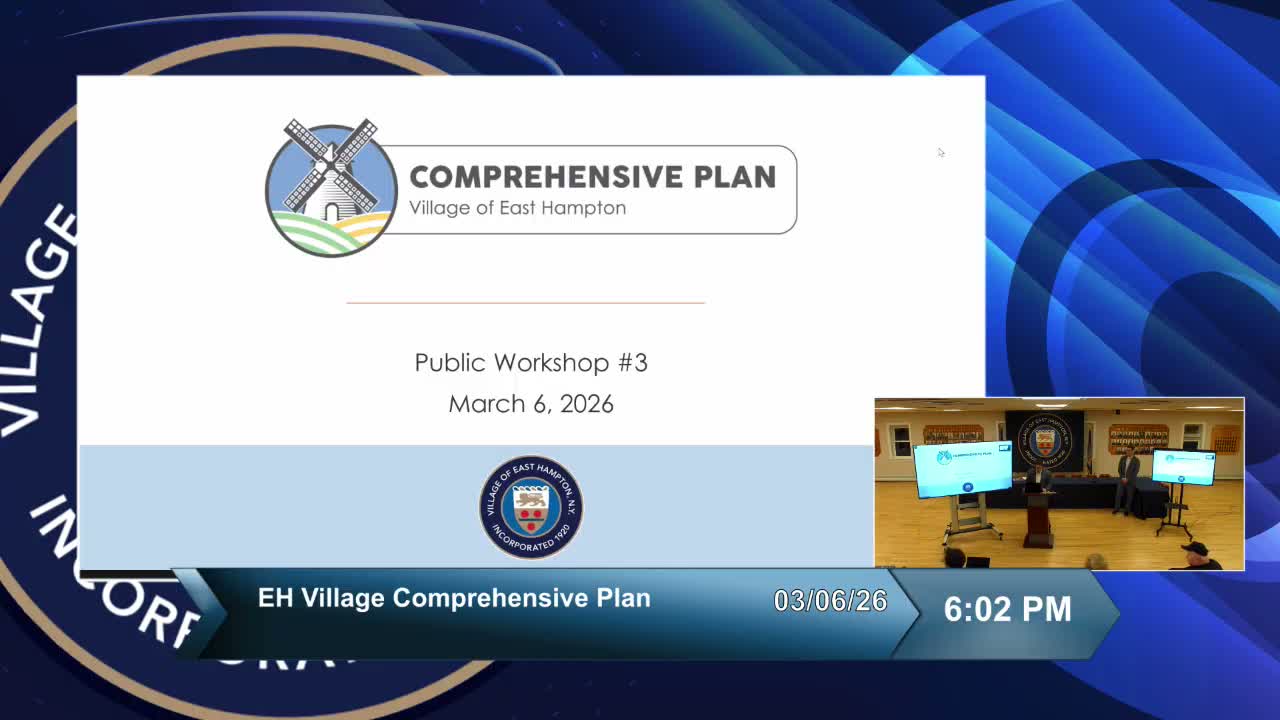
Consultants for East Hampton Village presented a working draft of a comprehensive plan and opened a steering-committee public hearing Friday, asking residents to submit comments through April before the plan is revised for Village Board review and environmental review.
Noah Levine, who led the presentation, said the draft is a roadmap covering demographics, housing and neighborhoods, commercial development, transportation, community facilities, parks and resilience and an implementation and action plan. "This is a public hearing for the steering committee," Levine said, framing the session as one step in a larger review process.
The draft highlights long-term population decline, a high median age, and a sharp seasonal population swing — "about 1,200 to over 6,000 people" in summer — that strains services and infrastructure, consultant Emily Tolbert said. Tolbert outlined housing recommendations including stronger neighborhood-character protections, studying accessory dwelling unit policy, codifying transfer-of-development-rights use, and exploring town and community housing funds to support acquisition and rehabilitation.
On infrastructure, residents and consultants stressed sewer capacity as a constraint on new housing and commercial uses in the village center. Tolbert said longer-term sewer planning may be necessary to support expanded uses and improve water quality impaired by septic systems. Robert Retenny, a commercial property owner, urged practical circulation fixes and said bringing "wet uses" into the village through sewer improvements had helped vibrancy where implemented.
Traffic and parking emerged repeatedly. Consultants recommended targeted traffic calming, intersection studies and a villagewide parking management plan that could include smart-parking technology and designated contractor or seasonal parking zones. Resident Bill Lukaszak, who described decades of cycling in the area, recommended traffic-calming measures such as speed bumps: "That's the only thing that slows people down," he said.
Historic preservation and community facilities were also central to public comments. Hugh King, the village historian, asked the steering committee to correct missing or misstated sites in the draft and to include specific properties and inns in the cultural resources list. Consultants recommended a cultural-resources survey, updated design guidelines and possible preservation easements.
Other public comments raised implementation details and local governance questions: a commenter identifying only as Bob urged the plan to rank priorities and provide cost estimates for key actions; Kirby Marcantonio highlighted the scarcity of developable land and recent local real-estate prices — noting a nearby sale of $13,000,000 and an adjacent parcel listed for $24,000,000 — and argued for closer coordination with town government and pooled housing funds to acquire land for workforce housing.
Residents also urged improvements to village communications and internet. David Gans called the current village website "a dog's breakfast," cited broken links and missing postings, and recommended issuing an RFP to secure reliable public-facing communications and high-speed service rather than relying on private arrangements.
Next steps: the steering committee will review oral and written comments submitted through April, revise the draft as appropriate, and when the committee is ready submit the plan to the Village Board of Trustees for consideration and the required environmental review.
Noah Levine, who led the presentation, said the draft is a roadmap covering demographics, housing and neighborhoods, commercial development, transportation, community facilities, parks and resilience and an implementation and action plan. "This is a public hearing for the steering committee," Levine said, framing the session as one step in a larger review process.
The draft highlights long-term population decline, a high median age, and a sharp seasonal population swing — "about 1,200 to over 6,000 people" in summer — that strains services and infrastructure, consultant Emily Tolbert said. Tolbert outlined housing recommendations including stronger neighborhood-character protections, studying accessory dwelling unit policy, codifying transfer-of-development-rights use, and exploring town and community housing funds to support acquisition and rehabilitation.
On infrastructure, residents and consultants stressed sewer capacity as a constraint on new housing and commercial uses in the village center. Tolbert said longer-term sewer planning may be necessary to support expanded uses and improve water quality impaired by septic systems. Robert Retenny, a commercial property owner, urged practical circulation fixes and said bringing "wet uses" into the village through sewer improvements had helped vibrancy where implemented.
Traffic and parking emerged repeatedly. Consultants recommended targeted traffic calming, intersection studies and a villagewide parking management plan that could include smart-parking technology and designated contractor or seasonal parking zones. Resident Bill Lukaszak, who described decades of cycling in the area, recommended traffic-calming measures such as speed bumps: "That's the only thing that slows people down," he said.
Historic preservation and community facilities were also central to public comments. Hugh King, the village historian, asked the steering committee to correct missing or misstated sites in the draft and to include specific properties and inns in the cultural resources list. Consultants recommended a cultural-resources survey, updated design guidelines and possible preservation easements.
Other public comments raised implementation details and local governance questions: a commenter identifying only as Bob urged the plan to rank priorities and provide cost estimates for key actions; Kirby Marcantonio highlighted the scarcity of developable land and recent local real-estate prices — noting a nearby sale of $13,000,000 and an adjacent parcel listed for $24,000,000 — and argued for closer coordination with town government and pooled housing funds to acquire land for workforce housing.
Residents also urged improvements to village communications and internet. David Gans called the current village website "a dog's breakfast," cited broken links and missing postings, and recommended issuing an RFP to secure reliable public-facing communications and high-speed service rather than relying on private arrangements.
Next steps: the steering committee will review oral and written comments submitted through April, revise the draft as appropriate, and when the committee is ready submit the plan to the Village Board of Trustees for consideration and the required environmental review.
View the Full Meeting & All Its Details
This article offers just a summary. Unlock complete video, transcripts, and insights as a Founder Member.
✓
Watch full, unedited meeting videos
✓
Search every word spoken in unlimited transcripts
✓
AI summaries & real-time alerts (all government levels)
✓
Permanent access to expanding government content
30-day money-back guarantee
