CalPERS chief actuary tells lawmakers funding improved but warns market volatility could raise costs
March 04, 2026 | California State Assembly, House, Legislative, California
This article was created by AI summarizing key points discussed. AI makes mistakes, so for full details and context, please refer to the video of the full meeting. Please report any errors so we can fix them. Report an error »
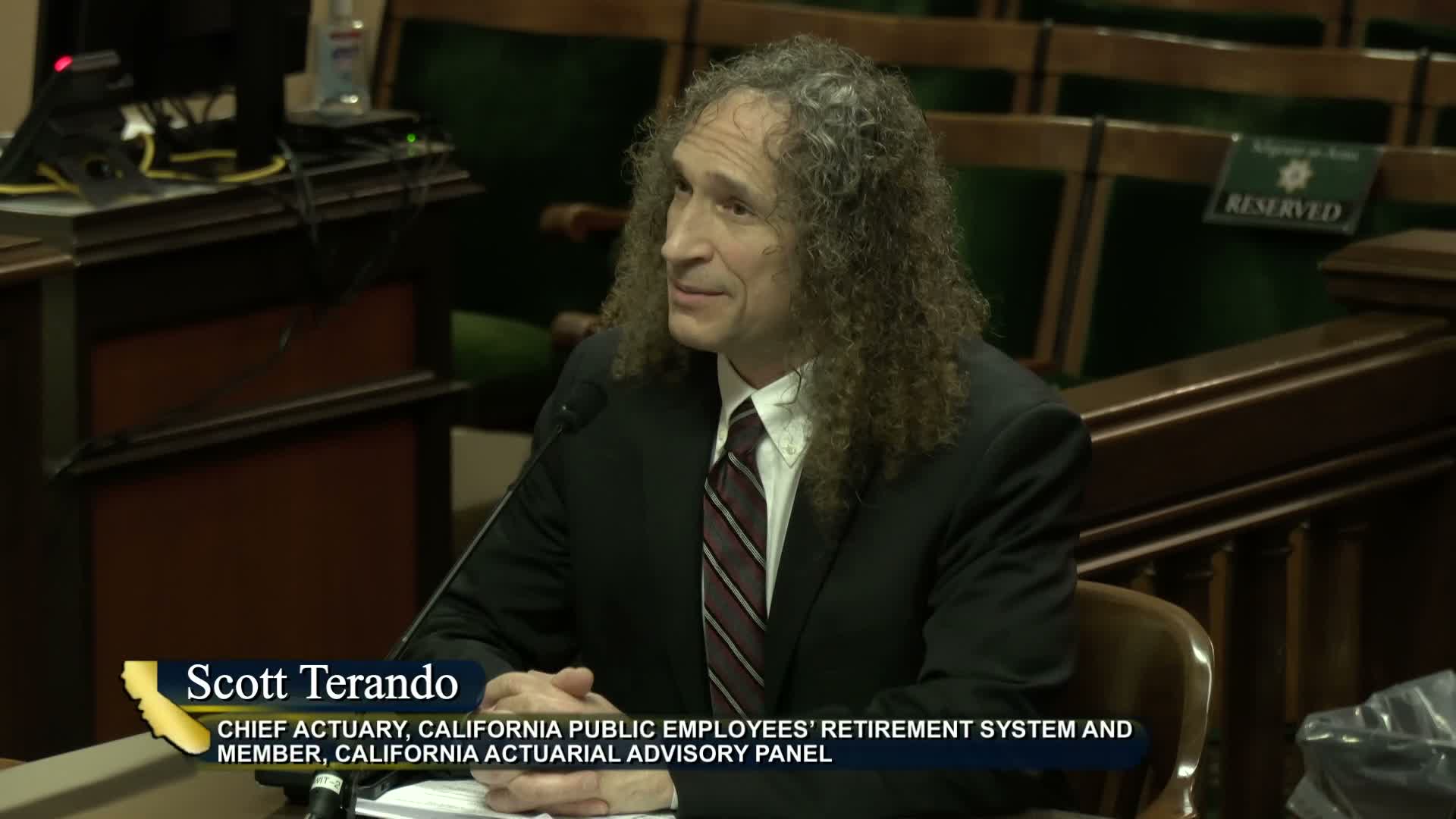
Scott Turandau, CalPERS’ chief actuary, told a joint hearing of the California State Assembly and Senate committees on pensions that the system’s funded status has improved materially in the past decade but that investment volatility and actuarial assumptions remain central to future contribution costs.
Turandau said the independent California Actuarial Advisory Panel (CAP) and CalPERS follow statutory disclosure rules under Government Code Section 20,229 requiring CalPERS to show sensitivity of liabilities and contribution rates to a plus‑and‑minus 2 percentage‑point change in the discount rate. He reiterated that CalPERS’ current long‑term discount rate used in the valuation is 6.8% and explained how that assumption affects the present value of liabilities and required contributions.
"The investment return assumption plays a central role because it determines the present value of liabilities," Turandau said. He explained that if returns run lower than assumed, unfunded liabilities rise and contribution rates would need to increase, placing pressure on employers and state budgets.
Turandau outlined CalPERS’ amortization practice — the plan currently amortizes gains and losses over a 20‑year period — and compared that choice to a mortgage: shorter amortization reduces lifetime interest but raises near‑term payments and can introduce contribution volatility. He noted CAP guidance and industry practice that place a reasonable amortization range at about 15–20 years for large, ongoing plans.
Lawmakers asked detailed questions about timing and data. Turandau described the data and approval calendar: asset and census data are taken as of the fiscal‑year end (June), audited and finalized in November, presented to the CalPERS board in April, and then used to set contribution rates for the following budget cycle. He said the office was working with 2025 fiscal‑year data that would inform contribution rates for 2026–27.
Senator Smallwood Cuevas pressed whether more current data could be used, citing rapidly changing technologies and geopolitical risks. Turandau responded that participant (member) data typically does not change materially month‑to‑month, that assets are volatile and can move substantially in a single trading day, and that the established audit and reconciliation timetable provides reliable, auditable inputs for the actuarial work.
An Assemblymember asked whether annual valuations affect retirees’ benefits; Turandau answered that benefit amounts are fixed at retirement and are not changed by the valuation process. He described cost‑of‑living adjustment mechanics (most retirees receive a 2% COLA, subject to purchase‑power protection caps) and explained the protective features that limit inflation’s erosion of benefit value.
On funded status, Turandau said CalPERS’ funded ratio was in the mid‑60s (roughly 65%) about a decade ago and had risen to about 79% as of the June 30 valuation; he said returns later in the year pushed the funded ratio above 80% and toward the mid‑80s by year end. He cautioned that these numbers are point‑in‑time measures and sensitive to market swings.
Michael Cohen, CalPERS’ Chief Officer for Investment Operations, told the committees that CalPERS is audited annually, that the system has complied with requests for information from federal authorities, and that the audits and related documents are posted publicly. Cohen said there had been no formal federal review report released at the time of the hearing.
During public comment, Eric Lohrer of the California State Association of Counties commended pension staff and reforms such as PEPRA and cited county experience that corresponded with the presented funding improvements.
The committees concluded with chairs stressing fiduciary duty and asking CalPERS to continue communication as new data emerges. Turandau and Cohen told the committees they would provide updates as available and that the board would review audited results in April.
Turandau said the independent California Actuarial Advisory Panel (CAP) and CalPERS follow statutory disclosure rules under Government Code Section 20,229 requiring CalPERS to show sensitivity of liabilities and contribution rates to a plus‑and‑minus 2 percentage‑point change in the discount rate. He reiterated that CalPERS’ current long‑term discount rate used in the valuation is 6.8% and explained how that assumption affects the present value of liabilities and required contributions.
"The investment return assumption plays a central role because it determines the present value of liabilities," Turandau said. He explained that if returns run lower than assumed, unfunded liabilities rise and contribution rates would need to increase, placing pressure on employers and state budgets.
Turandau outlined CalPERS’ amortization practice — the plan currently amortizes gains and losses over a 20‑year period — and compared that choice to a mortgage: shorter amortization reduces lifetime interest but raises near‑term payments and can introduce contribution volatility. He noted CAP guidance and industry practice that place a reasonable amortization range at about 15–20 years for large, ongoing plans.
Lawmakers asked detailed questions about timing and data. Turandau described the data and approval calendar: asset and census data are taken as of the fiscal‑year end (June), audited and finalized in November, presented to the CalPERS board in April, and then used to set contribution rates for the following budget cycle. He said the office was working with 2025 fiscal‑year data that would inform contribution rates for 2026–27.
Senator Smallwood Cuevas pressed whether more current data could be used, citing rapidly changing technologies and geopolitical risks. Turandau responded that participant (member) data typically does not change materially month‑to‑month, that assets are volatile and can move substantially in a single trading day, and that the established audit and reconciliation timetable provides reliable, auditable inputs for the actuarial work.
An Assemblymember asked whether annual valuations affect retirees’ benefits; Turandau answered that benefit amounts are fixed at retirement and are not changed by the valuation process. He described cost‑of‑living adjustment mechanics (most retirees receive a 2% COLA, subject to purchase‑power protection caps) and explained the protective features that limit inflation’s erosion of benefit value.
On funded status, Turandau said CalPERS’ funded ratio was in the mid‑60s (roughly 65%) about a decade ago and had risen to about 79% as of the June 30 valuation; he said returns later in the year pushed the funded ratio above 80% and toward the mid‑80s by year end. He cautioned that these numbers are point‑in‑time measures and sensitive to market swings.
Michael Cohen, CalPERS’ Chief Officer for Investment Operations, told the committees that CalPERS is audited annually, that the system has complied with requests for information from federal authorities, and that the audits and related documents are posted publicly. Cohen said there had been no formal federal review report released at the time of the hearing.
During public comment, Eric Lohrer of the California State Association of Counties commended pension staff and reforms such as PEPRA and cited county experience that corresponded with the presented funding improvements.
The committees concluded with chairs stressing fiduciary duty and asking CalPERS to continue communication as new data emerges. Turandau and Cohen told the committees they would provide updates as available and that the board would review audited results in April.
Don't Miss a Word: See the Full Meeting!
Go beyond summaries. Unlock every video, transcript, and key insight with a Founder Membership.
✓
Get instant access to full meeting videos
✓
Search and clip any phrase from complete transcripts
✓
Receive AI-powered summaries & custom alerts
✓
Enjoy lifetime, unrestricted access to government data
30-day money-back guarantee
