Secretary Crowfoot tells Assembly subcommittee Prop 4 and targeted investments are central to climate resilience as federal capacity wanes
March 04, 2026 | California State Assembly, House, Legislative, California
This article was created by AI summarizing key points discussed. AI makes mistakes, so for full details and context, please refer to the video of the full meeting. Please report any errors so we can fix them. Report an error »
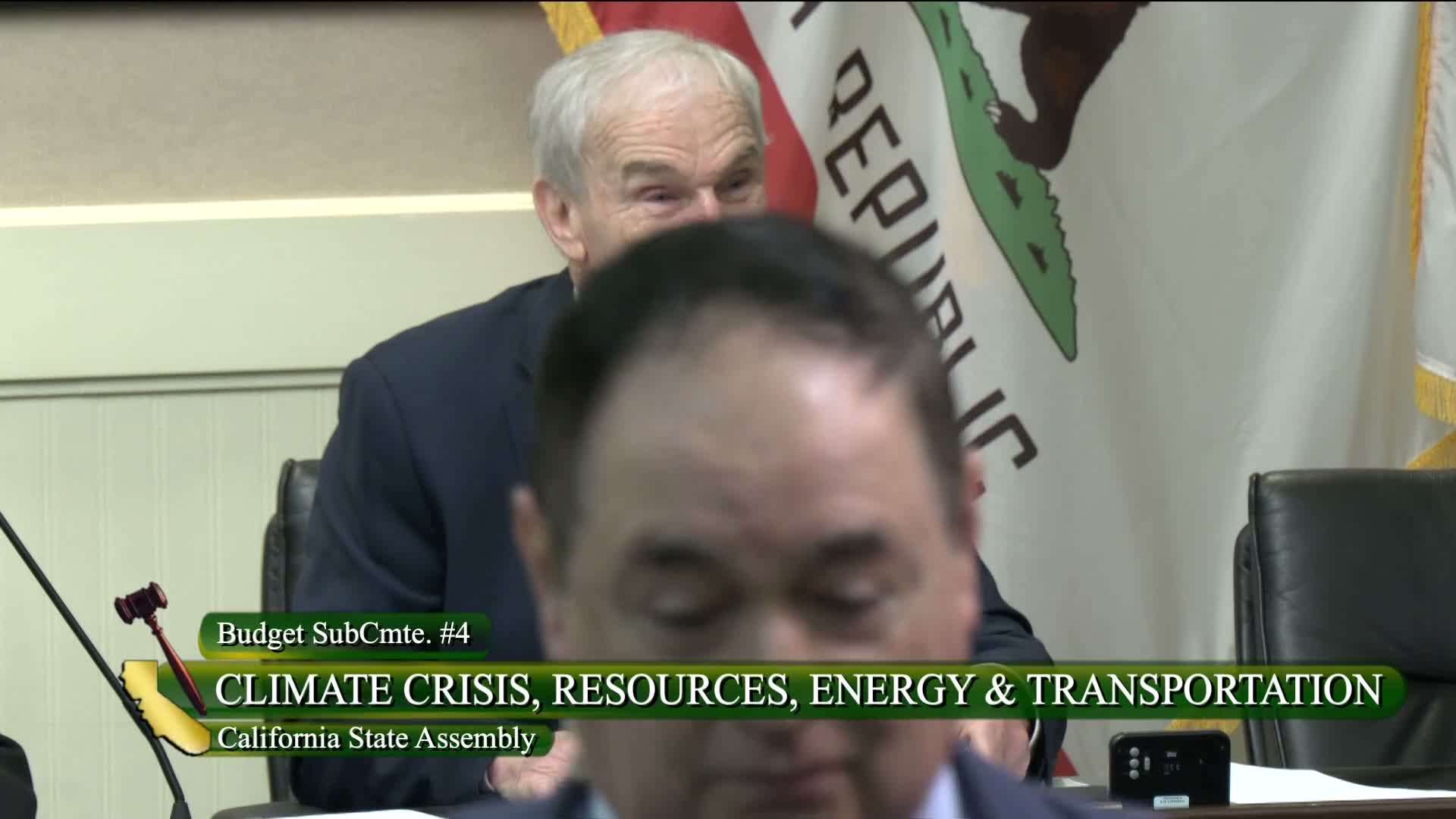
Wade Crowfoot, secretary of the California Natural Resources Agency, opened the subcommittee's presentation by praising a decade of climate investments and warning that recent federal cuts have eroded partners the state once relied on.
Crowfoot told the Assembly Budget Subcommittee for Climate, Resources, Energy and Transportation that California has directed roughly $40 billion toward climate work in recent years and highlighted gains in wildfire resilience, water planning, coastal adaptation and land conservation. "We are decarbonizing the grid," he said, noting that clean energy supplied two‑thirds of the state's electricity last year and that conservation investments have added millions of acres of protected lands.
At the same time, Crowfoot said, the state now faces a loss of federal capacity that previously underpinned forecasting, monitoring and other operations. "Overnight, we lost the federal staff to that river forecasting center," he said, arguing the state had to step in to maintain flood forecasting and other services. He described shortfalls across agencies including NOAA, the Bureau of Reclamation and U.S. Forest Service offices that had previously partnered with state teams.
Crowfoot highlighted the governor's reliance on Prop 4 (the climate bond) to fund priority work and described administrative reforms — such as streamlining permitting and rolling application processes at the State Coastal Conservancy and Wildlife Conservation Board — intended to get projects on the ground faster. He pointed to a suite of wildfire prevention projects, tribal co‑management efforts and investments in local water resilience as examples of progress.
Crowfoot also urged the subcommittee to focus on projects that make the largest difference for communities, such as community hardening and fuel breaks near populated areas. He said the administration is exploring ways to maintain environmental safeguards while reducing procedural delays.
The subcommittee did not vote on any measures at the hearing; Crowfoot's presentation framed the administration's priorities for follow‑up meetings and for the committee's budget deliberations.
Crowfoot told the Assembly Budget Subcommittee for Climate, Resources, Energy and Transportation that California has directed roughly $40 billion toward climate work in recent years and highlighted gains in wildfire resilience, water planning, coastal adaptation and land conservation. "We are decarbonizing the grid," he said, noting that clean energy supplied two‑thirds of the state's electricity last year and that conservation investments have added millions of acres of protected lands.
At the same time, Crowfoot said, the state now faces a loss of federal capacity that previously underpinned forecasting, monitoring and other operations. "Overnight, we lost the federal staff to that river forecasting center," he said, arguing the state had to step in to maintain flood forecasting and other services. He described shortfalls across agencies including NOAA, the Bureau of Reclamation and U.S. Forest Service offices that had previously partnered with state teams.
Crowfoot highlighted the governor's reliance on Prop 4 (the climate bond) to fund priority work and described administrative reforms — such as streamlining permitting and rolling application processes at the State Coastal Conservancy and Wildlife Conservation Board — intended to get projects on the ground faster. He pointed to a suite of wildfire prevention projects, tribal co‑management efforts and investments in local water resilience as examples of progress.
Crowfoot also urged the subcommittee to focus on projects that make the largest difference for communities, such as community hardening and fuel breaks near populated areas. He said the administration is exploring ways to maintain environmental safeguards while reducing procedural delays.
The subcommittee did not vote on any measures at the hearing; Crowfoot's presentation framed the administration's priorities for follow‑up meetings and for the committee's budget deliberations.
Don't Miss a Word: See the Full Meeting!
Go beyond summaries. Unlock every video, transcript, and key insight with a Founder Membership.
✓
Get instant access to full meeting videos
✓
Search and clip any phrase from complete transcripts
✓
Receive AI-powered summaries & custom alerts
✓
Enjoy lifetime, unrestricted access to government data
30-day money-back guarantee
