Residents press Thurston County for diagnostic review to pursue quiet zone at Atchison Road
March 04, 2026 | Thurston County, Washington
This article was created by AI summarizing key points discussed. AI makes mistakes, so for full details and context, please refer to the video of the full meeting. Please report any errors so we can fix them. Report an error »
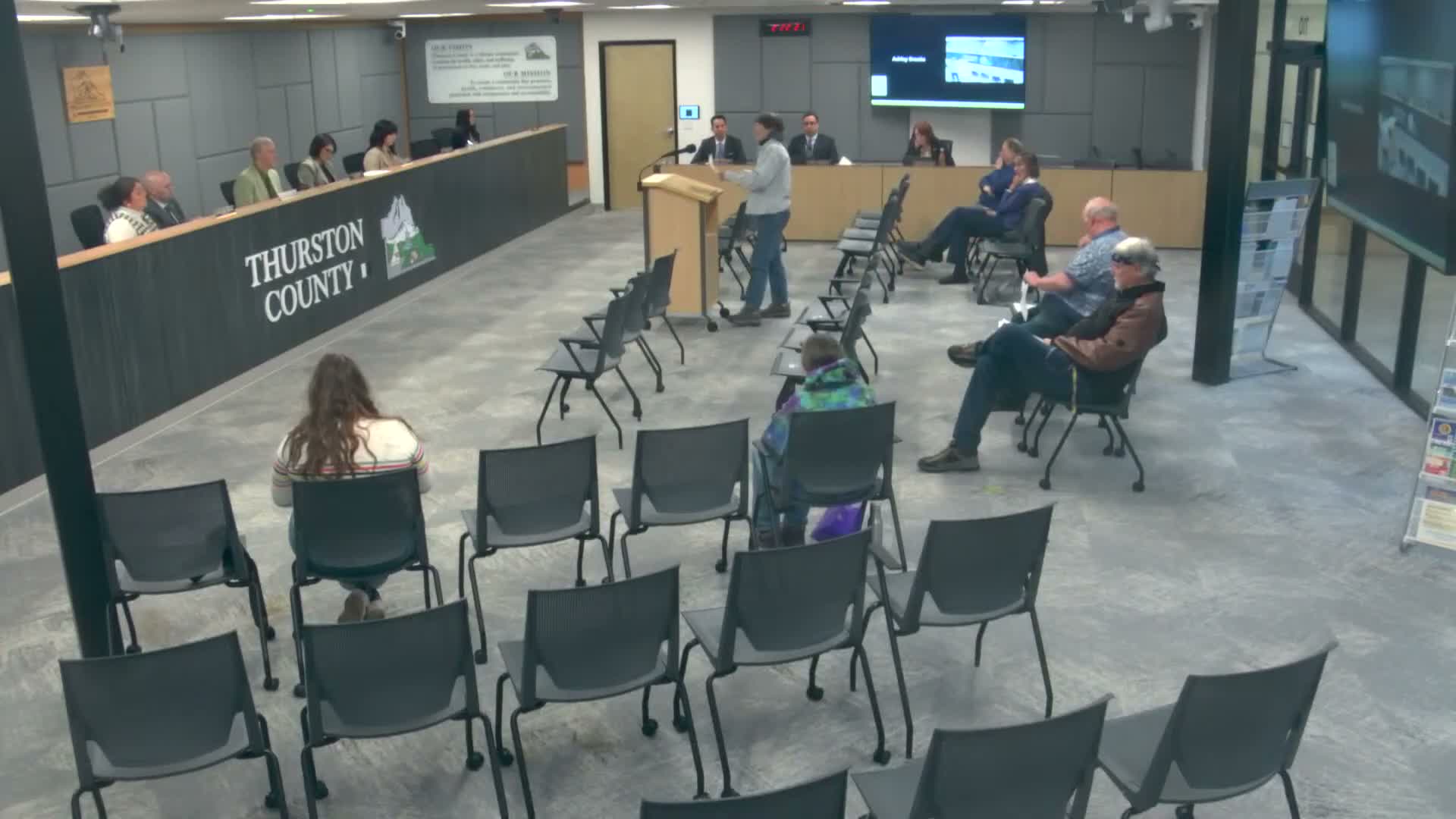
Several residents told the Thurston County Board on March 3 that a diagnostic review is necessary to evaluate a quiet zone at the Atchison Road railroad crossing and offered volunteer data and analysis for the county to use.
Patricia Williams, representing residents near Patterson Lake, said the quiet-zone team has produced a study and volunteer CVs and asked the county when it would initiate a diagnostic review for the Atchison crossing. "You are being handed an opportunity for an amazing amount of skilled research and analysis at no cost to the county," Williams said, urging the board to use the volunteers’ work as a pilot for a countywide diagnostic review.
Jane Poole and David Nightingale, members of the Patterson Lake Association Quiet Zone Committee, described years of data gathering. Nightingale said diagnostic reviews are typically short documents—"maybe two pages"—that bring experts together to identify likely remedies and cost estimates and that public works has experience doing similar diagnostic work. Speakers cited community findings that the crossing now sees many trains—committee material referenced about 30 trains per day at that location and residents reported frequent horn use—and urged county action to study options such as a center median or supplemental safety measures.
Commissioners and staff acknowledged longstanding conversations about liability, maintenance and costs and said they were working to bring the topic back to the full board. County staff told residents they expected to place the review on an upcoming agenda within roughly two weeks for further discussion; no formal commitment to adopt a quiet zone was made during this meeting.
Why this matters: quiet zones can reduce repeated horn use that residents say is affecting sleep and quality of life, but installing one typically requires federal involvement, coordination with the railroad and clarity about maintenance and liability. The diagnostic review is intended to clarify feasible improvements and cost estimates before the board considers next steps.
Patricia Williams, representing residents near Patterson Lake, said the quiet-zone team has produced a study and volunteer CVs and asked the county when it would initiate a diagnostic review for the Atchison crossing. "You are being handed an opportunity for an amazing amount of skilled research and analysis at no cost to the county," Williams said, urging the board to use the volunteers’ work as a pilot for a countywide diagnostic review.
Jane Poole and David Nightingale, members of the Patterson Lake Association Quiet Zone Committee, described years of data gathering. Nightingale said diagnostic reviews are typically short documents—"maybe two pages"—that bring experts together to identify likely remedies and cost estimates and that public works has experience doing similar diagnostic work. Speakers cited community findings that the crossing now sees many trains—committee material referenced about 30 trains per day at that location and residents reported frequent horn use—and urged county action to study options such as a center median or supplemental safety measures.
Commissioners and staff acknowledged longstanding conversations about liability, maintenance and costs and said they were working to bring the topic back to the full board. County staff told residents they expected to place the review on an upcoming agenda within roughly two weeks for further discussion; no formal commitment to adopt a quiet zone was made during this meeting.
Why this matters: quiet zones can reduce repeated horn use that residents say is affecting sleep and quality of life, but installing one typically requires federal involvement, coordination with the railroad and clarity about maintenance and liability. The diagnostic review is intended to clarify feasible improvements and cost estimates before the board considers next steps.
View the Full Meeting & All Its Details
This article offers just a summary. Unlock complete video, transcripts, and insights as a Founder Member.
✓
Watch full, unedited meeting videos
✓
Search every word spoken in unlimited transcripts
✓
AI summaries & real-time alerts (all government levels)
✓
Permanent access to expanding government content
30-day money-back guarantee
