Santa Barbara planning panel forwards draft short‑term rental ordinance to ordinance committee after hours of public comment
March 06, 2026 | Santa Barbara City, Santa Barbara County, California
This article was created by AI summarizing key points discussed. AI makes mistakes, so for full details and context, please refer to the video of the full meeting. Please report any errors so we can fix them. Report an error »
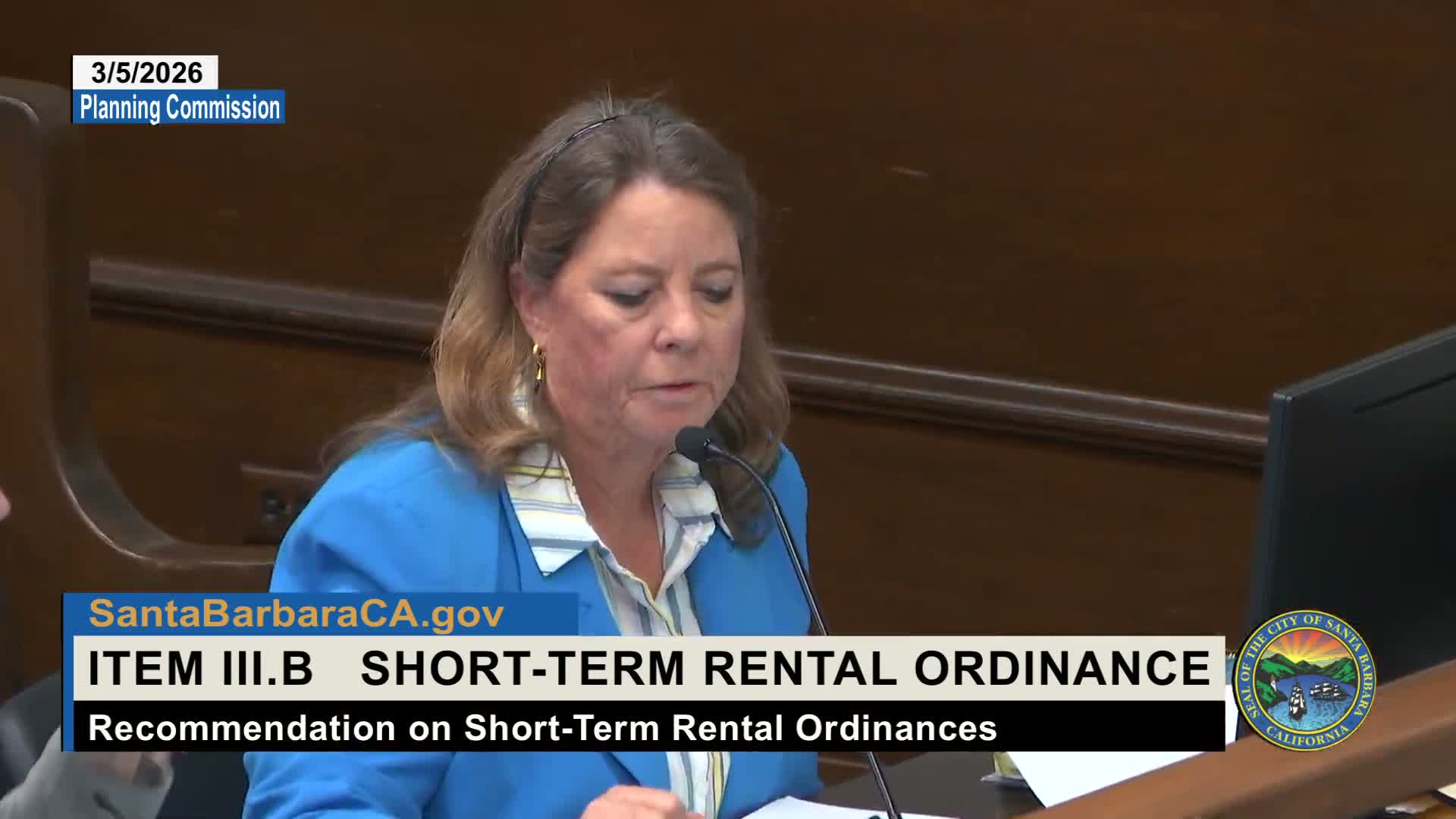
The Santa Barbara City Planning Commission on March 5, 2026 voted to forward a draft short‑term rental ordinance to the city ordinance committee, asking staff for detailed follow‑up on enforcement tools, projected transient occupancy tax (TOT) impacts, parking waivers and whether a cap or lottery model would better distribute short‑term rentals across neighborhoods.
The commission heard a multi‑hour staff presentation from project planner Laura Bridal and an interdepartmental team, who said the draft ordinance was written to preserve long‑term housing and provide an online licensing path to regulate and mitigate neighborhood nuisance. Bridal told the commission the ordinance is designed to “engineer compliance” through screening, operational standards and posting requirements, and that staff coordinated iteratively with the California Coastal Commission while drafting the coastal provisions.
The draft would allow whole‑house short‑term rentals only inside a defined coastal license area and certain commercial zones, while allowing “home shares” — hosted rentals where a resident is present — more broadly in parts of the coastal zone. The proposal includes occupancy limits, quiet hours (10 p.m.–7 a.m.), a requirement that a property manager respond to complaints within 30 minutes, and outside and inside postings with manager and city enforcement contact information. Staff said existing legally authorized conversions (about 25 properties identified through prior change‑of‑use permits) would be grandfathered; other operators who have paid TOT or hold a business tax certificate but lack a land‑use conversion would need to apply for licenses under the new program.
Public commenters were sharply split. Neighbors described repeated late‑night parties, noise and safety concerns in neighborhoods such as Yankee Farm/Braemar and the Mesa and urged stricter limits; owners, managers and business groups — including the Santa Barbara Association of Realtors and short‑term‑rental alliances — warned the draft would eliminate visitor capacity in the coastal zone, threaten low‑cost visitor accommodation and produce large TOT losses. Representatives for STR industry groups and planners argued the ordinance as drafted would functionally operate as a ban in the coastal zone and urged grandfathering for longtime operators and clearer transition rules. One commenter cited an estimate that permitted STRs generate roughly $4 million a year in TOT; staff said finance is preparing more precise revenue analyses to accompany future council hearings.
Commissioners used the question period to press staff on several unresolved issues: the gap between the roughly 25 conversion permits staff identified and the much larger numbers of listings seen on platforms; how home shares would be verified and enforced; the treatment of accessory dwelling units; the practicality of parking standards that require off‑street parking proportions similar to single‑family requirements; and whether listing platforms would cooperate in removing noncompliant ads. Staff said enforcement tools would include SBConnect complaint tracking, code enforcement follow‑up, platform takedown requests and reliance on advertising listings to detect inconsistencies between licensed use and what is being advertised.
Chair Boss moved that the commission forward the draft ordinance to the city’s ordinance committee with a list of follow‑up requests: targeted analysis and options for parking waivers, a full TOT impact analysis, enforcement details and assurances (including platform cooperation), annual reporting metrics on TOT, enforcement and housing outcomes, and a comparative analysis of the drafted zoning‑based approach versus a cap/density/lottery model and how to transition existing operators (the disparity between permitted conversions and operational listings). The motion passed on a roll‑call vote.
Next steps: staff said the ordinance committee review is planned in April, with council introduction and potential adoption targeted for mid–late May; staff would then send the adopted coastal provisions to the California Coastal Commission (staff estimated the Coastal Commission review would take six to 12 months). Commissioners and public speakers repeatedly emphasized that the outcome hinges on more complete revenue and enforcement analysis and on whether the Coastal Commission accepts the balance between preserving housing and maintaining visitor‑serving accommodations.
The planning commission’s recommendation will inform the ordinance committee and city council as staff completes the requested analyses.
The commission heard a multi‑hour staff presentation from project planner Laura Bridal and an interdepartmental team, who said the draft ordinance was written to preserve long‑term housing and provide an online licensing path to regulate and mitigate neighborhood nuisance. Bridal told the commission the ordinance is designed to “engineer compliance” through screening, operational standards and posting requirements, and that staff coordinated iteratively with the California Coastal Commission while drafting the coastal provisions.
The draft would allow whole‑house short‑term rentals only inside a defined coastal license area and certain commercial zones, while allowing “home shares” — hosted rentals where a resident is present — more broadly in parts of the coastal zone. The proposal includes occupancy limits, quiet hours (10 p.m.–7 a.m.), a requirement that a property manager respond to complaints within 30 minutes, and outside and inside postings with manager and city enforcement contact information. Staff said existing legally authorized conversions (about 25 properties identified through prior change‑of‑use permits) would be grandfathered; other operators who have paid TOT or hold a business tax certificate but lack a land‑use conversion would need to apply for licenses under the new program.
Public commenters were sharply split. Neighbors described repeated late‑night parties, noise and safety concerns in neighborhoods such as Yankee Farm/Braemar and the Mesa and urged stricter limits; owners, managers and business groups — including the Santa Barbara Association of Realtors and short‑term‑rental alliances — warned the draft would eliminate visitor capacity in the coastal zone, threaten low‑cost visitor accommodation and produce large TOT losses. Representatives for STR industry groups and planners argued the ordinance as drafted would functionally operate as a ban in the coastal zone and urged grandfathering for longtime operators and clearer transition rules. One commenter cited an estimate that permitted STRs generate roughly $4 million a year in TOT; staff said finance is preparing more precise revenue analyses to accompany future council hearings.
Commissioners used the question period to press staff on several unresolved issues: the gap between the roughly 25 conversion permits staff identified and the much larger numbers of listings seen on platforms; how home shares would be verified and enforced; the treatment of accessory dwelling units; the practicality of parking standards that require off‑street parking proportions similar to single‑family requirements; and whether listing platforms would cooperate in removing noncompliant ads. Staff said enforcement tools would include SBConnect complaint tracking, code enforcement follow‑up, platform takedown requests and reliance on advertising listings to detect inconsistencies between licensed use and what is being advertised.
Chair Boss moved that the commission forward the draft ordinance to the city’s ordinance committee with a list of follow‑up requests: targeted analysis and options for parking waivers, a full TOT impact analysis, enforcement details and assurances (including platform cooperation), annual reporting metrics on TOT, enforcement and housing outcomes, and a comparative analysis of the drafted zoning‑based approach versus a cap/density/lottery model and how to transition existing operators (the disparity between permitted conversions and operational listings). The motion passed on a roll‑call vote.
Next steps: staff said the ordinance committee review is planned in April, with council introduction and potential adoption targeted for mid–late May; staff would then send the adopted coastal provisions to the California Coastal Commission (staff estimated the Coastal Commission review would take six to 12 months). Commissioners and public speakers repeatedly emphasized that the outcome hinges on more complete revenue and enforcement analysis and on whether the Coastal Commission accepts the balance between preserving housing and maintaining visitor‑serving accommodations.
The planning commission’s recommendation will inform the ordinance committee and city council as staff completes the requested analyses.
Don't Miss a Word: See the Full Meeting!
Go beyond summaries. Unlock every video, transcript, and key insight with a Founder Membership.
✓
Get instant access to full meeting videos
✓
Search and clip any phrase from complete transcripts
✓
Receive AI-powered summaries & custom alerts
✓
Enjoy lifetime, unrestricted access to government data
30-day money-back guarantee
