Advocates clash over bill that would require historic documents — including the Ten Commandments — in Tennessee schools
March 04, 2026 | 2026 Legislature TN, Tennessee
This article was created by AI summarizing key points discussed. AI makes mistakes, so for full details and context, please refer to the video of the full meeting. Please report any errors so we can fix them. Report an error »
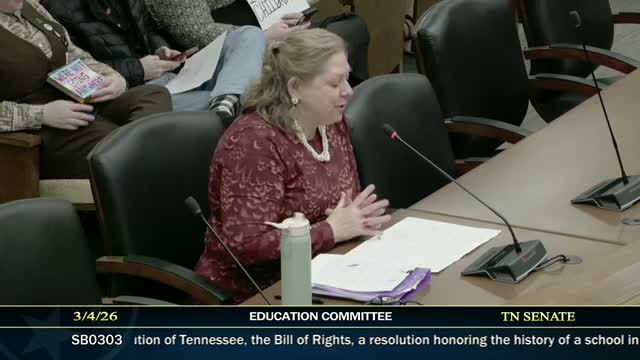
The Tennessee Senate Education Committee took public testimony on Senate Bill 303, a proposal to direct LEAs to display a list of historic documents in schools — the list would include the Declaration of Independence, the U.S. Constitution, the Tennessee Constitution and, controversially, the Ten Commandments.
Lucreta Martin, state policy advocate for the National Council of Jewish Women, said the bill would "demean and trivialize" sacred scripture if the Ten Commandments were treated as merely another item on a display wall in a public school and warned the inclusion would exclude students of minority faiths. "As a Jewish woman of faith, I strongly oppose Senate Bill 303," she told the committee.
Representatives of First Liberty Institute and WallBuilders argued the displays are constitutional under a post‑Kennedy Supreme Court legal framework and pointed to historical practice in American education. Nate Kellum of First Liberty told senators that the Supreme Court’s more recent decisions have undercut the Lemon test used in earlier cases and said the Ten Commandments have historical tradition supporting permissibility of displays. Timothy Barton of WallBuilders provided historical examples and described a long tradition of religious material appearing in early American educational readers and public buildings.
Committee exchange focused on two central questions: whether the Ten Commandments can be presented as a historical text without impermissible religious endorsement, and whether recent Supreme Court decisions meaningfully undercut earlier precedents like Stone v. Graham. Members pressed witnesses on both the legal theory and the practical effects for families and classroom instruction.
Outcome: after roughly three minutes of testimony per witness and extensive Q&A, sponsor Sen. Pote asked to roll the bill for one week in order to file an amendment and the committee agreed to do so.
Context: the measure is one of several similar bills considered in other states this legislative session; proponents cited recent Supreme Court decisions as altering the legal landscape for displays of religiously derived texts while opponents urged caution because religious texts remain central to faith communities and their government-sponsored display in schools raises statutory and constitutional risk.
Next steps: the sponsor will file an amendment within the week; committee members said they want clearer drafting and an explanation of how school districts should implement any required display.
Lucreta Martin, state policy advocate for the National Council of Jewish Women, said the bill would "demean and trivialize" sacred scripture if the Ten Commandments were treated as merely another item on a display wall in a public school and warned the inclusion would exclude students of minority faiths. "As a Jewish woman of faith, I strongly oppose Senate Bill 303," she told the committee.
Representatives of First Liberty Institute and WallBuilders argued the displays are constitutional under a post‑Kennedy Supreme Court legal framework and pointed to historical practice in American education. Nate Kellum of First Liberty told senators that the Supreme Court’s more recent decisions have undercut the Lemon test used in earlier cases and said the Ten Commandments have historical tradition supporting permissibility of displays. Timothy Barton of WallBuilders provided historical examples and described a long tradition of religious material appearing in early American educational readers and public buildings.
Committee exchange focused on two central questions: whether the Ten Commandments can be presented as a historical text without impermissible religious endorsement, and whether recent Supreme Court decisions meaningfully undercut earlier precedents like Stone v. Graham. Members pressed witnesses on both the legal theory and the practical effects for families and classroom instruction.
Outcome: after roughly three minutes of testimony per witness and extensive Q&A, sponsor Sen. Pote asked to roll the bill for one week in order to file an amendment and the committee agreed to do so.
Context: the measure is one of several similar bills considered in other states this legislative session; proponents cited recent Supreme Court decisions as altering the legal landscape for displays of religiously derived texts while opponents urged caution because religious texts remain central to faith communities and their government-sponsored display in schools raises statutory and constitutional risk.
Next steps: the sponsor will file an amendment within the week; committee members said they want clearer drafting and an explanation of how school districts should implement any required display.
Don't Miss a Word: See the Full Meeting!
Go beyond summaries. Unlock every video, transcript, and key insight with a Founder Membership.
✓
Get instant access to full meeting videos
✓
Search and clip any phrase from complete transcripts
✓
Receive AI-powered summaries & custom alerts
✓
Enjoy lifetime, unrestricted access to government data
30-day money-back guarantee
