Education committee advances a slate of K–12 bills on funding transparency, special‑education access and workforce supports
March 04, 2026 | 2026 Legislature TN, Tennessee
This article was created by AI summarizing key points discussed. AI makes mistakes, so for full details and context, please refer to the video of the full meeting. Please report any errors so we can fix them. Report an error »
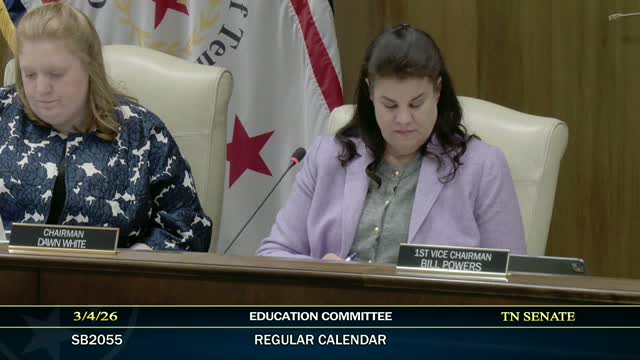
The Senate Education Committee voted on and advanced a broad set of K–12 measures during a long session that combined nomination votes, public testimony and policy debate.
Key committee actions at a glance:
- SB 2072 (Sen. Watson): Amendment adopted to require LEAs and charter schools to submit two annual public reports that break out revenue by source and spending by consistent categories (instructional costs, personnel, student supports, administration, operations, professional development and direct TISA allocations). Committee voted to move the bill to finance (reported as 8 ayes in committee).
- SB 2159 (Treasurer-sponsored): Establishes a $10 million annual cap on transfers to the Tennessee Promise endowment trust fund. Committee moved the bill to finance (9 ayes recorded).
- SB 2055 (Sen. Wally): Requires LEAs and public charter schools to allow licensed private-pay ABA providers to deliver services on school grounds under memoranda of understanding, IEP-team coordination and background checks; amendment adopted and bill moved to calendar (9 ayes reported).
- Multiple nominations for university advisory boards and trustees (SJR0626, SJR0628, SJR0631, SJR0632, SJR0637, SJR0644, SJR0646) were considered and advanced to the committee on calendar, typically by unanimous or near‑unanimous voice vote.
- Other bills advanced with little controversy included measures on charter-term flexibility, hunter education courses as optional offerings, clarification of honorifics and name/pronoun rules in schools, and updates to driver’s education. Where recorded, votes were typically unanimous or carried on strong bipartisan margins.
Why it matters: reforms to transparency and TISA reporting are intended to give the public more granular information about how local, state and federal funds are used in K–12 schools. Changes to service access (ABA) and workforce or early-education task-force proposals could directly affect service delivery and staffing.
Details and next steps: committee sponsors described amendments and implementation mechanics during the hearing; most bills were forwarded to the calendar or finance committee, where floor scheduling and fiscal analysis will follow. Sponsors and committee staff signaled follow-up work on reporting formats, and the Department of Education will participate in implementation guidance if bills become law.
Outcome: a mix of unanimous and near‑unanimous committee votes moved bills onward; several items were rolled for amendment or summer study where sponsors asked for more drafting time.
Key committee actions at a glance:
- SB 2072 (Sen. Watson): Amendment adopted to require LEAs and charter schools to submit two annual public reports that break out revenue by source and spending by consistent categories (instructional costs, personnel, student supports, administration, operations, professional development and direct TISA allocations). Committee voted to move the bill to finance (reported as 8 ayes in committee).
- SB 2159 (Treasurer-sponsored): Establishes a $10 million annual cap on transfers to the Tennessee Promise endowment trust fund. Committee moved the bill to finance (9 ayes recorded).
- SB 2055 (Sen. Wally): Requires LEAs and public charter schools to allow licensed private-pay ABA providers to deliver services on school grounds under memoranda of understanding, IEP-team coordination and background checks; amendment adopted and bill moved to calendar (9 ayes reported).
- Multiple nominations for university advisory boards and trustees (SJR0626, SJR0628, SJR0631, SJR0632, SJR0637, SJR0644, SJR0646) were considered and advanced to the committee on calendar, typically by unanimous or near‑unanimous voice vote.
- Other bills advanced with little controversy included measures on charter-term flexibility, hunter education courses as optional offerings, clarification of honorifics and name/pronoun rules in schools, and updates to driver’s education. Where recorded, votes were typically unanimous or carried on strong bipartisan margins.
Why it matters: reforms to transparency and TISA reporting are intended to give the public more granular information about how local, state and federal funds are used in K–12 schools. Changes to service access (ABA) and workforce or early-education task-force proposals could directly affect service delivery and staffing.
Details and next steps: committee sponsors described amendments and implementation mechanics during the hearing; most bills were forwarded to the calendar or finance committee, where floor scheduling and fiscal analysis will follow. Sponsors and committee staff signaled follow-up work on reporting formats, and the Department of Education will participate in implementation guidance if bills become law.
Outcome: a mix of unanimous and near‑unanimous committee votes moved bills onward; several items were rolled for amendment or summer study where sponsors asked for more drafting time.
Don't Miss a Word: See the Full Meeting!
Go beyond summaries. Unlock every video, transcript, and key insight with a Founder Membership.
✓
Get instant access to full meeting videos
✓
Search and clip any phrase from complete transcripts
✓
Receive AI-powered summaries & custom alerts
✓
Enjoy lifetime, unrestricted access to government data
30-day money-back guarantee
