Neighbors and board press safety, parking and scale concerns at Palo Alto ARB study session for 4103 Old Trace Road subdivision
March 06, 2026 | Palo Alto, Santa Clara County, California
This article was created by AI summarizing key points discussed. AI makes mistakes, so for full details and context, please refer to the video of the full meeting. Please report any errors so we can fix them. Report an error »
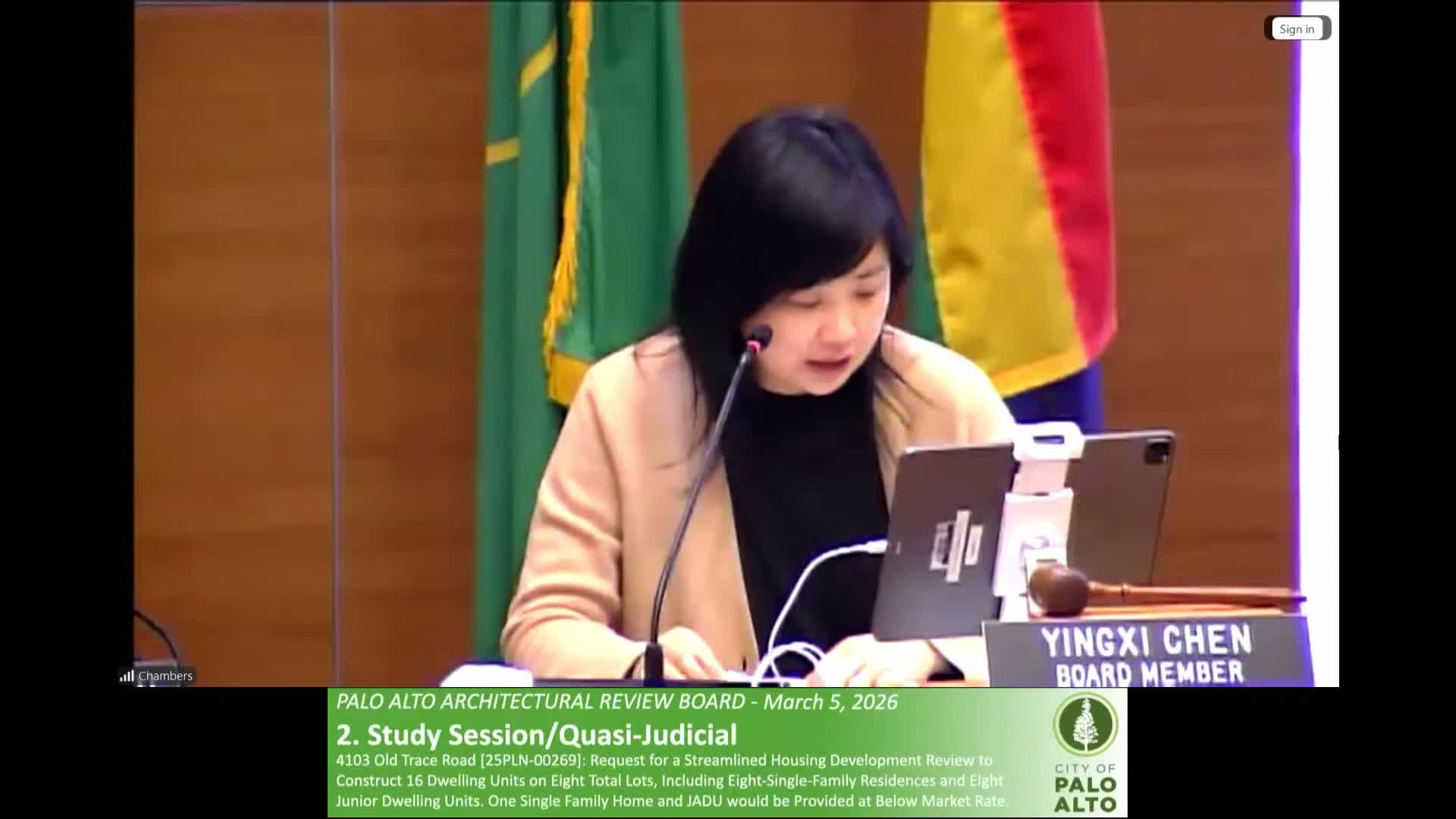
The Palo Alto Architectural Review Board on March 5 held a study session on a proposed subdivision at 4103 Old Trace Road — branded by the developer as “The Oaks” — that would subdivide a 1.02‑acre vacant parcel into eight residential lots with eight single‑family homes and eight junior accessory dwelling units (16 on‑site units), including one deed‑restricted below‑market‑rate unit.
City project planner Nishitha Ghandicopa told the board the applicant submitted a compliant SB 330 filing in 2025 that froze development standards, and the project team is pursuing density‑bonus waivers and an AB 130 CEQA exemption. Ghandicopa said staff is evaluating AB 130 eligibility and conducting required tribal consultation, expected to be complete in April 2026; a vesting tentative map for the subdivision is tentatively scheduled to go to council in May.
Why it matters: neighbors said the site, which sits at the Erastradero Road and Old Trace Road intersection adjacent to Esther Clark Park, relies on a single ingress/egress and narrow local streets that already see high speeds and constrained sight lines. Residents and board members warned the added dwellings, deliveries and guest parking could impede emergency response and daily access for elderly neighbors.
Residents pressed safety and access concerns in a long public‑comment period. Shaillou Shmara, representing a group of neighbors, said the neighborhood’s single ingress and aging population made the proposal untenable: “We’re increasing the number of homes by 55%…it’s untenable in terms of the safety hazard it creates,” Shmara said, adding that the 600‑foot mailed‑notice radius and three‑day ADA window did not reach many neighbors who wanted to participate.
Other speakers described blocked driveways for emergency vehicles, fast bicycle and vehicle traffic on Erastradero, the absence of sidewalks on Old Trace Road, and the risk that additional on‑street parking would prevent ambulances or VTA shuttles from accessing cul‑de‑sacs. Jeanie Clancy, who lives nearby, said the project’s parking supply would force overflow onto Old Trace Road and could delay emergency vehicles: “This corner…is the primary evacuation route for our area — anything that would impede emergency vehicles would cause a significant concern.”
Developer and applicant Melanie Griswold acknowledged neighbors’ concerns and said the team had voluntarily adopted several transportation and safety suggestions from staff and its consultant. Griswold cited a traffic analysis by Hexagon Transportation Consultants that, she said, estimated about five vehicle trips at peak PM hours and four outbound AM trips with one inbound (roughly one vehicle every 12 minutes in peak periods). “According to Hexagon…this is not something that is likely to increase traffic substantially,” she said, and offered to work with the city on striping, no‑parking zones and rapid‑flashing beacons where warranted.
Legal limits and staff position: the deputy city attorney reminded the board that state law constrains the city’s ability to deny density‑bonus concessions and waivers. The attorney said the city may deny a waiver only if it would violate state or federal law or create an unmitigable health or safety impact. Ghandicopa and Assistant Director Jennifer Armer told the board staff consulted with HCD and attorneys about the applicant’s requested concession for the size and distribution of the BMR unit and that HCD guidance restricts some local denials.
Board concerns and technical questions: commissioners asked detailed technical questions about circulation, emergency vehicle turning radii and trash staging; civil engineering staff explained driveway slopes (some driveways proposed under 5–7% and others higher), drainage strategies (gravity flow to storm systems with pump‑back), and where sidewalks might be feasible. Board members repeatedly urged stronger transportation mitigation: at minimum a stop sign or other intersection control at Old Trace/Erastradero, a sidewalk connection on Old Trace Road, and stricter limits on parking impacts.
Several board members said they were unconvinced the consultant analysis captured lived experience in the neighborhood. “When 30 people show up to raise safety issues, I don’t think we can simply trust those consultant numbers,” one board member said, urging the city to pursue neighborhood‑level traffic controls and to weigh safety over preserving a single heritage tree that may block a proposed sidewalk.
Design and program details: staff said one unit (Lot 5A) would be deed‑restricted at up to 100% of area median income to meet the 15% affordability requirement that triggers certain concessions. The applicant proposes a mix of architectural styles across lots, partially subterranean garages on sloped lots to reduce front‑facing garage impact, and one on‑site public art installation. Several board members suggested lowering parapet heights, reducing interior ceiling plate heights, rethinking light wells to improve basement daylight, and enhancing privacy screening toward adjacent homes.
Outcome and next steps: the ARB held the item as a study session and provided extensive feedback; no vote or formal action on the project occurred. Staff will continue AB 130 eligibility review and tribal consultation, coordinate with the Office of Transportation on intersection controls and pedestrian improvements, and require follow‑up technical refinements (drainage/dewatering plans, revised elevations, privacy treatments and parking/guest parking solutions) in subsequent submittals. The vesting tentative map is anticipated to go to the City Council in May, per staff.
Votes at a glance: the board approved meeting minutes for Dec. 4, 2025 (motion carries 5–0) and Jan. 15, 2026 (motion carries 3–0 with two abstentions).
What’s next: staff and the applicant will continue technical reviews, and the board asked the applicant to coordinate with transportation staff on intersection and sidewalk solutions and to return with revisions addressing scale, drainage and emergency access.
Quotes used in this article are taken verbatim from the March 5 study session and are attributed to speakers who identified themselves on the record.
City project planner Nishitha Ghandicopa told the board the applicant submitted a compliant SB 330 filing in 2025 that froze development standards, and the project team is pursuing density‑bonus waivers and an AB 130 CEQA exemption. Ghandicopa said staff is evaluating AB 130 eligibility and conducting required tribal consultation, expected to be complete in April 2026; a vesting tentative map for the subdivision is tentatively scheduled to go to council in May.
Why it matters: neighbors said the site, which sits at the Erastradero Road and Old Trace Road intersection adjacent to Esther Clark Park, relies on a single ingress/egress and narrow local streets that already see high speeds and constrained sight lines. Residents and board members warned the added dwellings, deliveries and guest parking could impede emergency response and daily access for elderly neighbors.
Residents pressed safety and access concerns in a long public‑comment period. Shaillou Shmara, representing a group of neighbors, said the neighborhood’s single ingress and aging population made the proposal untenable: “We’re increasing the number of homes by 55%…it’s untenable in terms of the safety hazard it creates,” Shmara said, adding that the 600‑foot mailed‑notice radius and three‑day ADA window did not reach many neighbors who wanted to participate.
Other speakers described blocked driveways for emergency vehicles, fast bicycle and vehicle traffic on Erastradero, the absence of sidewalks on Old Trace Road, and the risk that additional on‑street parking would prevent ambulances or VTA shuttles from accessing cul‑de‑sacs. Jeanie Clancy, who lives nearby, said the project’s parking supply would force overflow onto Old Trace Road and could delay emergency vehicles: “This corner…is the primary evacuation route for our area — anything that would impede emergency vehicles would cause a significant concern.”
Developer and applicant Melanie Griswold acknowledged neighbors’ concerns and said the team had voluntarily adopted several transportation and safety suggestions from staff and its consultant. Griswold cited a traffic analysis by Hexagon Transportation Consultants that, she said, estimated about five vehicle trips at peak PM hours and four outbound AM trips with one inbound (roughly one vehicle every 12 minutes in peak periods). “According to Hexagon…this is not something that is likely to increase traffic substantially,” she said, and offered to work with the city on striping, no‑parking zones and rapid‑flashing beacons where warranted.
Legal limits and staff position: the deputy city attorney reminded the board that state law constrains the city’s ability to deny density‑bonus concessions and waivers. The attorney said the city may deny a waiver only if it would violate state or federal law or create an unmitigable health or safety impact. Ghandicopa and Assistant Director Jennifer Armer told the board staff consulted with HCD and attorneys about the applicant’s requested concession for the size and distribution of the BMR unit and that HCD guidance restricts some local denials.
Board concerns and technical questions: commissioners asked detailed technical questions about circulation, emergency vehicle turning radii and trash staging; civil engineering staff explained driveway slopes (some driveways proposed under 5–7% and others higher), drainage strategies (gravity flow to storm systems with pump‑back), and where sidewalks might be feasible. Board members repeatedly urged stronger transportation mitigation: at minimum a stop sign or other intersection control at Old Trace/Erastradero, a sidewalk connection on Old Trace Road, and stricter limits on parking impacts.
Several board members said they were unconvinced the consultant analysis captured lived experience in the neighborhood. “When 30 people show up to raise safety issues, I don’t think we can simply trust those consultant numbers,” one board member said, urging the city to pursue neighborhood‑level traffic controls and to weigh safety over preserving a single heritage tree that may block a proposed sidewalk.
Design and program details: staff said one unit (Lot 5A) would be deed‑restricted at up to 100% of area median income to meet the 15% affordability requirement that triggers certain concessions. The applicant proposes a mix of architectural styles across lots, partially subterranean garages on sloped lots to reduce front‑facing garage impact, and one on‑site public art installation. Several board members suggested lowering parapet heights, reducing interior ceiling plate heights, rethinking light wells to improve basement daylight, and enhancing privacy screening toward adjacent homes.
Outcome and next steps: the ARB held the item as a study session and provided extensive feedback; no vote or formal action on the project occurred. Staff will continue AB 130 eligibility review and tribal consultation, coordinate with the Office of Transportation on intersection controls and pedestrian improvements, and require follow‑up technical refinements (drainage/dewatering plans, revised elevations, privacy treatments and parking/guest parking solutions) in subsequent submittals. The vesting tentative map is anticipated to go to the City Council in May, per staff.
Votes at a glance: the board approved meeting minutes for Dec. 4, 2025 (motion carries 5–0) and Jan. 15, 2026 (motion carries 3–0 with two abstentions).
What’s next: staff and the applicant will continue technical reviews, and the board asked the applicant to coordinate with transportation staff on intersection and sidewalk solutions and to return with revisions addressing scale, drainage and emergency access.
Quotes used in this article are taken verbatim from the March 5 study session and are attributed to speakers who identified themselves on the record.
View the Full Meeting & All Its Details
This article offers just a summary. Unlock complete video, transcripts, and insights as a Founder Member.
✓
Watch full, unedited meeting videos
✓
Search every word spoken in unlimited transcripts
✓
AI summaries & real-time alerts (all government levels)
✓
Permanent access to expanding government content
30-day money-back guarantee
